
Short answer: Passive solar heating uses the greenhouse’s own shape, glazing, insulation and thermal mass to collect and store heat, with no equipment. Active solar heating adds collectors, fluid storage, pumps or fans. The Chinese solar greenhouse is a passive design: a lean-to with a heat-storage north wall that, per a 2019 review, runs through winter without auxiliary heating.
Key takeaways
- Passive systems store heat in the structure; active systems move heat with fluid, fans or pumps.
- University of Florida IFAS describes solar radiant heating as collecting solar energy and storing it in an insulated tank, usually of water, for later use.
- A 2019 review in Energy and Buildings calls Chinese solar greenhouses fully passive for vegetables, with no auxiliary heating in winter.
- Energy is 65% of greenhouse crop production cost in colder northern China, and a 2012 review names the lean-to Chinese solar greenhouse as a design that needs less energy.
- Even with solar in the design, size heating capacity from the most adverse conditions you can reasonably expect, as UF/IFAS advises.
What is solar heating in a greenhouse?
Solar heating is any way of using sunlight to warm the greenhouse, instead of or alongside fuel or electric heat. Every greenhouse gains solar heat by day; solar heating means capturing the surplus and keeping it for the night.
The process has three steps:
- Collect: glazing admits sunlight, which the structure, soil and crop absorb.
- Retain: insulation, double covers and tight construction reduce heat loss.
- Store and release: thermal mass, water or other media hold daytime heat and give it back after dark.
Heat storage matters because the greenhouse loses heat fastest at night. For the heat-load method used to size any backup heater, see our guide to greenhouse heaters.
What is the difference between passive and active solar greenhouse heating?
Passive systems rely on the building’s design and thermal mass with no powered equipment, while active systems use collectors, pumps or fans to move and store heat. The table compares the two.
| Item | Passive solar | Active solar |
|---|---|---|
| How heat moves | Radiation, conduction and natural convection through the structure | Fluid or air moved by pumps or fans |
| Typical parts | Orientation, glazing, insulated walls, thermal mass (water, soil, masonry) | Collectors, insulated storage tank, heat exchanger, pumps, controls |
| Control | Fixed by design; managed by vents, covers and curtains | Adjustable by controller |
| Maintenance | Low; no moving parts | Higher; pumps, valves and sensors |
| Best fit | Cold, sunny winters and hardy or low-value-per-area crops | Larger houses and crops that need tighter temperature control |
| Main limit | Output depends on sun and design; risk of overheating in warm weather | Higher first cost and more parts to service |
Many real greenhouses combine both: a well-oriented, well-insulated structure plus a conventional backup heater. Treat the “best fit” row as a design starting point, not a guarantee.
How does an active solar radiant system work?
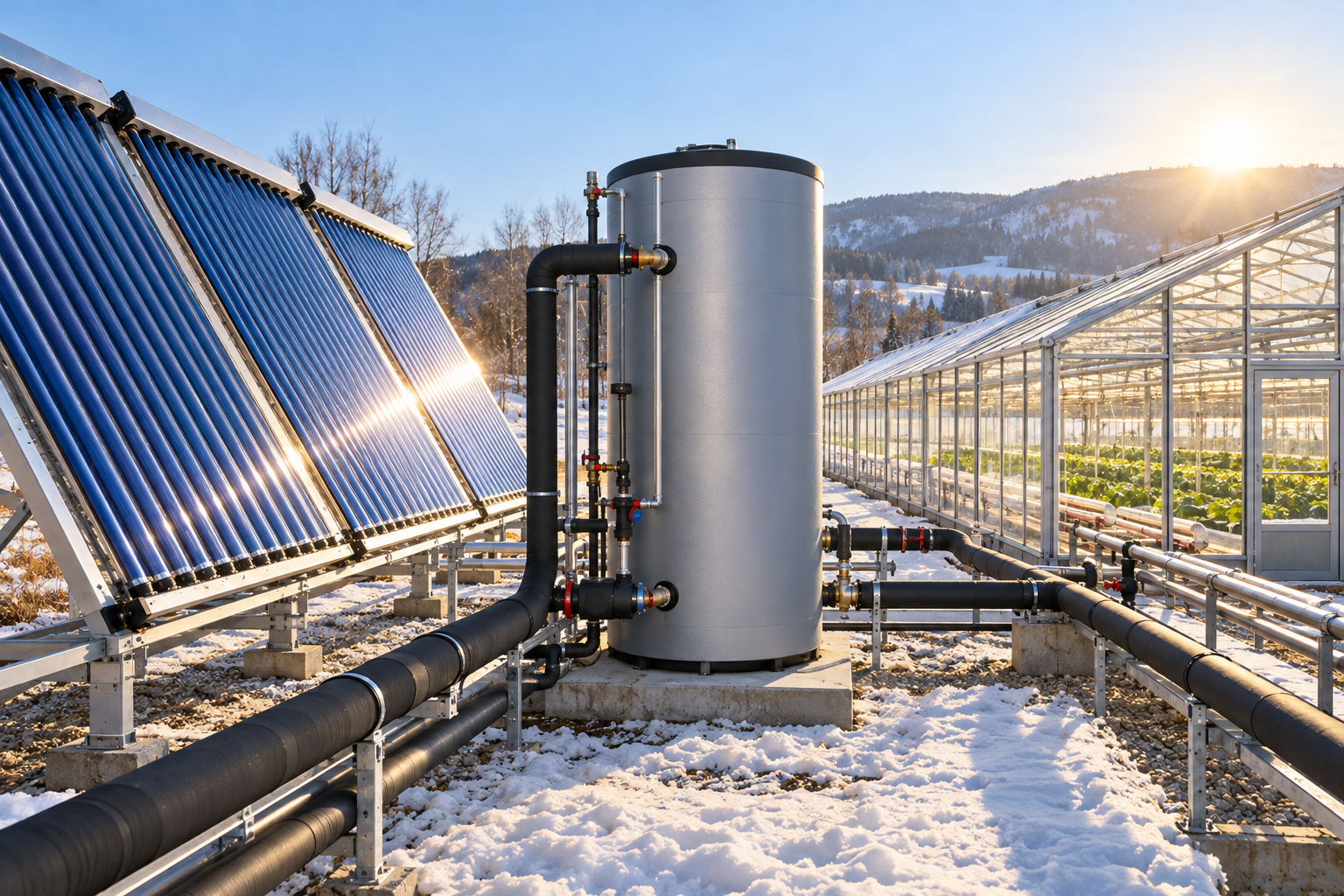
An active solar radiant system captures solar energy and stores it in an insulated tank of fluid, usually water, for use later. University of Florida IFAS describes two types, direct and indirect.
- Direct systems: heat and store the fluid itself until it is needed.
- Indirect systems: heat one fluid, then pass the energy through a heat exchanger to a separate fluid.
- Climate fit: IFAS says indirect systems suit colder climates where fluids may be exposed to freezing temperatures, and notes that the costs of solar radiant systems have decreased.
- Local practicality: IFAS adds that in Florida such systems may only be practical in the northern part of the state, so check the climate before you invest (UF/IFAS, Heating Greenhouses).
IFAS also says the heat required should be calculated from the most adverse conditions a grower can reasonably expect, so a solar-assisted system still needs a plan for the coldest nights.
What is a Chinese solar greenhouse?
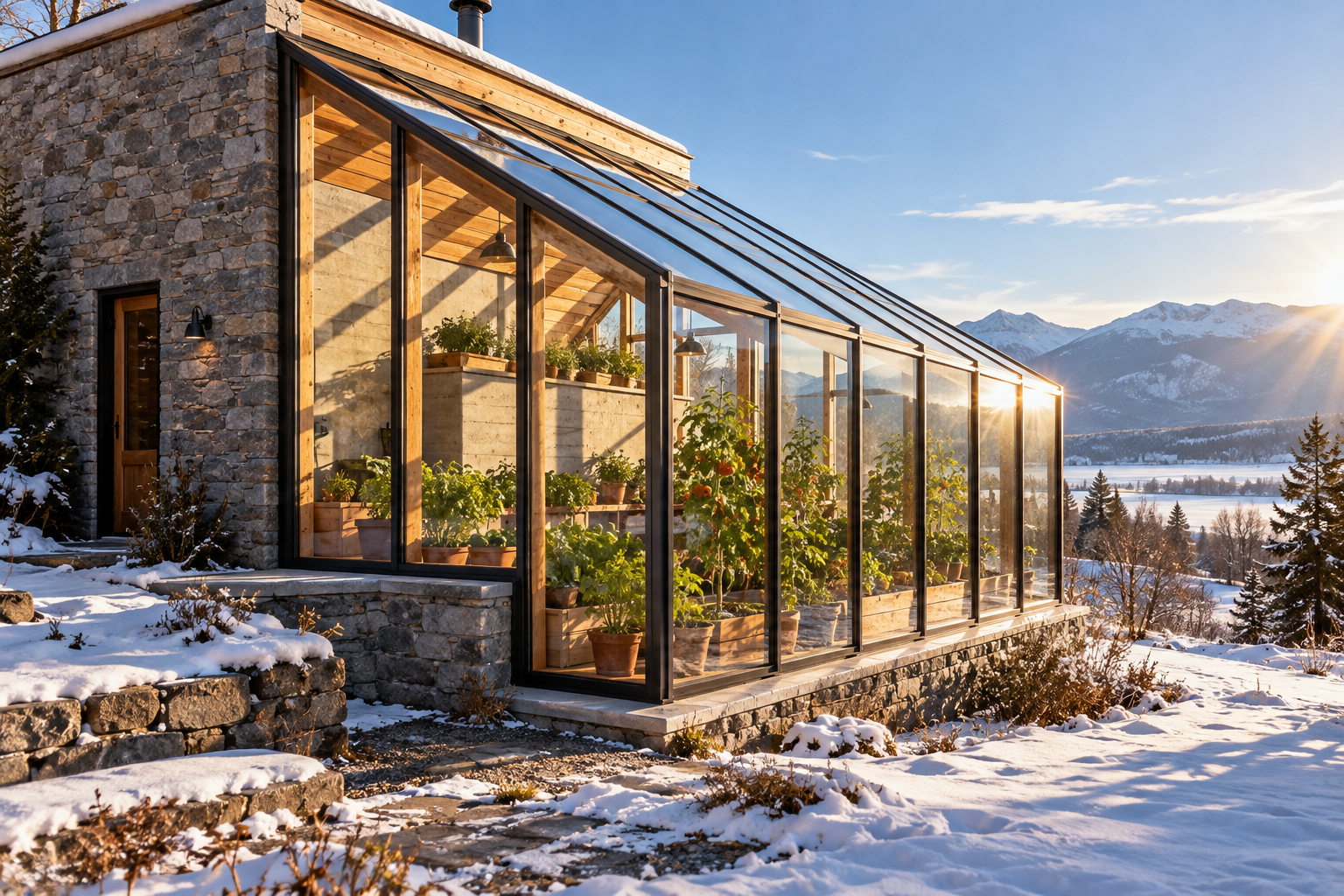
A Chinese solar greenhouse is a lean-to greenhouse with a heat-storage north wall that relies on the sun for winter heat. A 2019 review in Energy and Buildings calls these houses “fully passive solar greenhouses for vegetables without auxiliary heating system during the winter” (Cao et al., 2019).
The review groups improvements into three families:
- Structures: sunken houses, variable south roofs and houses with an air-channel heat exchanger.
- North wall materials: hollow walls, pebble walls and phase-change materials.
- Supporting equipment: the abstract lists this as a third group of options.
A 2012 review in Acta Horticulturae explains the motivation. It says energy accounts for 65% of total greenhouse crop production cost in colder northern China, and it names the lean-to Chinese solar greenhouse with north-side heat storage walls as an example of designing a greenhouse to need less energy (Yang, Acta Horticulturae 957).
The abstracts do not give heat-storage performance numbers, so this article does not either. For the lean-to layout and orientation basics, see our guide to the lean-to greenhouse.
Which climates and crops suit each solar heating approach?
Passive solar suits cold but sunny winters and tolerant crops; active solar suits larger houses that need steadier temperatures. Match the approach to the lowest night temperature and the crop’s minimum.
| Condition | Better fit | Why |
|---|---|---|
| Cold, sunny winter; cold-tolerant vegetables | Passive, such as a lean-to with a heat-storage north wall | Chinese solar greenhouses run through winter without auxiliary heating in the 2019 review |
| Cold winter, frequent cloud, high-value crop | Conventional heating with solar as a supplement | Solar output falls when light falls; the crop cannot tolerate a cold night |
| Mild winter | Passive features plus ventilation | IFAS says heat pump costs may outweigh savings in Florida’s short, mild winters, and solar radiant systems may only be practical in northern Florida |
| Large multi-span house | Active storage and distribution, with conventional backup | Heat must reach many bays, so distribution and backup are design questions for the supplier |
For the full range of heating options, see our greenhouse heating system page.
What should buyers specify before requesting a quote?
Give the supplier your coldest expected night, your crop’s minimum temperature and your site sunshine, so the solar and backup heating can be sized together. Confirm these items in writing:
- Design low temperature: the coldest night you must protect against, based on long-term local records.
- Crop minimum: the lowest temperature the crop tolerates at each growth stage.
- Site and orientation: latitude, shading from nearby buildings and trees, and the available wall for a lean-to.
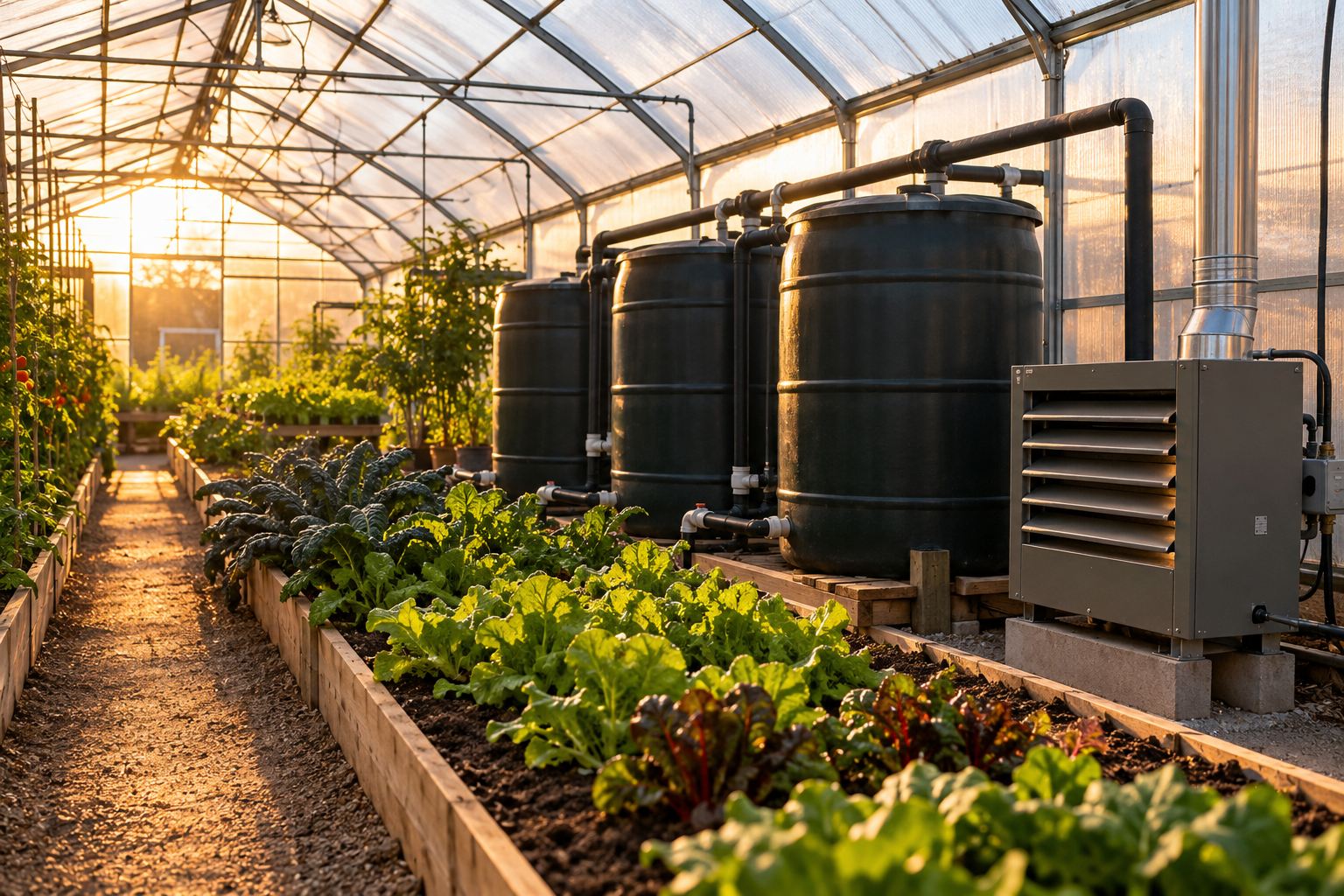
- Heat storage: what stores the heat (soil, water, masonry), where it sits and how it is protected from damp.
- Backup heating: the fuel, capacity and controls that take over when the sun does not.
- Snow and wind loads: especially for heavy walls and external insulation covers.
- Ventilation and shade: how the house avoids overheating in spring and autumn.
How does FANGCHENG supply this?
FANGCHENG plans, designs, manufactures and installs greenhouses, and its listed systems include heating, ventilation, shading, cooling and environmental control. It has done so since 2002.
- Heating systems: see the greenhouse heating system page.
- Custom design: structures are designed around your local wind, snow, humidity and crop.
- Drawings and design: see greenhouse drawing and design.
- Project details: heating capacity, storage design, lead times and prices are confirmed per project.
Planning a solar-assisted greenhouse? Send your crop, site, coldest night and local wind and snow loads, and FANGCHENG will propose a structure and heating system to match.
Request a quote
FAQ
What is the difference between passive and active solar greenhouses?
A passive solar greenhouse stores and releases heat through its own design, while an active one uses collectors, pumps or fans. Passive designs have no powered equipment, and active designs add control but also first cost and maintenance.
Can a greenhouse be heated by solar energy alone?
A greenhouse can be heated by solar energy alone only in specific designs and climates. A 2019 review describes Chinese solar greenhouses as fully passive for vegetables in winter, but a commercial project should still size a backup heater for the coldest night.
What is a Chinese solar greenhouse?
A Chinese solar greenhouse is a lean-to greenhouse with a heat-storage north wall, used for winter vegetable production. The 2012 Acta Horticulturae review names it as an example of designing a greenhouse to need less energy.
How does a solar radiant heating system store heat?
A solar radiant heating system stores heat in an insulated tank of fluid, usually water, for later use. University of Florida IFAS describes direct systems that heat the stored fluid and indirect systems that use a heat exchanger.
Is solar greenhouse heating worth it?
Solar greenhouse heating is worth it where winters are cold and sunny and the system is sized to the real heat load. IFAS notes that in Florida’s short, mild winters the up-front cost of heat pumps may outweigh the savings, so run the numbers for your site.
Bottom line
Passive solar relies on the building, active solar adds equipment, and the Chinese solar greenhouse is the best-documented passive example. Match the approach to your coldest night, crop and sunshine, and keep a sized backup heater in the plan.
Editorial note: Solar radiant system types and the heat pump note are from the University of Florida IFAS publication Heating Greenhouses (revised November 2019). The Chinese solar greenhouse description is from the abstract of Cao et al., Energy and Buildings, 2019, via the HAL repository. The 65% energy cost share and the north-wall example are from the abstract of Yang, Acta Horticulturae 957 (2012). All pages were opened in October 2026. Only abstracts were read for the two reviews, so no performance figures are quoted.
 Blog
 Blog
 Blog
