
...

Greenhouse Structures Built For Performance

Film Greenhouses for Commercial Growers

A film greenhouse is a steel-framed structure covered with plastic film, usually polyethylene. It is the most widely used commercial greenhouse because it costs less to build, goes up quickly and can be made in almost any size. The trade-off is that the film has a limited life and needs replacing every few years.

Arch film greenhouseArch film greenhouse
Overview

What is a film greenhouse?

FANGCHENG builds film greenhouses on hot-dip galvanized steel frames, from simple single-span tunnels to large multi-span houses with roof ventilation.

A film greenhouse has a galvanized steel frame and a covering of polyethylene (PE) or polyolefin (PO) film. The words film greenhouse, plastic greenhouse, poly greenhouse and polytunnel describe the same family of structures. What changes between them is the frame shape, the size and how much climate control is added.

The family is wide, which is why the word alone says little about performance. A low single-span tunnel and a tall multi-span house with roof vents are both film greenhouses, yet they hold very different climates. When you compare offers, look at the frame and the ventilation first, then the film.

Types

Film greenhouse types we build

Single-span
01 / 05

Single-span

One independent span covered with film. Easy to build and cost-effective, used on small and medium farms.

Arch
02 / 05

Arch

A curved roof that gives good strength, drains water well and lets air move smoothly. Suits many climates and crops.

Large sawtooth roof vent
03 / 05

Large sawtooth roof vent

Wide-span sawtooth roofs with strong natural ventilation. For large-scale growing in warm or high-sun regions.

Small sawtooth roof vent
04 / 05

Small sawtooth roof vent

Several narrow sawtooth vents that give controlled ventilation. Suited to moderate climates.

Butterfly roof vent
05 / 05

Butterfly roof vent

Two symmetrical roof slopes that open outward like wings. Lets hot air escape quickly.

Single-span and multi-span versions are covered on their own pages, with more detail on structure and specifications.

Single-span page

See the single-span tunnel in detail.

Single-Span Tunnel
Multi-span page

See the gutter-connected film greenhouse in detail.

Multi-Span Film
Build

How a film greenhouse is built and why frame and film work together

How a film greenhouse is built

The frame is made of galvanized steel pipes or tubes, prefabricated in a factory and joined on site with bolts. The covering is film held by channels and spring wire or by clips. Ventilation comes from roll-up sidewalls, roof vents or both. Because the parts are prefabricated, assembly is quick and does not need on-site welding.

Frame and film work as one system

The film only performs as well as the frame holds it. A frame with the wrong arch distance lets the film sag and flap. A frame with sharp edges cuts it. Tension, channels, wiggle wire and the shape of the arch decide how long the film lasts. We design the frame and fit the fixings together.

Greenhouse film rollsGreenhouse film
The film

Choosing the film

Film is the part that decides how the greenhouse performs for the crop. Clear film gives the most light, diffused film spreads it over the canopy, thermal film holds heat at night, and anti-drip film keeps water off the crop in humid regions. Thickness and UV stabilizers decide how long the film lasts.

Film properties also work together. A diffused film cuts hot spots in bright climates, while an anti-drip layer matters most where nights are cool and humid. Multilayer films can combine several properties in one sheet. Tell us the crop and the climate, and we narrow the list to the films that solve your main problem.

Compare

Film greenhouse or glass or polycarbonate?

01Purchase cost

Film is the lowest.

02Build time

Film is the quickest.

03Service life

Film is the shortest, so plan for replacement.

04Insulation

A single layer of film insulates less than polycarbonate or double glazing. Two layers help.

05Flexibility

A film structure is easier to extend or change.

Layers

Single-layer or double-layer film

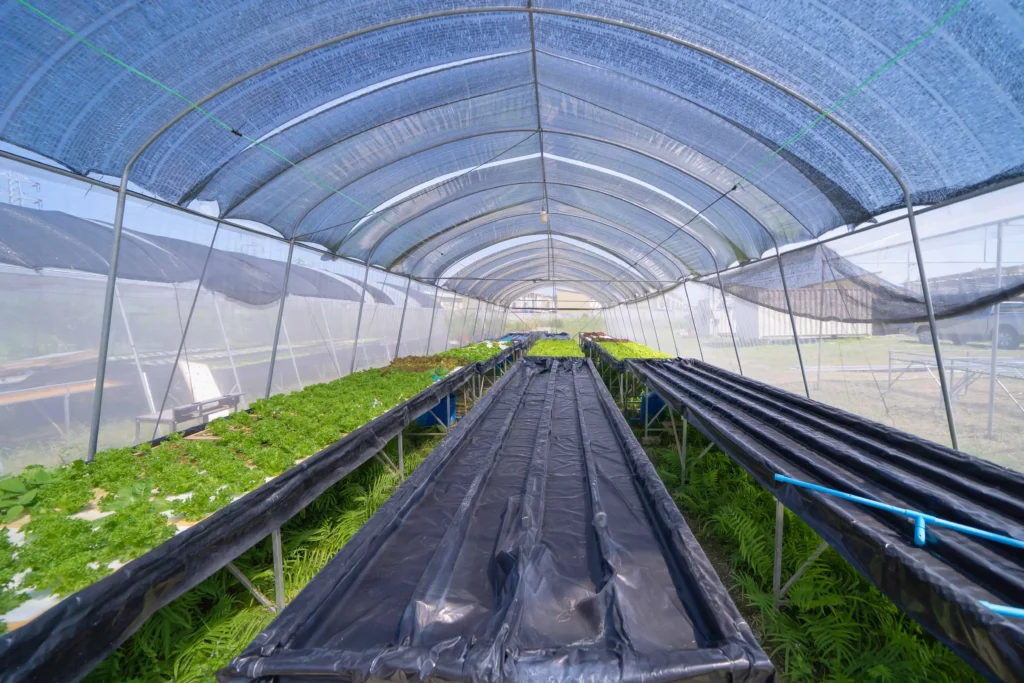
Single-layer film tunnel
Double-layer film greenhouse
Single layer
Default

A single layer is the simple, low-cost default and lets in the most light.

A double layer is usually inflated, so a cushion of air sits between the two sheets and holds heat much better on cold nights. A small blower keeps the gap.

Where it pays

In warm regions, a single layer with good ventilation is usually the better choice.

The second layer costs some light as well as money, so it pays where heating is a real cost.

Tap a side to compare.
Choosing

Choosing between the five film greenhouse types

Small farm, simple crop, mild climate.

Single-span.

Single-Span Tunnel
Wind, rain and snow, with a need for smooth water run-off.

Arch.

Multi-Span Film
Large area in a hot or high-sun region.

Large sawtooth roof vent.

Sawtooth
Moderate climate and controlled natural ventilation.

Small sawtooth roof vent.

Sawtooth
Fast heat release for a warm region.

Butterfly roof vent.

Sawtooth
Vegetables under filmVegetables under film
Crops

Crops that suit a film greenhouse

Film greenhouses are used for leafy greens, herbs, strawberries, cucumbers, tomatoes, spinach, bell peppers and green onions, as well as seedlings, flowers and nursery stock. Crops that need very tight temperature control all year are usually grown under glass or polycarbonate instead.

The deciding point is how well the crop tolerates swings. Leafy greens and strawberries handle the daily ups and downs of a naturally ventilated house. Crops grown to strict quality contracts, or sensitive young plants, gain more from the steadier climate of a rigid-covered house.

Price

What drives the price of a film greenhouse

  • Span, height and length
  • The strength the frame needs for local wind and snow
  • Film grade, thickness and the number of layers
  • Ventilation: roll-up sides, roof vents and motors
  • Added systems such as shading, fans and cooling
  • Foundations and freight

We quote per project. A film greenhouse is the lowest-cost route, but the film and the frame still need to match the climate.

Film greenhouse with roof ventsRoof vents
Ventilation

Ventilation and climate control

Natural ventilation does most of the work in a film greenhouse. Side roll-ups and roof vents release heat. In hot climates, shade systems, fans and evaporative cooling can be added. In cold climates, a second film layer and heating can be added. The more climate control you need, the more a multi-span layout makes sense.

Vent area is the figure to watch. A film house that looks generous in size can still overheat if its openings are small for the volume of air inside. Side roll-ups work well on narrow houses, but wide and multi-span houses need roof vents, because air from the sides does not reach the middle.

Care

Looking after a film greenhouse

0 of 4 ready

Planning the re-cover

Replacing film should be a planned job, not an emergency. Choose a calm, mild day, have the new film and fixings on site, and check the bare frame for sharp edges and worn channels. Timing the re-cover between crops keeps production running.

Process

How we build a film greenhouse

01

Site analysis

We look at the site, crop and local weather.

02

Load design

Structural calculations for local wind and snow.

03

Prefabrication

Hot-dip galvanized steel, fabricated for bolted assembly.

04

Delivery and guidance

Export packing, drawings and installation guidance.

Diagnosis

Common film greenhouse problems and what causes them

Sign 01

Film flapping and wearing

It was fitted loose, or the fixing does not hold evenly.

Sign 02

Water pooling on the roof

The roof is too flat, or film is sagging between arches.

Sign 03

Drips on the crop

There is no working anti-drip layer, or the film is old.

Sign 04

Overheating on sunny days

Ventilation is too small. Add vents or shading.

Sign 05

Tearing at the fixings

Sharp edges, uneven tension or strong wind.

Upgrading a film greenhouse later

A film greenhouse can be upgraded in steps. Add a second film layer for insulation, roof vents and motors for airflow, shading and cooling for hot months, and heating for cold ones. If the structure needs to grow, ask us at the design stage so the frame can take the extra load.

Talk to an engineer
FAQ

Common questions

Straight answers. If yours is not here, ask us.

A polytunnel is a simple film-covered tunnel. A film greenhouse covers the whole family, from tunnels to large multi-span houses with ventilation and climate systems.

It depends on the film grade, the sunlight and the care taken in fitting it. Plan for replacement every few years.

It can be, with a second layer of film and heating. For very cold climates, polycarbonate or glass insulates better.

Yes. Tell us your plans and we design the structure so it can be extended.

It depends on crop and climate. Tell us both and we suggest a film type.

It can be, when the frame is designed for your local loads. Arch spacing, tube size and bracing are set by calculation, and arch or Gothic roofs shed snow better than flat ones.

Get started

Get a film greenhouse designed for your site

Send your location, crop and area. We reply within 24 hours.

Consultation and project proposals are free.

What to include

  • Location
  • Your crop
  • Planned area
  • Reply within 24 hours
滚动至顶部
Two people choosing plants inside a greenhouse
Greenhouse manufacturer in Guangzhou
  • We reply within 24 hours
  • Free consultation and project proposals
  • Free sample and quote
Contact us

Leave us your info

We are always happy to help you with any commercial greenhouse questions or requests you may have.

We use your details only to answer your inquiry.