 Skip to content

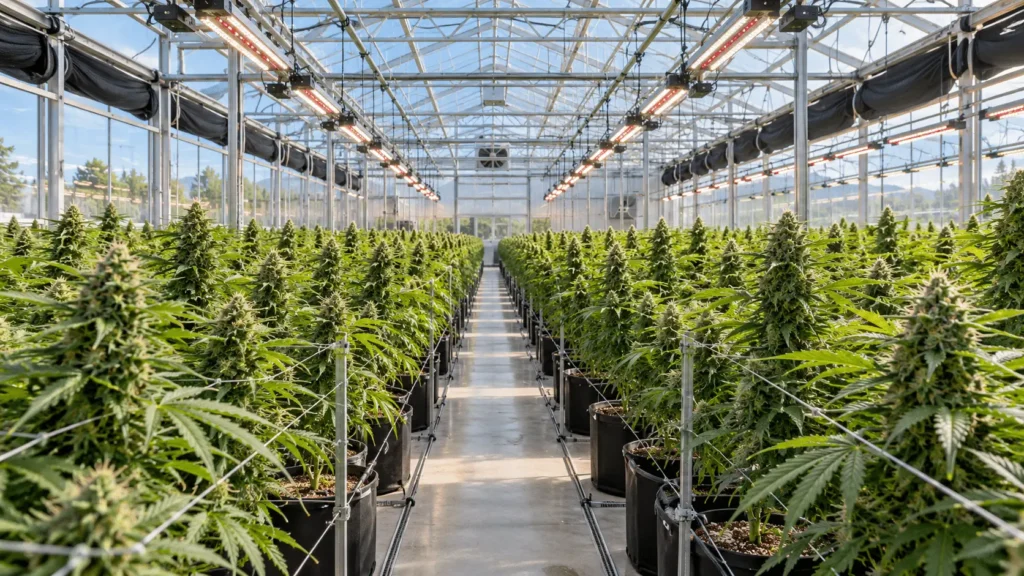 Photoperiod crop
What is a light-deprivation greenhouse?
FANGCHENG builds light-deprivation greenhouses with a hot-dip galvanized structure, a blackout curtain system and the ventilation to go with it.
It is a greenhouse that can be darkened. Curtains of blackout fabric are pulled across the roof, and often the walls, to end the day early. The grower controls how many hours of light the crop sees, whatever the season. It is used for photoperiod crops that flower when days become short, and for crops that need controlled day length.
How a blackout system works
A blackout curtain moves across the greenhouse on tracks or cables. A controller closes it at a set time, keeps it closed for the dark period and opens it again. Some controllers also respond to temperature and light levels. Manual curtains need someone to pull them twice a day, so they suit smaller or seasonal operations more than commercial ones.
 Blackout openNatural day lengthDay length set by the grower
With the blackout open, the day follows the sun.With the blackout closed, the grower sets the day length.
Timing has to be exact and repeated every day. Photoperiod crops respond to the length of the dark period, so a curtain that closes late or leaks light can upset flowering. That is why the controller and the seals matter as much as the fabric.
What makes a blackout system good

Real darkness.
A well-installed system cuts light by more than 99%, but leaks come from two places: pinholes in the fabric and gaps at the edges. Multi-layer fabric helps with pinholes. Careful edge sealing handles the rest.
Light-tight sidewalls.
Walls and irregular corners are the usual weak point. Plan them early in the design.

Automation.
A controller removes the daily work and the risk of a missed closing.
Correct installation.
Design and installation decide how dark the house really is.
Energy performance.
Aluminized blackout fabric can reflect heat in summer and keep it in on cold nights.
Blackout curtain systemCurtain materials
Blackout fabric is made in layers so no light shows through the weave. Aluminized fabrics reflect heat in summer, and hold it in on cold nights. Ask for the layer structure and for how the fabric is joined and edged.
Ventilation during blackoutVentilation during blackout
A sealed, dark house heats up and gets humid. Without a way to move air, the crop suffers. Breathable walls and light traps let air in and out without letting light in, so the house can keep ventilating during the dark period. Plan the airflow together with the curtains, not afterward.
The safest approach is to treat airflow as part of the blackout design. Light traps on vents and fans are shaped so air turns corners that light cannot follow. They have to be sized for the airflow you need, because a trap that is too tight chokes the air.
Frame and curtain tracksStructure and covering
A light-deprivation greenhouse is built on a galvanized steel frame, with a covering chosen for climate and crop: film, polycarbonate or glass. The frame must carry the curtain system and its tracks as well as the roof. Tell us whether the curtains are inside the house or part of the roof design, and whether the walls will be blacked out as well.
The covering also changes how the house behaves in the open hours. A diffused covering spreads light evenly over the canopy, while a clear one gives the most light for growth.


