
Short answer: Most greenhouse vegetables are shaded with 20% to 40% cloth, and about 30% is the most common choice, according to University of Delaware Extension. For tomatoes, University of Missouri guidance suggests 30% cloth, because the plastic cover already blocks up to 20% of the light. The percentage is the share of light blocked, not the temperature drop you will get.
Key takeaways
- Shade cloth is rated by the percentage of light it blocks (University of Missouri), so a 30% cloth passes about 70% of the light that reaches it.
- University of Delaware Extension recommends 20% to 40% for vegetables, with about 30% most common.
- Count the cover first: a plastic cover can block up to 20% of light before any cloth is added.
- A 30% cloth does not cut temperature by 30%; Alabama Extension warns the two numbers are not the same.
- External shade usually cools better than internal shade, and white or reflective cloth may beat black.
- Published crop-by-crop figures are thin; get a crop-specific target from your cultivar supplier or local extension before you order.
What shade cloth percentage should a greenhouse use?
Most greenhouse vegetable crops do well under 20% to 40% shade, and 30% is the usual starting point. University of Delaware Extension says to “choose a percent shade between 20% and 40% with ~30% being the most common recommendation” (Delaware Weekly Crop Update, 2013).
Use these rules of thumb to narrow the choice:
- Fruiting vegetables such as tomato: start at 30%. University of Missouri guidance calls 30% cloth “a good choice for tomato growers” (Missouri Produce Growers Bulletin).
- Plastic-covered houses: pick a lighter cloth than you would for a glass house, because the film already removes light.
- Light-sensitive or shade-loving crops: go higher only on a crop-specific target. Supplier guides disagree by 20 points or more for the same crop, so do not copy a retail chart.
- Hot, high-light sites: raise the percentage in steps, and add ventilation before you add more shade.
Delaware also calls shading a balancing act: give enough shade to cut the heat load, but not so much that it “significantly impacts photosynthesis.” It adds that little field research on shade cloth for vegetables existed as of 2013, so treat any single number as a starting point.
What does the shade percentage actually mean?
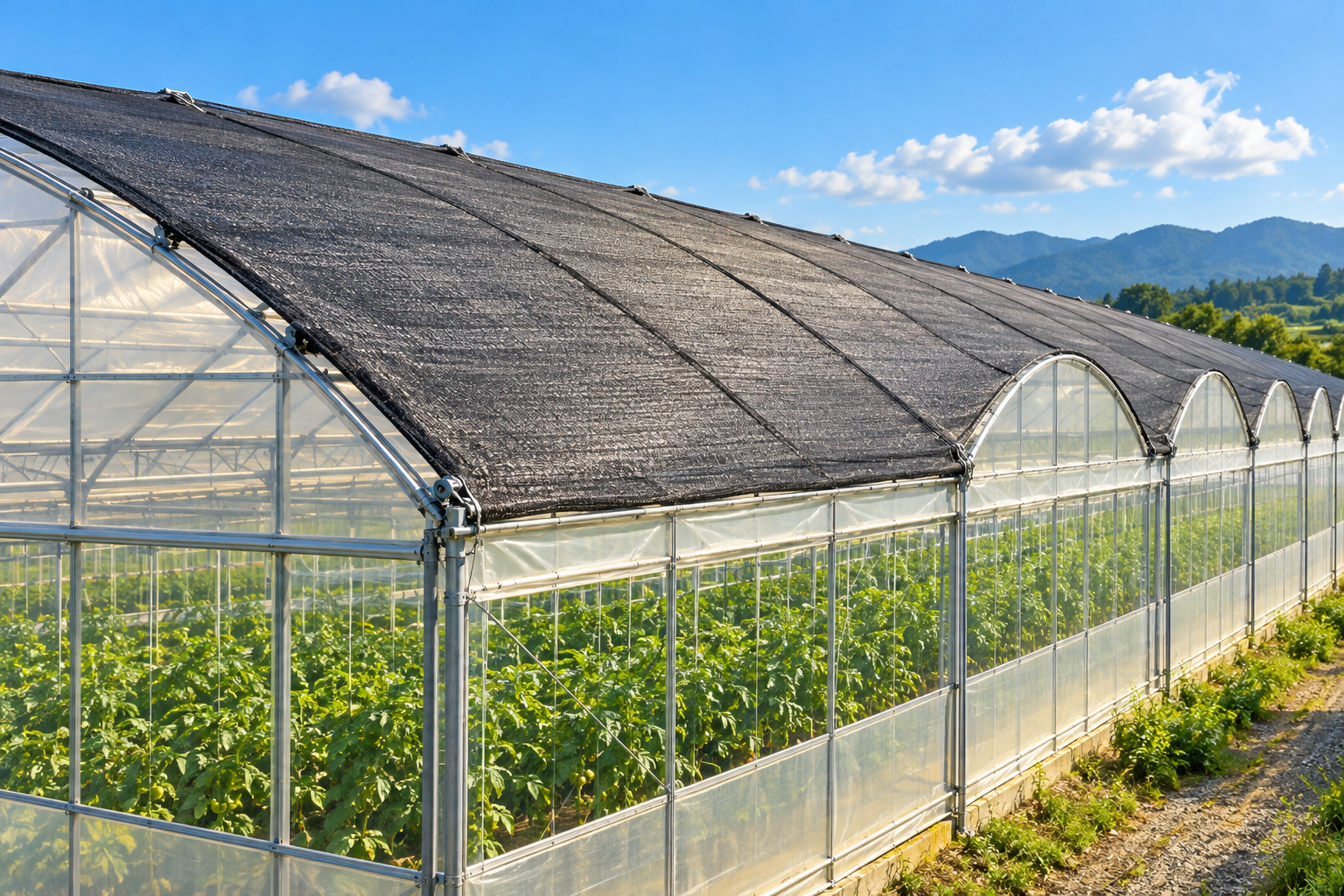
The shade percentage is the share of light the cloth blocks. University of Missouri puts it plainly: shade cloth is rated by the percentage of light it blocks, so a 30% cloth passes about 70% of the light that reaches it.
That does not mean a 47% temperature drop. Alabama Cooperative Extension warns that the shade percentage “does not necessarily represent the amount of heat energy reduced,” and that 30% shade cloth “may not provide a 30 percent temperature reduction” (Alabama Extension ANR-2925).
- Percent shade: how much light reaches the crop, which drives photosynthesis.
- Temperature effect: depends on cloth position, color, ventilation and humidity as well.
- Combined use: Alabama Extension says shading is combined with ventilation to reduce air temperature or light intensity.
How do shade percentages compare by crop group?
Published university guidance is firm for vegetables and tomatoes but thin for other crops. The table shows what the sources we opened actually say, and where you need a crop-specific figure from your supplier.
| Crop group | Published guidance | Source | What to confirm |
|---|---|---|---|
| Vegetables in general | 20% to 40%, about 30% most common | University of Delaware Extension | Crop, season and cover type |
| Tomato | 30% cloth; cover plus cloth should block about 50% of peak summer sun | University of Missouri | Age and clarity of the cover |
| Leafy greens, herbs, strawberries | No university figure found | – | Cultivar target from the seed or plant supplier |
| Ornamentals, orchids, foliage plants | No university figure found | – | Light target per crop and growth stage |
| Nursery and seedling houses | No university figure found | – | Seedling light target and hardening plan |
For crop-specific conditions on orchids, see our guidance for phalaenopsis greenhouses, and for tomatoes see our tomato greenhouse page.
Why should you count the greenhouse cover before choosing shade?
The cover already blocks light, so the cloth percentage and the cover loss add up. University of Missouri says the plastic covering of a greenhouse or high tunnel “often blocks up to 20 percent” of the light, depending on age and clarity.
Missouri’s aim for tomatoes is for the cover and shade together to block about 50% of peak summer sunlight. It cites about 9,000 foot-candles at peak, and about 4,500 foot-candles as the level where tomato is light-saturated.
Here is an arithmetic example, not a recommendation. Start with 9,000 foot-candles outside, a cover that blocks 20% and a 30% cloth:
- After the cover: 9,000 x 0.80 = 7,200 foot-candles.
- After the cloth: 7,200 x 0.70 = 5,040 foot-candles.
- Total blocked: about 44% of the outside light, close to Missouri’s 50% target.
An older, cloudier cover loses more light, so the same cloth can give a darker house. Measure light in the house if you can, and re-check as the cover ages. For cover options, see our guide to greenhouse plastic film.
Is internal or external shade cloth better?
External shade usually cools better than internal shade. Alabama Extension says an externally mounted cloth “will have a better effect on temperature reduction” than an internal one in most cases, because the heat is stopped before it enters the greenhouse.
| Type | Advantages | Limits |
|---|---|---|
| External shade cloth | Better temperature reduction; stops heat before it enters | Exposed to wind and weather; needs a stronger frame and anchoring |
| Internal shade curtain | Retractable; can double as an “energy blanket” at night in cold weather (Alabama Extension) | Heat is already inside; less cooling |
| Retractable external curtain | More flexible when seasons change (Alabama Extension) | More hardware and control |
| Shade compound (whitewash) | Sprayed on the cover | Less flexible to apply and remove than cloth (Alabama Extension) |
Does shade cloth color matter?
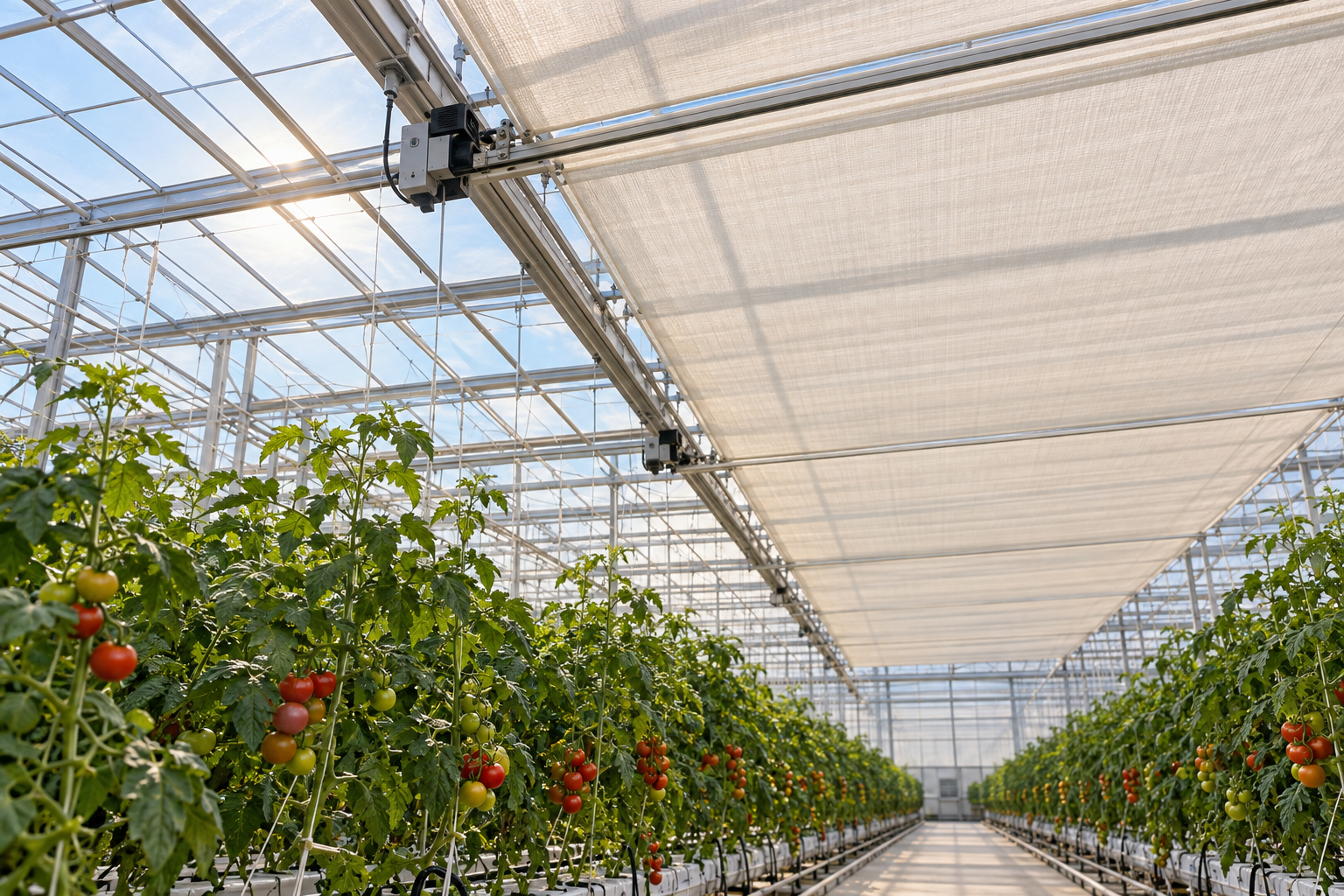
Yes, color changes how much heat the cloth passes into the greenhouse. Black is the most common and cheapest, but “black shade cloth can get very hot in the sun as it absorbs heat,” and that heat radiates into the greenhouse, Alabama Extension notes.
- Black: least expensive and most durable, according to Alabama Extension, but it absorbs heat.
- White or aluminized: Delaware says white or aluminized cloth “may offer additional cooling,” and Alabama Extension says white and reflective cloths may lower temperatures more efficiently.
- Green: Delaware lists black and green as the most common colors.
- Red and other colors: Delaware says red may help specific crops by filtering light wavelengths; confirm with trial data before you buy at scale.
When should shade go up and come down?
Put shade up when peak summer heat starts and take it down when excess heat is no longer a concern. University of Missouri says tomato growers commonly apply shade in late May or early June and leave it until late September or early October.
- Warm spring: apply earlier.
- Cool spring: apply later.
- Retractable systems: let you open the cloth on cloudy days, so you lose less light than with fixed cloth.
- Seasonal dates: these are US Midwest figures; set your own dates from local weather.
Shade works with other climate control. See our comparison of greenhouse cooling systems, and our VPD chart for how heat and humidity interact.
What should buyers specify before requesting a quote?
Give the supplier your crop, site and cover details, so the shading system is sized for the real load rather than a catalog number. Confirm these items in writing:
- Crop and light target: the crop, growth stage and the light level you want under the cloth.
- Percent shade and color: the shade percentage, the color, and whether you want a single cloth or two layers.
- Position: internal, external or both, fixed or retractable, manual or motorized.
- Control: what triggers it, such as a time schedule, a light sensor or a temperature setpoint.
- Structure and wind: frame spacing, anchoring and local wind speed, especially for external shade.
- Cover: the cover type and age, since it removes light before the cloth does.
- Service: installation scope, spare parts and replacement cloth.
How does FANGCHENG supply this?
FANGCHENG plans, designs, manufactures and installs greenhouses, and its listed systems include shading, ventilation, cooling, heating and environmental control. It has done so since 2002.
- Shading systems: see the greenhouse shading system page and the shade cloth page.
- Custom design: structures are designed around your local wind, snow, humidity and crop.
- Installation: FANGCHENG offers on-site installation or remote guidance.
- Project details: shade percentages, lead times and prices are confirmed per project.
Planning a shading system for your greenhouse? Send your crop, site, cover type and local wind conditions, and FANGCHENG will propose a shading layout to match.
Request a quote
FAQ
What percentage shade cloth is best for a greenhouse?
The best shade cloth percentage for most greenhouse vegetables is 20% to 40%, with about 30% the most common choice, according to University of Delaware Extension. Tomato growers in Missouri guidance use 30% cloth over a plastic cover.
Is 30% or 50% shade cloth better for tomatoes?
For tomatoes, 30% shade cloth is the better starting point in University of Missouri guidance, because a plastic cover already blocks up to 20% of the light. A 50% cloth on top of the cover can cut light below what tomato needs.
Does shade cloth lower greenhouse temperature?
Shade cloth lowers greenhouse temperature, but by less than its percentage. Alabama Extension says 30% shade cloth may not give a 30% temperature reduction, and that external cloth cools better than internal cloth.
Should shade cloth go inside or outside the greenhouse?
Shade cloth usually works better outside the greenhouse, because it blocks heat before it enters. Internal curtains are retractable and can also act as an energy blanket at night, but they cool less.
When should you put up and remove shade cloth?
You should put up shade cloth when peak summer heat begins and remove it once heat is no longer a concern. University of Missouri says tomato growers commonly shade from late May or early June until late September or early October, adjusting for the weather.
Bottom line
For most greenhouse vegetables, start with a 20% to 40% cloth and about 30% as the default, then adjust for your cover, crop and climate. Remember that the percentage is light blocked, not temperature saved. Choose external, reflective cloth where cooling matters, and confirm crop-specific light targets before you order.
Editorial note: Vegetable shade ranges are from University of Delaware Extension (Weekly Crop Update, May 2013). Tomato, cover-loss, light-level and timing guidance is from the University of Missouri Produce Growers Bulletin (2012, revised 2015). Heat, position and color guidance is from Alabama Cooperative Extension ANR-2925. All pages were opened in October 2026. The 9,000 / 7,200 / 5,040 foot-candle sequence is our own arithmetic from Missouri’s figures, not a measured result. Crop groups without a university figure are marked as such.
 Blog
 Blog
 Blog
