 跳至内容

Short answer: A greenhouse VPD chart shows vapor pressure deficit, in kPa, for each combination of air temperature and relative humidity. VPD is the drying power of the air. Published targets for most greenhouse crops fall between 0.3 and 1.0 kPa, with 0.3 to 0.5 kPa for cuttings. Sources disagree on exact bands, so confirm crop targets with a crop adviser.
Key takeaways
- VPD is the gap between the vapor pressure the air could hold and the vapor pressure it holds now. It rises with temperature and falls with humidity.
- Relative humidity alone is misleading, because the same RH gives a different VPD at each temperature.
- Reviews of tomato research give 0.3 to 1.0 kPa as the usual optimal range, and 0.3 to 0.5 kPa for root cuttings.
- No source we opened gives one agreed table by crop and growth stage, so treat any single band as a starting point.
- VPD is a result of temperature, humidity and airflow, not a setting you control directly. Buyers should specify the equipment that moves it.
What is VPD, and why use it instead of relative humidity?
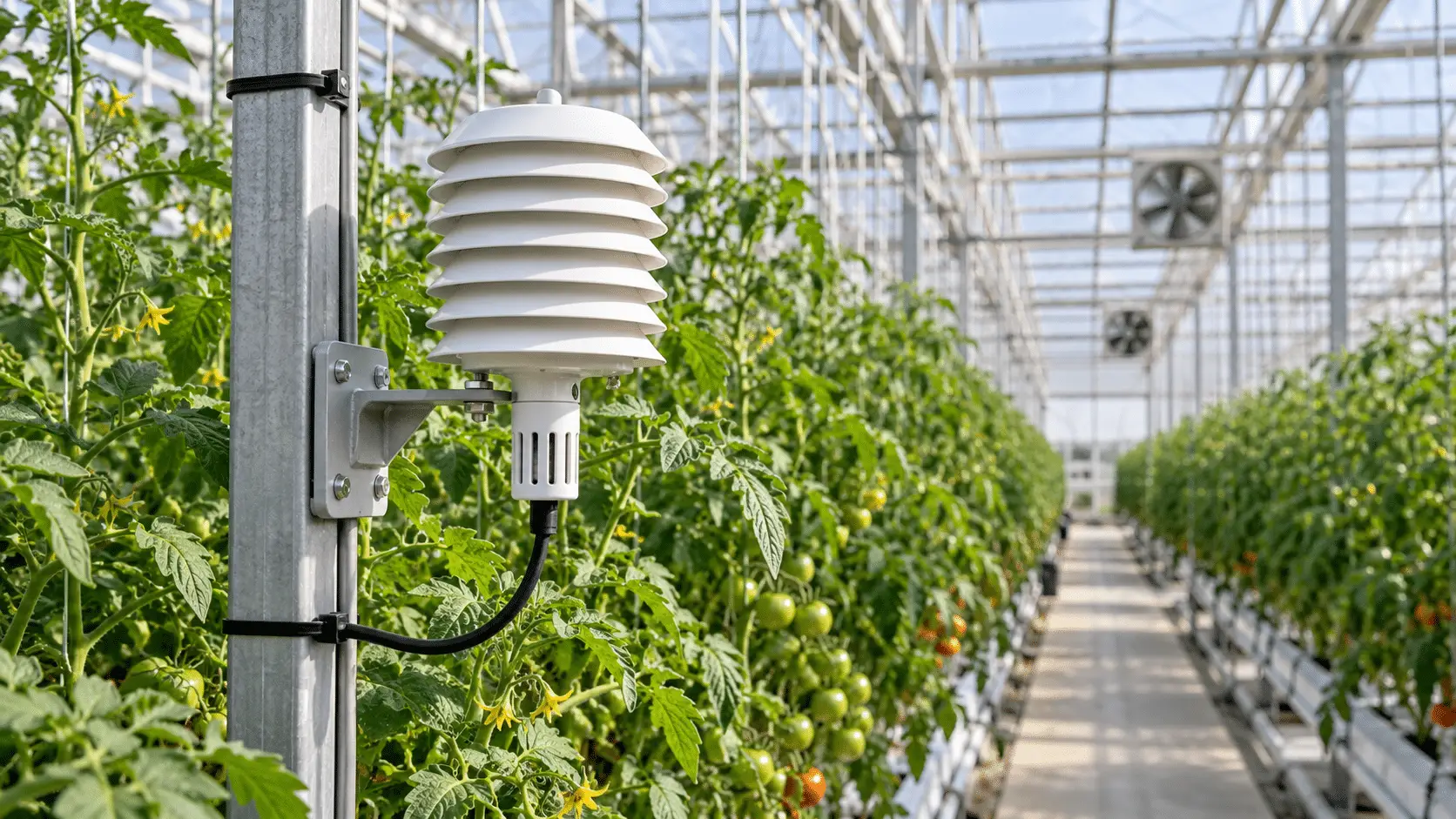
Vapor pressure deficit (VPD) is the difference between saturation vapor pressure and actual vapor pressure in the air. The FAO irrigation guidelines (FAO Irrigation and Drainage Paper 56, chapter 3) describe it as an indicator of the evaporative capacity of the air. A higher VPD pulls more water out of leaves.
VPD is more useful than relative humidity (RH) for three reasons:
- It includes temperature: A tomato review by Shamshiri and co-authors (International Agrophysics, 2018) notes that saturation vapor pressure rises exponentially with air temperature, so VPD reflects both temperature and humidity.
- It tracks water movement: The same review calls VPD the driving force for water movement between roots and leaves, directly related to transpiration.
- It shows condensation risk: The review also uses VPD to judge how close a crop house is to saturation.
How do you calculate VPD?
Air VPD equals saturation vapor pressure at air temperature multiplied by (1 minus RH as a fraction). Saturation vapor pressure comes from the FAO equation e°(T) = 0.6108 × exp[17.27 T ÷ (T + 237.3)], with T in °C and the result in kPa.
- Find saturation pressure: Put the air temperature into the equation.
- Find actual pressure: Multiply saturation pressure by RH divided by 100.
- Subtract: Saturation pressure minus actual pressure is the VPD.
Example: at 25 °C the saturation pressure is about 3.17 kPa. At 60% RH, the actual pressure is about 1.90 kPa, so air VPD is about 1.27 kPa.
Leaf VPD is different. It uses the leaf’s temperature for the saturation term. The Rutgers article in GrowerTalks (Vapor Pressure Deficit Revisited) says to assume leaf temperature equals air temperature if you do not measure it, and warns this overstates VPD when transpiring leaves run cooler than the air. With a 25 °C leaf in 30 °C air at 60% RH, leaf VPD is about 0.62 kPa instead of 1.70 kPa.
What is the VPD at each temperature and humidity?
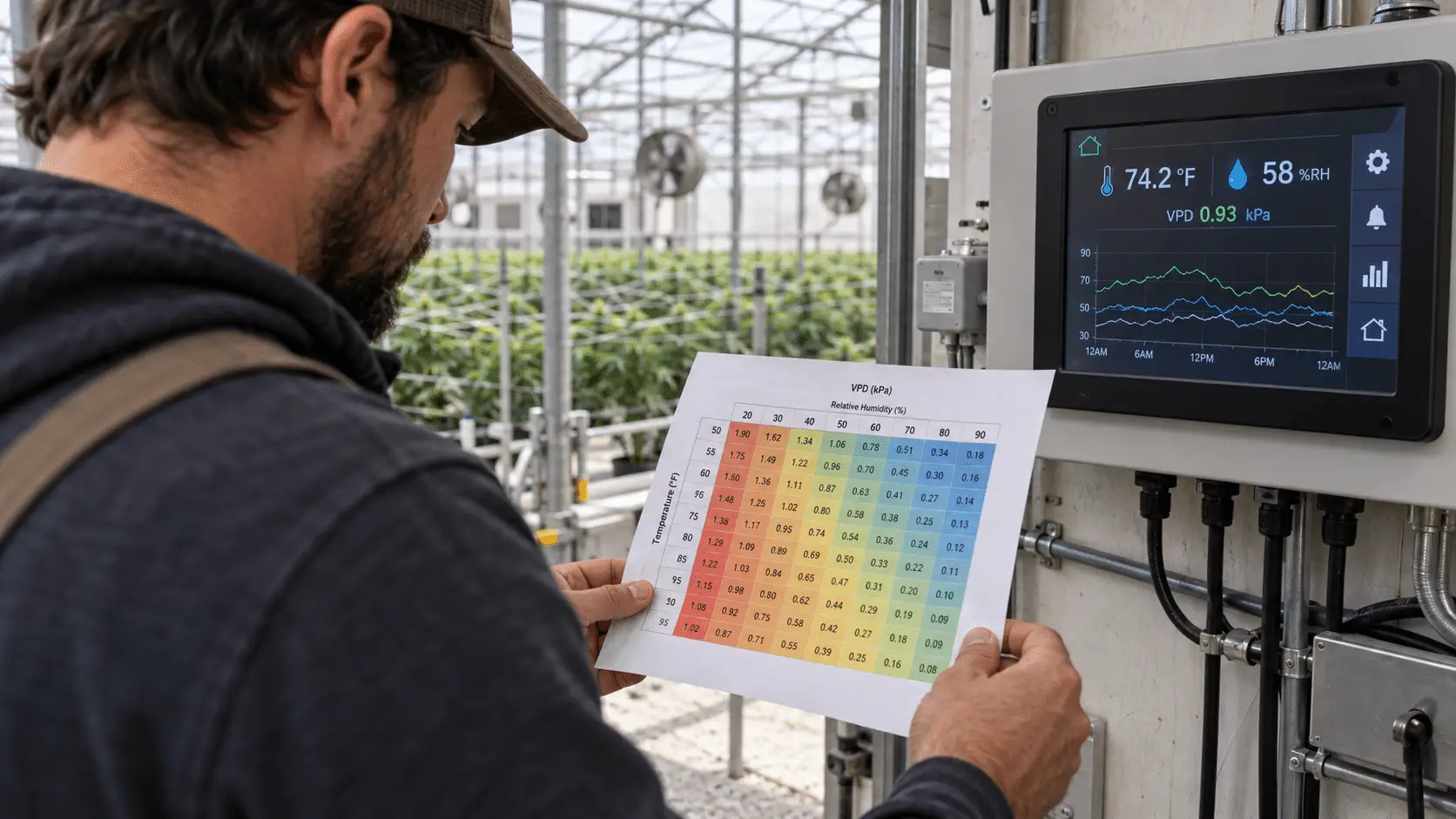
Read the chart by finding your air temperature in the left column and your RH across the top. The cell is the air VPD in kPa. Values below were calculated with the FAO equation above, assuming leaf temperature equals air temperature.
| Air temp (°C) | 40% RH | 50% RH | 60% RH | 70% RH | 80% RH | 90% RH |
|---|---|---|---|---|---|---|
| 15 | 1.02 | 0.85 | 0.68 | 0.51 | 0.34 | 0.17 |
| 18 | 1.24 | 1.03 | 0.83 | 0.62 | 0.41 | 0.21 |
| 20 | 1.40 | 1.17 | 0.94 | 0.70 | 0.47 | 0.23 |
| 22 | 1.59 | 1.32 | 1.06 | 0.79 | 0.53 | 0.26 |
| 24 | 1.79 | 1.49 | 1.19 | 0.90 | 0.60 | 0.30 |
| 26 | 2.02 | 1.68 | 1.34 | 1.01 | 0.67 | 0.34 |
| 28 | 2.27 | 1.89 | 1.51 | 1.13 | 0.76 | 0.38 |
| 30 | 2.55 | 2.12 | 1.70 | 1.27 | 0.85 | 0.42 |
| 32 | 2.85 | 2.38 | 1.90 | 1.43 | 0.95 | 0.48 |
| 35 | 3.37 | 2.81 | 2.25 | 1.69 | 1.12 | 0.56 |
The chart shows why one RH target fails. Shamshiri and co-authors point out that 0.85 kPa can come from 15 °C at 50% RH or from 34 °C at 84% RH. At 60% RH, VPD in the table is 0.68 kPa at 15 °C and 1.70 kPa at 30 °C.
What VPD range should a greenhouse target?
Most published targets for greenhouse crops sit between 0.3 and 1.0 kPa, but no single table by crop and growth stage is agreed. The table lists what the sources we opened actually say.
| Use | Range (kPa) | Source and note |
|---|---|---|
| Root cuttings and propagation | 0.3 to 0.5 | Shamshiri review: generally recommended, to limit dry-out and fungal disease |
| Most greenhouse crops | 0.5 to 0.8 | Barker (1990), cited in the review, to avoid fruit shrinkage and fungal disease |
| Tomato, day and night | 0.8 | Iraqi et al. (1995), cited in the review: higher photosynthesis and yield than 0.5 |
| General optimum across sources | 0.3 to 1.0 | Shamshiri review summary of different sources |
| Broad working guideline | 0.2 to 2.0 | Rutgers (GrowerTalks), with air 10 to 30 °C and RH 50 to 85%; can be exceeded in some conditions |
| Upper limit, tomato at 30 °C | Keep at or below 2.0 | Alcorn et al. (2023): growth measures were undesirable above 2.0 kPa without control |
Two cautions apply. First, the review’s own sources disagree, with optimal bands ranging from 0.4 to 0.79 kPa in one source to 0.5 to 1.2 kPa in another. Second, evidence is crop-specific. We found primary studies for tomato and lettuce, not for every crop, so ask your seed or crop adviser for flowers, cannabis, peppers or cucumbers.
What happens when VPD is too low or too high?
Low VPD slows transpiration and favors disease, while high VPD can push plants into water stress.
- Too low: The air is close to saturation. Shamshiri and co-authors link optimal VPD to fewer fungal problems and to avoiding calcium-related disorders, and use VPD to judge condensation risk.
- Too high: Rutgers authors say that if VPD stays above roughly 1.5 to 2.0 kPa with low RH, air movement and high sun, plants may not be able to regulate water loss.
- Tomato in summer: In a Chinese greenhouse trial (Zhang et al., PLoS One, 2015), micro-fog cut midday VPD from 1.75 to 0.75 kPa and raised marketable yield about 12.3% per plant. The authors note limited replication.
- Heat limit: Alcorn and co-authors (Acta Horticulturae, 2023) found undesirable tomato growth above 2.0 kPa at 30 °C, and misting kept VPD at or below 2.0 kPa.
- Swings: A lettuce study (Inoue et al., Frontiers in Plant Science, 2021) held average VPD near 1.03 kPa. The drastic-swing treatment cut shoot dry weight by 15% and leaf area by 29% against the moderate-swing treatment.
How do you change VPD in a greenhouse?
You change VPD by changing air temperature, humidity or both, because VPD cannot be controlled directly. Shamshiri and co-authors state that a given VPD can come from many temperature and RH pairs, so they advise against using VPD alone as feedback in a closed control loop.
| To do this | Typical action | Effect on VPD |
|---|---|---|
| Lower VPD | Misting, fogging or evaporative cooling; shading to cut leaf load | Adds humidity and can cool the air, so VPD falls |
| Raise VPD | Heating; more ventilation with drier outside air | Raises temperature or removes humid air, so VPD rises |
| Hold VPD steady | Staged vent, fan and fog control with a short response time | Reduces swings between setpoints |
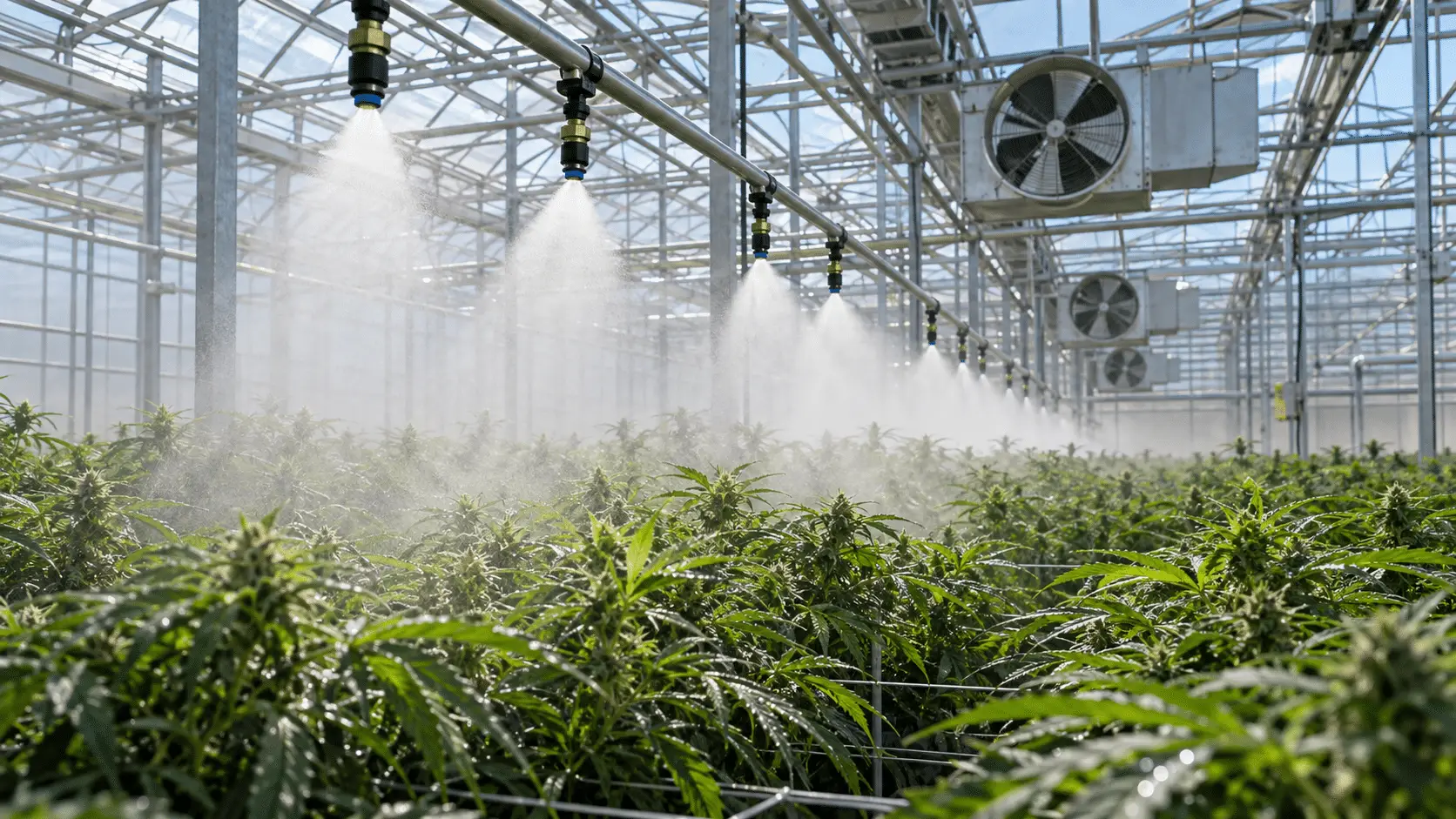
The review gives the general rule: less ventilation raises temperature and VPD, while evaporative cooling, misting or fogging raises RH and lowers VPD. Rutgers authors add that raising RH is a simple way to ease transpiration under high solar radiation. See our guides to fan-pad, fog and shade cooling and dew point and humidity control.
How should you measure VPD?
Measure air temperature and RH at crop height, and add a leaf temperature reading if you want leaf VPD. Rutgers authors suggest a thermocouple on the leaf underside or an infrared thermometer for a canopy average.
- Sensor position: Place sensors in the crop zone, shaded from direct sun and ventilated, not near a fan or fog nozzle.
- Calibration and logging: RH sensors drift, so check them on a schedule, and log values to see swings, not just averages.
What to specify before requesting a quote
Give the supplier your crop, climate and target VPD band, then ask for written confirmation of the equipment that will hold it. A VPD target is only as good as the vent, cooling, heating and control systems behind it.
- Target and crop: Your VPD band by crop stage, taken from your crop adviser, plus local summer and winter design conditions.
- Cooling and humidification: Method, capacity and water quality needs. See our greenhouse cooling system page.
- Ventilation: Vent area, fans and airflow path. See our greenhouse ventilation system page.
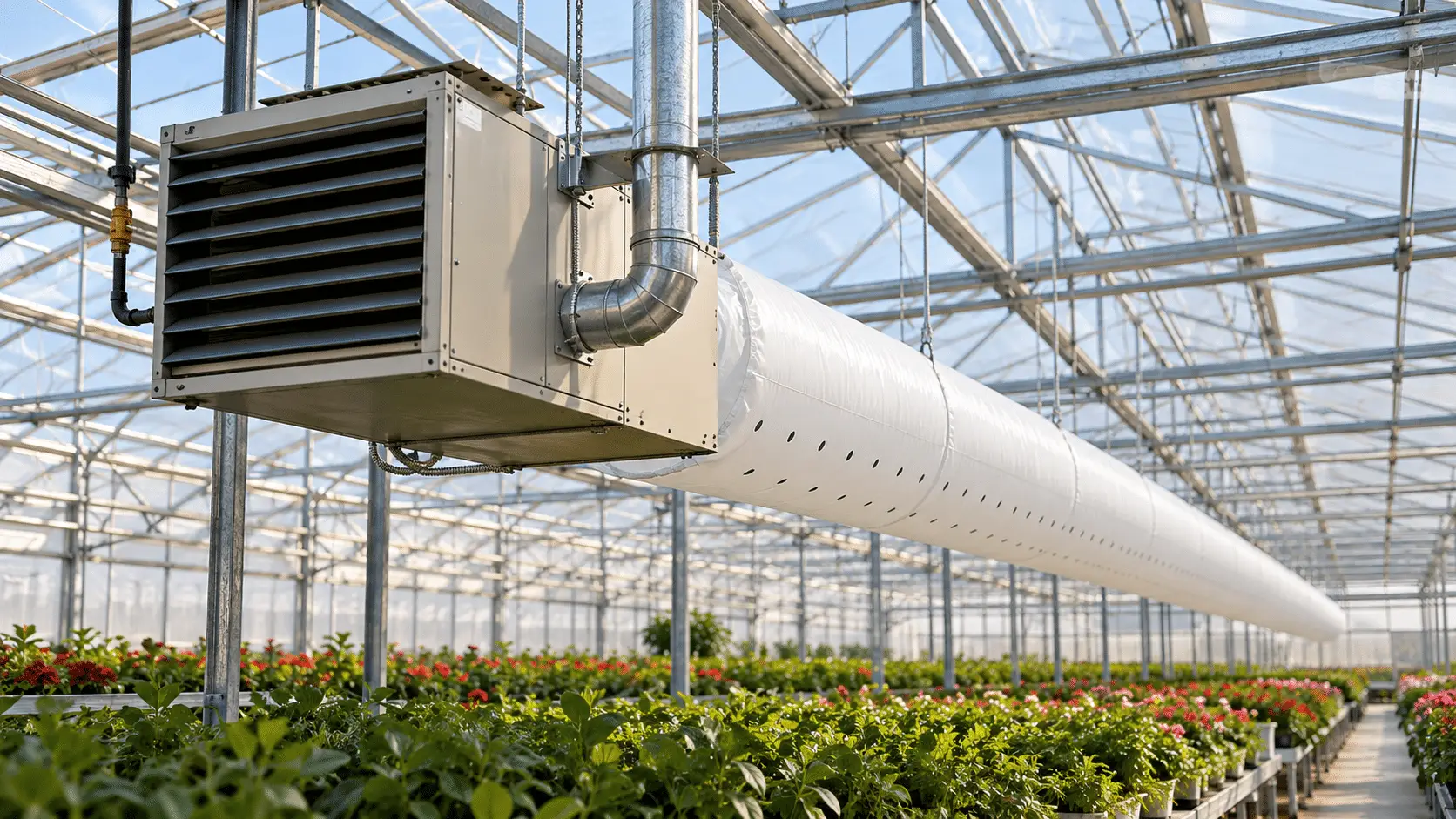
- Heating: Capacity to raise temperature at night and in winter. See our greenhouse heating system page.
- Controls: Sensors per zone, and whether the controller can work to a VPD setpoint or only to temperature and RH.
- Installation and support: Commissioning, sensor calibration and after-sales support.
How does FANGCHENG supply this?
FANGCHENG supplies the structure and the climate systems that set VPD, and it has done so since 2002. Its systems include ventilation, cooling, shading, heating and environmental control, so they can be specified together. Details are on the greenhouse control system page.
- Custom design: Designs are set for your local wind, snow, humidity and crop.
- Installation: On-site installation or remote guidance is available.
- Supply terms: OEM and ODM supply is available, and samples and quotes can be requested. Controller features and lead times are confirmed per project.
Planning a climate-controlled greenhouse? Send your crop, site climate and target conditions, and FANGCHENG will propose a structure and systems to match.
Request a quote
FAQ
What is a good VPD for a greenhouse?
A good VPD for a greenhouse is usually between 0.3 and 1.0 kPa, according to a review of tomato research. Lower values of 0.3 to 0.5 kPa suit cuttings, and your crop adviser should confirm the band for your crop and stage.
Is VPD the same as relative humidity?
No, VPD is not the same as relative humidity, because VPD also depends on temperature. At 60% RH the VPD is 0.68 kPa at 15 °C and 1.70 kPa at 30 °C.
What VPD is too high in a greenhouse?
A greenhouse VPD above about 1.5 to 2.0 kPa can stress plants when RH is low and sun is strong, according to Rutgers authors. In a tomato study at 30 °C, growth measures were undesirable above 2.0 kPa.
How do you lower VPD in a greenhouse?
You lower VPD in a greenhouse by adding humidity or cutting temperature, for example with misting, fogging, evaporative cooling or shading. Check that the extra moisture does not leave leaves wet for long.
What is the difference between air VPD and leaf VPD?
Air VPD uses air temperature for the saturation term, while leaf VPD uses the leaf’s own temperature. Leaf VPD is lower when transpiring leaves are cooler than the air, so air VPD can overstate the demand on the plant.
Bottom line
A VPD chart turns temperature and humidity into one number that tracks how hard the air pulls water from the crop. Published targets cluster between 0.3 and 1.0 kPa, but they differ by source and crop. Set the band with your crop adviser, then specify the cooling, ventilation, heating and sensors that can hold it.
Editorial note: The VPD formula is from FAO Irrigation and Drainage Paper 56. Target ranges and the control comments are from Shamshiri et al. (International Agrophysics, 2018) and the Rutgers GrowerTalks article (2018). Crop effects are from Alcorn et al. (Acta Horticulturae, 2023), Zhang et al. (PLoS One, 2015) and Inoue et al. (Frontiers in Plant Science, 2021). The chart values and worked examples are our own calculations from the FAO equation. All pages were opened in October 2026.
 Blog
 Blog
 Blog
