 跳至内容

Short answer: Small and single-bay greenhouses are usually heated with vented unit heaters, and large ranges with a central hot water or steam boiler. Infrared heaters warm the crop directly rather than the air. Biomass boilers pay off only when the fuel price gap is wide and a backup heater is kept. Size every system on heat output at your coldest design night.
Key takeaways
- University of Florida guidance treats unit heaters as the moderate-cost, easy-to-expand option, and boilers as the choice for large ranges.
- Required heat is roughly surface area × temperature difference × a glazing factor, and boilers need at least 25% extra.
- Gas and oil heaters must be vented outside, because combustion by-products can harm plants and people.
- Compare fuels by cost per unit of useful heat: fuel price divided by efficiency.
- Cut the heating load first with double covers, curtains and good controls, then size the heater.
What types of greenhouse heaters are there?
Commercial growers choose between seven main heating systems, and the right one depends on greenhouse size, fuel and crop. The table summarizes each as described by university extension sources.
| Heater type | How it works | Strengths | Watch-outs |
|---|---|---|---|
| Unit heater (gas or oil) | Fan-driven heater that blows warm air through the house | Moderate capital cost, easy to install, easy to expand | Must be vented outside; needs fresh combustion air |
| Hot water system | Boiler sends hot water through pipes at the perimeter, under benches, in trusses or under floors | Simple to install, less maintenance than steam, uniform temperatures | Slower to heat and cool; significant investment |
| Steam system | Boiler sends steam through smooth or finned lines | Rapid response, long life, steam can also pasteurize soil | High initial cost and significant maintenance |
| Infrared radiant heater | Heats plants and objects rather than the air | Potential energy savings; leaves stay above air temperature | Less suited to tall, complex canopies; fire risk if overturned; shadows |
| Biomass boiler or furnace | Burns pellets, chips or wood to make hot water or air | Cheaper fuel per unit of heat in some regions | High capital cost; needs a backup heater |
| Heat pump | Moves heat from outside air, ground or water into the house | Can also cool; moves heat rather than making it | Efficiency falls below freezing; upfront cost can outweigh savings |
| Solar radiant storage | Stores solar heat in an insulated tank of fluid | Uses free energy | Practical only in some climates |
The University of Florida (UF/IFAS) guide Heating Greenhouses is the source for every row except biomass, which comes from the Wisconsin case studies below. It also warns against fuel-oil “Salamander” radiant heaters for routine use, because they have no thermostat and no outside venting.
Which greenhouse heater fits your greenhouse size?
Match the heater to the size of the range: unit heaters for single houses, central boilers for large ranges. UF/IFAS describes unit heaters as suited to individual Quonset or hoop greenhouses, and states that boilers producing steam or hot water are used for large ranges. The same guide notes that steam travels efficiently over long distances.
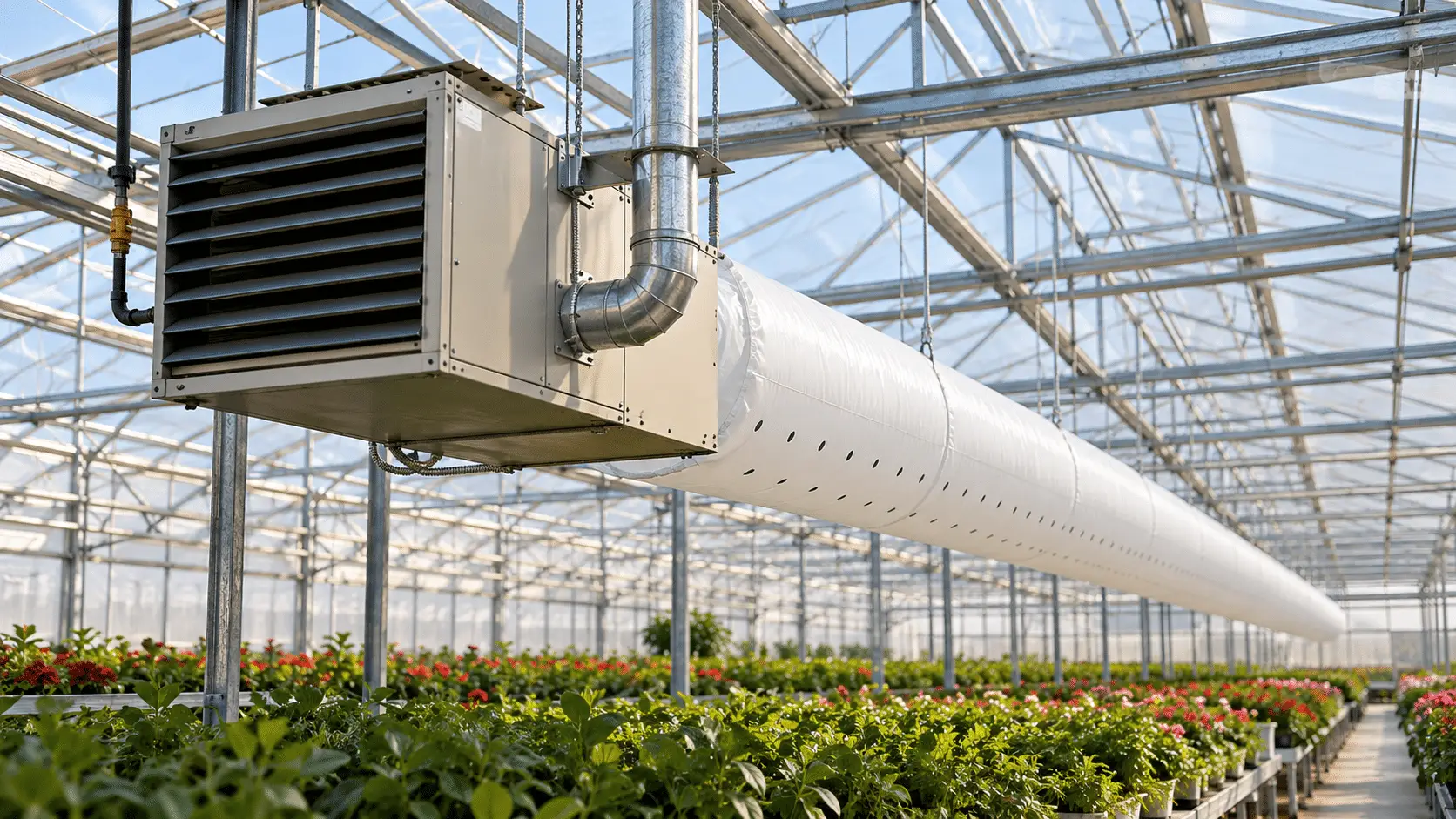
- Single bay or a few houses: Vented unit heaters, spaced so each blows toward the next.
- Many bays or a gutter-connected range: A central boiler with hot water distribution, so one plant room serves every bay.
- Uneven temperatures: Add a perforated polyethylene tube. UF/IFAS gives a discharge velocity limit of 1,200 to 1,800 feet per minute and total openings of 1.5 to 2.0 times the tube’s cross-section.
- Future growth: UF/IFAS advises choosing a system that is easy to expand and, if possible, can switch fuels.
How do you size a greenhouse heater?
Multiply the greenhouse surface area by the temperature difference you must hold, then by a heat transmission factor for the covering. UF/IFAS calls this an easy and fairly accurate estimate. The factors it gives are:
| Covering | Factor |
|---|---|
| Single polyethylene film or rigid plastic | 1.0 (tight, well built) to 1.2 (leakier) |
| Double polyethylene film, air space 3/4 to 4 inches | 0.75 to 1.0 |
| Glass | 1.1 to 1.4 |
Add 10% if the site is windy and leaky. UF/IFAS works one example: a 30 ft × 120 ft gable house with 6 ft sidewalls has about 5,750 square feet (about 534 m²) of surface. Covered with rigid plastic and held at 65°F against a 25°F outside low (a 40°F difference), it needs 5,750 × 40 × 1.2 = 276,000 BTU/hr, about 81 kW.
- Use output, not input: UF/IFAS says equipment sizing must be based on output capacity, and most makers list both.
- Boilers: Add at least 25% to allow for distribution losses. One boiler horsepower is about 33,500 BTU/hr.
- Design night: Design for temperatures slightly above the 15- to 25-year lows in local weather records. University of Wisconsin Extension used -20°F as the outdoor design temperature for its Madison examples.
- Do not oversize blindly: A unit that cannot be turned down overheats the house in mild weather. The Wisconsin case studies note that pellet boilers are difficult to throttle in early fall and late spring.
For a deeper load calculation, use our heating and cooling calculation guide. The factor for glass houses depends on the glazing; see our glass greenhouse glazing guide and the NGMA glazing guidance, which explains that a lower U-value means more resistance to heat transfer.
How must fuel-burning greenhouse heaters be vented?
Every gas or oil heater must be vented to the outside, because combustion by-products can poison people and damage plants. UF/IFAS lists carbon monoxide as harmful to people, and ethylene, sulfur dioxide and unburned hydrocarbons as harmful to many plants. Its venting rules are specific:
- Vent stack: Size the pipe to the manufacturer’s recommendation and end it at least 48 inches above the highest point of the building.
- Fresh air: Tight greenhouses need fresh-air intakes sized for the burner, normally 6 to 8 inches in diameter.
- Downdrafts: Keep stacks and intakes clear of tall buildings or trees that can push air back down.
- Carbon dioxide: Combustion does add CO₂, but heaters mostly run at night when plants cannot use it. UF/IFAS says supplemental CO₂ should come from a dedicated generator instead.
- Humidity: Combustion also makes water vapor, which UF/IFAS says is undesirable at night in a closed house from a disease-control standpoint.
Are infrared greenhouse heaters worth it?
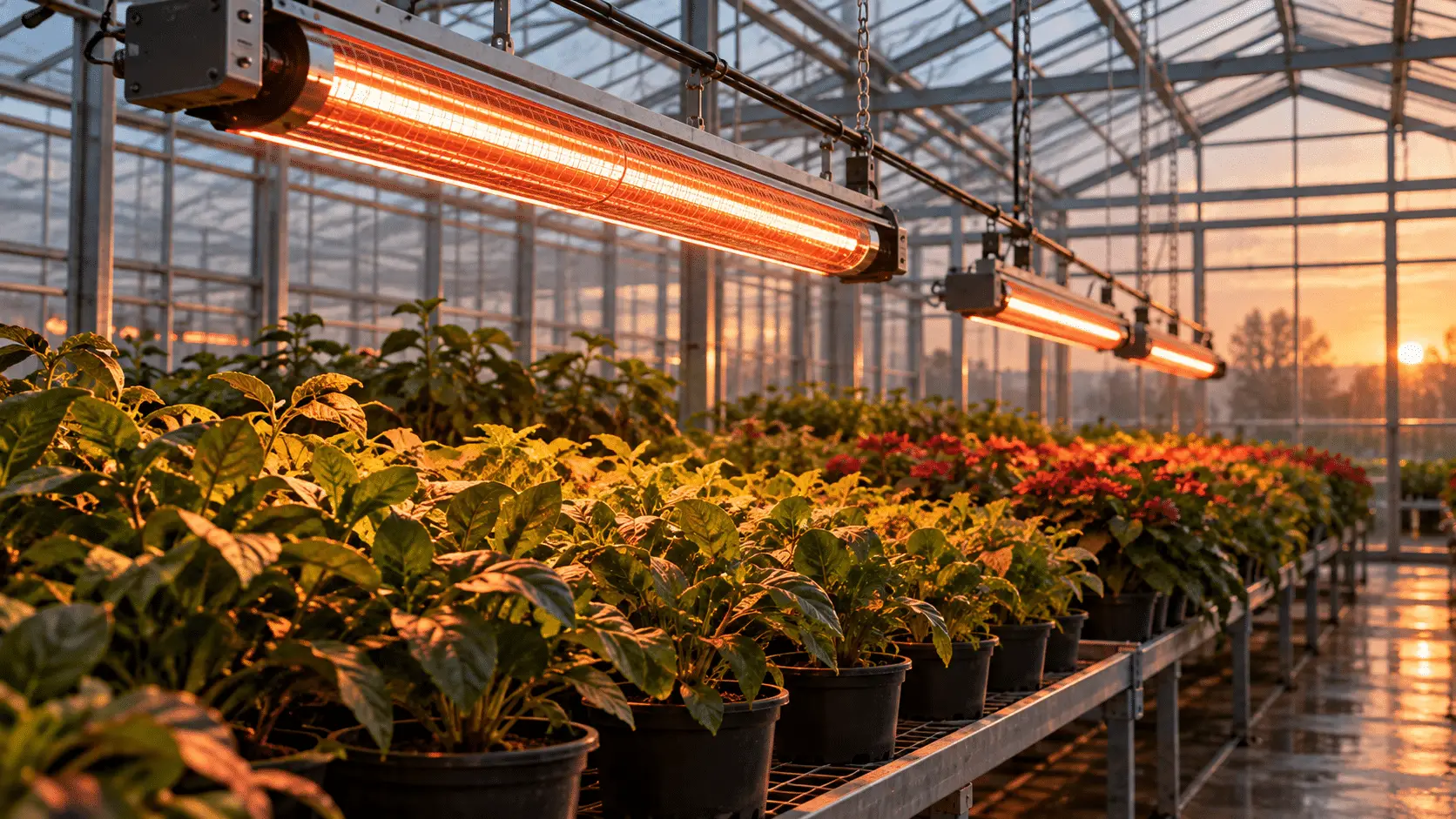
Infrared heaters can save energy because they warm plants and objects directly instead of the air. UF/IFAS lists the advantages and limits:
- Fast response: Heat is produced almost as soon as the equipment is switched on.
- Warm leaves: Leaf surfaces stay above air temperature, which can help disease management.
- Canopy limits: Coverage is directional and uneven under complex canopies such as high-wire tomatoes or roses.
- Safety and shade: Fire can occur if a heater is overturned or its coils meet flammable material, and the units can cast shadows.
The UF/IFAS heating page adds that tubing runs the length of the house 6 to 12 feet above the crop. Treat the savings as potential, not guaranteed, until a supplier gives a heat-loss-based estimate for your crop.
Should you choose hot water or steam?
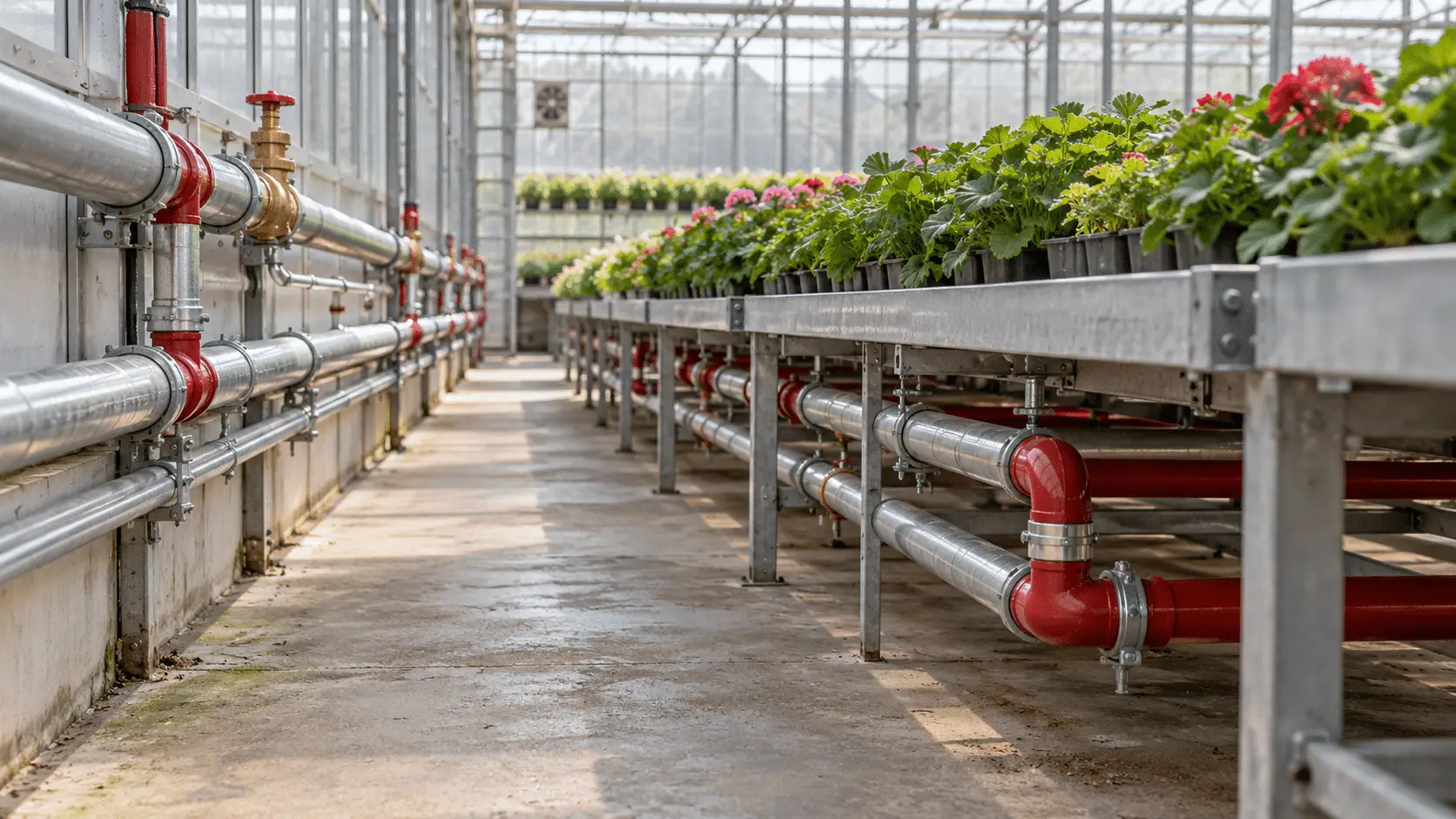
Hot water is usually the simpler central system, and steam is for very large ranges that value its speed and soil pasteurization. UF/IFAS describes hot water as simpler to install, lower in maintenance than steam, and more uniform, but slower to heat and cool. Steam heats and cools fast, lasts long and can pasteurize soil, but it costs more to install and maintain.
- Pipe position: Hot water pipes can run at the perimeter, under or on benches, overhead in the trusses or under concrete floors. Steam lines suit overhead and sidewall runs, with about one third overhead and two thirds along the sidewalls.
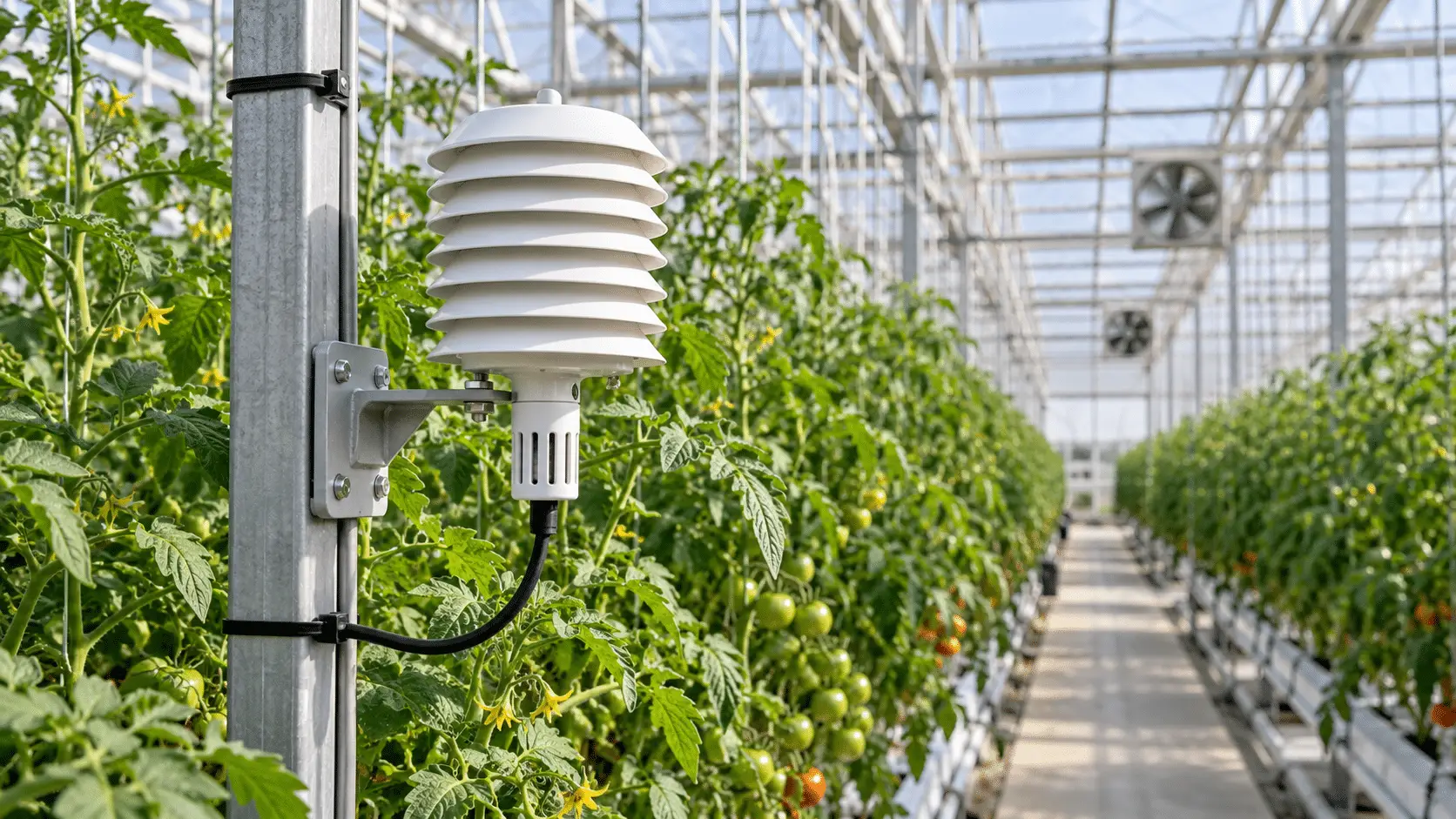
- Controls: Pair either system with a plant-level thermostat accurate to 2 to 3°F, as UF/IFAS recommends. See our greenhouse control system page.
When does biomass heating pay off?
Biomass heating pays off only when the biomass fuel is much cheaper than propane or oil and a backup heater stays in place. The University of Wisconsin Extension case studies, publication A3907-05, compared biomass with propane for a small and a large Wisconsin greenhouse. Prices date from 2010, so use the pattern, not the dollar figures.
| System in the study | Efficiency used | Notes |
|---|---|---|
| Propane unit heaters | 78% | The baseline in both studies |
| Pellet stove or furnace | 80% | Small house only; limited output |
| EPA-qualified outdoor wood boiler | 75% | Heat loss to the greenhouse not counted |
| Unqualified outdoor wood boiler | 40% | Pre-2008 type |
| Commercial pellet boilers | 75 to 82% (78% used) | Auto stoking and ash removal; hard to throttle |
| Wood-chip boiler | 80% | Chips up to 50% moisture; highest capital cost |
- Backup is required: The authors state that all biomass units should have a backup system, and propane still supplied about 20% of heat in some options.
- Payback swings with fuel prices: For the large range, simple payback was 3.2 to 4.7 years. For the small house it ran from 7.1 to 11.1 years, and moved with the propane-to-pellet price gap.
- Size for most of the load: In the large case, sizing boilers for average rather than peak demand had the shortest payback.
- Cheap gas changes the answer: The study notes that natural gas plus energy conservation would be a better investment than biomass if gas were available.
- Simple payback leaves out costs: Ash disposal, maintenance and labor are not counted.
How do you compare running costs across heater fuels?
Compare fuels by cost per unit of useful heat, which is fuel price per unit of energy divided by heater efficiency. A cheaper fuel in a poor boiler can cost more than a dearer fuel in an efficient one. UF/IFAS also notes that the lowest-cost dependable fuel is generally the one to use.
Here is an illustration with made-up prices, to show the method only. Suppose fuel A costs $20 per million BTU of fuel energy and burns at 78% efficiency, and fuel B costs $12 and burns at 80%. Fuel A delivers heat at $20 ÷ 0.78 = $25.64 per million BTU. Fuel B delivers it at $12 ÷ 0.80 = $15.00. Replace the example prices with delivered quotes.
- Use delivered prices: Include freight, storage and handling.
- Use real efficiency: Use the output rating, then allow for distribution losses.
- Add the unglamorous costs: Labor, ash, maintenance and standby fuel.
How can you cut the heating load before buying a heater?
Reduce heat loss first, because a smaller load means a smaller, cheaper heating system. The Wisconsin authors say investing in energy conservation first may save money by reducing the heating system needed. They name double-wall glazing, higher-efficiency heating systems and thermal night curtains.
- Covering: A double layer of polyethylene lowers the UF/IFAS transmission factor from 1.0 to 1.2 down to 0.75 to 1.0. Read our greenhouse plastic film guide.
- Night curtains and sealing: Cutting infiltration lowers the factor too. Our winter heating guide covers the options.
- Controls: Place the thermostat at plant level, shielded from sun, and check calibration several times a year.
What to specify before requesting a quote
A heating quote is only comparable if every supplier prices the same design conditions. Give or request these items:
- Design conditions: Indoor set-point for each crop stage and the outdoor design temperature, taken from local weather records.
- Covering and construction: Glazing type, single or double layer, sidewall height and infiltration expectations.
- Heater output: Output capacity in kW or BTU/hr, not just input, plus the calculation behind the load.
- Fuel and backup: Primary fuel, delivered price, storage space and a backup source.
- Distribution: Pipe layout, zones, perimeter or under-bench runs, air tubes and circulation fans.
- Venting and air: Stack height, fresh-air intake and local code requirements for fuel-burning equipment.
- Controls: Thermostat or climate computer, sensor positions and alarms.
- Documentation: Safety and conformity documents your market requires. Ask to see them rather than assuming.
- Installation and service: Who installs, commissions and trains your staff, and how spare parts are handled.
How does FANGCHENG supply this?
FANGCHENG designs and supplies the greenhouse structure and the heating system together, so the heat load and the building are specified as one project. The company has planned, designed, manufactured and installed greenhouses since 2002. Its greenhouse heating system page covers the heating side.
- Custom design: Designs are set for your local wind, snow, humidity and crop.
- In-house parts: FANGCHENG states that all key components are produced in-house.
- Installation: On-site installation or remote guidance is available.
- Supply terms: OEM and ODM supply is available, and samples and quotes can be requested. Heater capacity, fuel choice and lead times are confirmed per project.
Planning a heated greenhouse? Send your crop, site conditions and the lowest outdoor temperature on record, and FANGCHENG will propose a structure and heating system to match.
Request a quote
FAQ
What is the best heater for a commercial greenhouse?
The best greenhouse heater depends on size: vented unit heaters suit single houses and hot water boilers suit large ranges. UF/IFAS describes unit heaters as moderate in cost and easy to expand, and boilers as the usual choice for large ranges.
How do I size a greenhouse heater?
Size a greenhouse heater by multiplying surface area by the temperature difference and a glazing factor. UF/IFAS gives factors of 1.0 to 1.2 for single plastic, 0.75 to 1.0 for double film and 1.1 to 1.4 for glass, with 25% extra for boilers.
Do greenhouse heaters need to be vented?
Yes, gas and oil greenhouse heaters must be vented outside. Combustion produces carbon monoxide, which harms people, and ethylene and sulfur dioxide, which harm many plants.
Are infrared greenhouse heaters more efficient?
Infrared greenhouse heaters offer potential energy savings because they heat plants rather than the air. UF/IFAS cautions that coverage is uneven under tall, complex canopies and that fire risk needs attention.
Is a biomass greenhouse heater cheaper to run?
A biomass greenhouse heater can cost less to run, but it costs more to buy and needs a backup heater. In University of Wisconsin case studies, simple payback ranged from 3.2 to 11.1 years depending on size and fuel prices.
Bottom line
Pick the heater by greenhouse size, size it on output at your design night, and vent every fuel-burning unit outside. Compare fuels by cost per unit of useful heat, and cut the heating load before you buy equipment. Biomass and heat pumps need a project-specific payback calculation, not a rule of thumb.
Editorial note: Heater types, sizing factors and venting rules are from the University of Florida IFAS Extension guide Heating Greenhouses (revised 2019, reviewed 2025) and its heating systems page. Biomass efficiencies and paybacks are from University of Wisconsin Extension publication A3907-05 (2010), whose dollar figures are dated and specific to Wisconsin. U-value wording is from NGMA. All pages were opened in October 2026. The cost example uses invented prices to show the method.
 Blog
 Blog
 Blog
