 Skip to content

Short answer: Yes, heat pumps work for greenhouses, and they typically deliver about two to four units of heat for every unit of electricity they use. Ground-source heat pumps hold temperature better in cold climates. In a Japanese trial, a ground-source system kept a greenhouse at its 14 °C set point while an air-source system let it fall to 7 °C. Air-source units cost less to install and suit milder winters.
Key takeaways
- A heat pump moves heat instead of burning fuel, so its efficiency (COP) is usually well above 1.
- Ground-source systems use the stable soil temperature below about 2 ft and keep output up in cold weather.
- Air-source systems are cheaper and simpler to install, but their output drops as outdoor air gets colder.
- Poor design can push COP close to 1.5, so the ground loop, insulation and sizing matter as much as the unit.
How does a heat pump heat a greenhouse?
A heat pump heats a greenhouse by moving heat from outside air, soil or water into the house, using a refrigerant cycle driven by electricity. Because it moves heat rather than making it, one unit of electricity can deliver several units of heat. That ratio is the coefficient of performance (COP).
NCAT’s ATTRA program puts standard geothermal heat pump efficiencies at 300 to 600%, compared with 75 to 90% for a standard fossil-fuel furnace (NCAT ATTRA, Geothermal Greenhouses, November 2021). The two main types are:
- Air-source heat pump (ASHP): Takes heat from outdoor air through an outdoor coil. Quick to install and no digging.
- Ground-source heat pump (GSHP): Takes heat from the ground through buried pipe loops filled with water or brine. More installation work, steadier output.
Many units are reversible, so the same system can also cool the greenhouse in summer.
Air-source vs ground-source: which works better in a greenhouse?
Ground-source heat pumps work better in cold climates, and air-source heat pumps are the lower-cost choice where winters are mild. The clearest greenhouse comparison comes from Sakata, Japan, where researchers ran both systems side by side in winter (Furuno et al., Journal of the Society of Agricultural Structures, Japan, 2012).
| Result in the Sakata trial | Ground-source | Air-source |
|---|---|---|
| Greenhouse air temperature | Held the 14 °C set point | Ranged from 7 to 14 °C |
| Heating capacity | 67% higher | Baseline |
| Average system COP | 3.89 (measured, stable) | 2.14 (estimated, range 1.8–2.5) |
| Total electricity use | 22% less | Baseline |
Newer data show air-source units can still perform well with good design. A Korea Institute of Energy Research project heating a citrus greenhouse reported an annual average COP of 4.1 for a multi-source heat pump with solar seasonal storage, and 3.9 for the air-source unit used as backup (pv magazine, September 2026).

Why do ground-source heat pumps keep working in cold weather?
Ground-source heat pumps keep working because soil temperature stays almost constant through the year. ATTRA notes that underground temperature becomes stable from roughly two feet below the surface and averages about 55 °F across the United States. An air-source unit, in contrast, has to pull heat from air that gets colder exactly when the greenhouse needs the most heat.
Ground loops come in two main layouts:
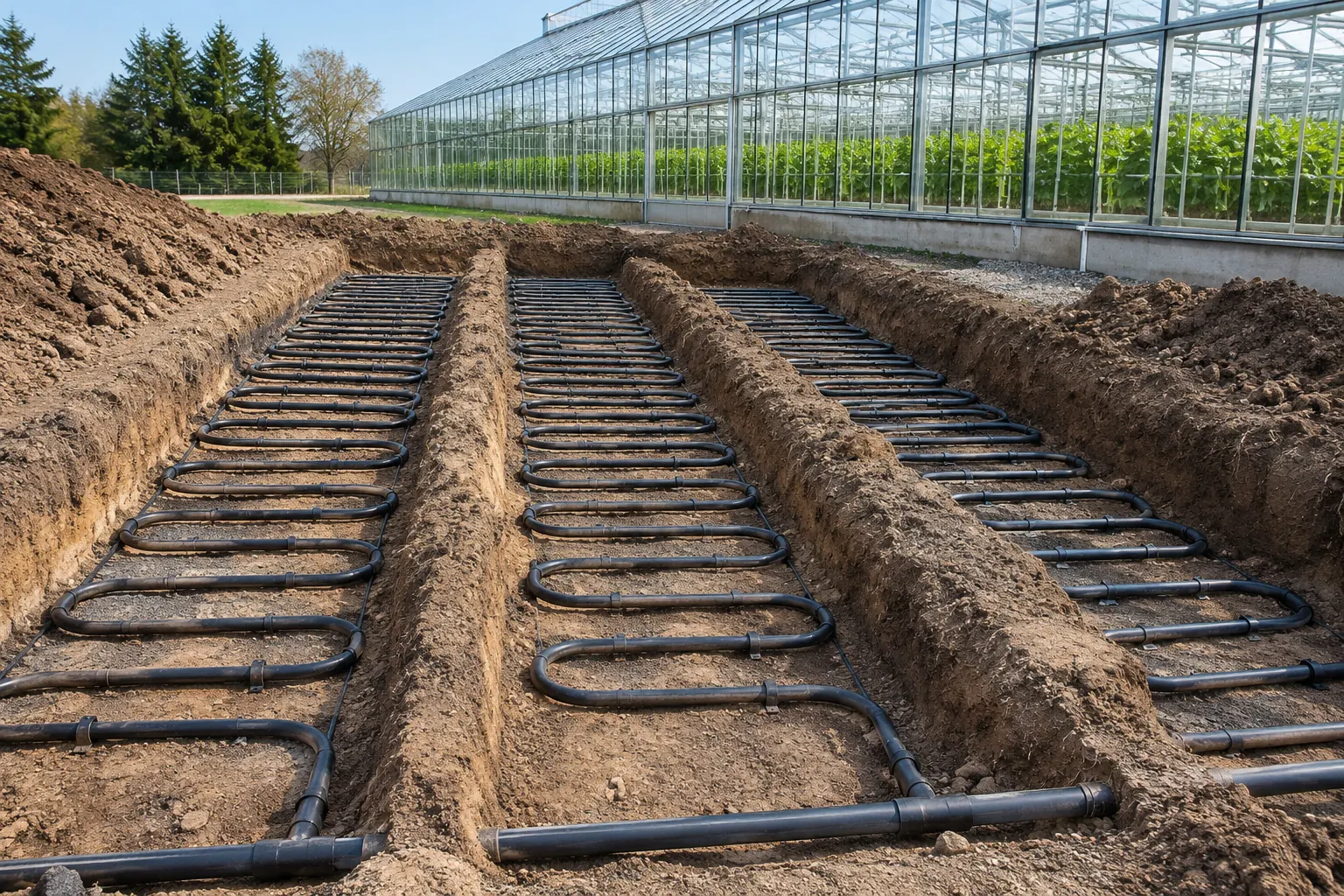
- Horizontal loops: Pipes laid in trenches. Cheaper to dig, but they need a large land area. ATTRA describes them as a fit for smaller operations.
- Vertical boreholes: Several deep holes, about 200 to 500 feet according to ATTRA. Less land, higher drilling cost.
Water sources such as ponds, wells or aquifers can also serve as the heat source where permits allow.
What COP can a greenhouse heat pump realistically reach?
A well-designed greenhouse heat pump typically reaches a system COP of about 3 to 4, but a poorly designed one can fall much lower. A 2021 study of a ground-source system with shallow soil storage reported seasonal heating COP between 1.48 and 2.97, and a system COP of about 1.5. Low brine temperature in winter let the greenhouse drop to 11 °C (HortiDaily, reporting Harjunowibowo et al., International Journal of Low-Carbon Technologies, 2021).
COP depends on these design choices:
- Source temperature: Warmer source water or soil gives a higher COP.
- Delivery temperature: Low-temperature delivery, such as floor or low pipe heating, runs more efficiently than very hot water.
- Loop sizing: An undersized ground loop cools down over the winter and drags COP down.
- Heat loss: A leaky, uninsulated house forces the unit to run harder.
Should you reduce heat loss before adding a heat pump?
Yes, reducing heat loss first is usually the cheapest way to make a heat pump pay. ATTRA advises improving energy efficiency before building a geothermal system, and notes that the heat pump itself can represent as much as 60% of the system cost. A smaller heat load means a smaller unit and a shorter ground loop.
- Energy screens: Close at night to cut heat loss through the roof. See thermal screens and insulation.
- Double covering: Double film or twin-wall polycarbonate insulates better than single layers.
- Air sealing: Tight doors, vents and gable ends reduce infiltration.
- Backup heat: Many growers keep a boiler or unit heater for the coldest nights instead of sizing the heat pump for the worst case.
For a full heat-load method, see our guide to calculating greenhouse heating and cooling. For fuel-based options, compare greenhouse heaters and solar heating systems.
What should buyers specify before requesting a quote?
A heat pump quote needs a heat-load figure, not just floor area. Give suppliers:
- Climate data: Winter design temperature, heating hours and summer peak temperature.
- Greenhouse details: Area, gutter height, covering type and whether energy screens are installed.
- Crop set points: Night and day temperatures for the crop, and humidity targets.
- Heat source: Land available for loops, borehole conditions, or a nearby water source.
- Power supply: Available electrical capacity and local electricity tariffs.
- Delivery system: Pipe rail, floor heating or air handling units, and any backup heater.
How does FANGCHENG supply this?
FANGCHENG designs greenhouse structures for the local wind, snow, humidity and crop, and supplies heating systems together with ventilation, cooling, shading and climate control so they are sized for each other. FANGCHENG has worked on greenhouse planning, design, manufacturing and installation since 2002 for commercial growers and project contractors in China and overseas. Heating options are confirmed per project after the site and crop are reviewed. See greenhouse heating systems for the options.
Considering a heat pump for your greenhouse? Send your location, greenhouse size, covering and crop temperatures. FANGCHENG will propose a heating and climate package to match.
Request a quote
FAQ
Do heat pumps work for greenhouses?
Yes, heat pumps work for greenhouses and usually deliver two to four units of heat per unit of electricity. Ground-source systems hold temperature best in cold climates, while air-source systems suit milder winters.
Is an air-source or ground-source heat pump better for a greenhouse?
A ground-source heat pump is usually better for a greenhouse in a cold climate. In a trial in Sakata, Japan, it held the 14 °C set point and used 22% less electricity than an air-source system. Air-source units cost less to install.
What COP does a greenhouse heat pump have?
A well-designed greenhouse heat pump typically has a system COP of about 3 to 4. Published examples include 3.89 for a ground-source system in Japan and 4.1 for a multi-source system in Korea. Poor designs can fall to about 1.5.
Can a heat pump also cool a greenhouse?
Yes, a reversible heat pump can also cool a greenhouse by running the refrigerant cycle in reverse. For large houses in hot climates, ventilation, shading and evaporative cooling usually carry most of the summer load.
Bottom line
Heat pumps can heat a greenhouse efficiently, with ground-source systems the stronger choice in cold climates and air-source units the cheaper choice in mild ones. The result depends on design: cut heat loss first, size the loop or unit from a real heat load, and keep backup heat for the coldest nights.
Editorial note: Performance data come from Furuno et al. (Journal of the Society of Agricultural Structures, Japan, 2012), NCAT ATTRA (November 2021), pv magazine’s report on Korea Institute of Energy Research work (September 2026) and HortiDaily’s report on Harjunowibowo et al. (2021). Sources retrieved November 2026.
 Blog
 Blog
 Blog
