
Short answer: A shade net house is covered with porous netting that cuts sunlight and heat but lets air and rain pass through, while a greenhouse is covered with solid film, sheet or glass that holds heat and moisture in. Choose a shade net house for low-cost protection from sun, wind and pests. Choose a greenhouse when you need to control temperature, humidity and rain. India’s cost norms set a shade net structure at ₹710 per sq m, against ₹950 to ₹1,200 for a naturally ventilated polyhouse.
Key takeaways
- The main difference is the cover. Porous net lets air and rain through. A solid cover traps heat and keeps rain out.
- A shade net house has no real climate control. It lowers light and heat but follows outdoor weather.
- Shade nets suit seedlings, nursery plants, leafy greens, flowers and hardy vegetables. Fruiting crops that need tight control usually need a greenhouse.
- Official Indian cost norms put a tubular shade net structure at about 25% to 40% less per sq m than a naturally ventilated polyhouse.
What is the difference between a shade net house and a greenhouse?
The difference is what covers the frame, and that cover decides the climate inside. BigHaat, an Indian agri-input retailer, describes a shade net house as a simple protected structure covered with netting that filters sunlight and reduces heat stress, and a polyhouse as a more advanced structure covered with polyethylene film (BigHaat, July 2026). The table compares them on the points buyers check.
| Feature | Shade net house | Greenhouse (film, polycarbonate or glass) |
|---|---|---|
| Cover | Porous shade or agro-textile net | Solid film, rigid sheet or glass |
| Temperature, humidity and light | Partial protection from sun and heat; little control beyond shading | Better control over temperature, humidity and light (BigHaat) |
| Rain | Partial protection from wind, pests and heavy rain | Full rain protection |
| Pests | Basic protection | Stronger with insect-proof nets and controlled entry |
| Cost (India MIDH norm) | ₹710 per sq m, tubular structure | ₹950–₹1,200 per sq m naturally ventilated; ₹1,450–₹1,800 fan-and-pad |
| Typical crops | Seedlings, nursery plants, leafy greens, flowers, hardy vegetables | Tomatoes, capsicum, cucumbers, strawberries, roses and other high-value crops |
The crop and protection rows follow BigHaat’s comparison. The cost row comes from the Mission for Integrated Development of Horticulture (MIDH) guidelines, April 2025, Annexure V (MIDH Operational Guidelines).

When is a shade net house enough?
A shade net house is enough when the main problem is too much sun or heat, not cold or heavy rain. BigHaat lists seedlings, nursery plants, leafy greens, flowers and hardy vegetables as the typical crops. These crops tolerate outdoor humidity and temperature swings once the light is reduced.
- Hot, bright climates: Netting reduces light and leaf temperature while letting heat and moisture escape.
- Nurseries and hardening areas: Plants stay protected from direct sun and wind before field planting.
- Low-capital starts: The lower norm cost per sq m makes it a lower-risk first structure.
Shade nets are sold in different shading percentages, and the right one depends on the crop. Our shade cloth percentage guide covers the choice by crop and climate.
When do you need a greenhouse instead?
You need a greenhouse when the crop needs controlled temperature, humidity or rain protection that netting cannot give. A solid cover keeps rain off the crop and lets you manage the climate with vents, fans and pads. BigHaat lists tomatoes, capsicum, cucumbers, strawberries and roses as typical polyhouse crops.
A greenhouse is the better choice when:
- Rain damages the crop: Fruit cracking, leaf disease and flower damage rise with rain on the plants.
- Cold nights limit growth: Only a closed structure can be heated and insulated.
- You need steady quality: Fruiting and cut-flower crops pay back controlled conditions.
- Pest pressure is high: A closed house with insect net on vents and controlled entry gives stronger exclusion. See insect net.
For what separates film houses from rigid-cover houses, read polyhouse vs greenhouse.
How do the costs compare?
The shade net structure costs less per square metre in every official norm. MIDH sets ₹710 per sq m for a tubular shade net structure and ₹450 for a bamboo or cable-purlin one. The same table sets ₹950 to ₹1,200 per sq m for a naturally ventilated tubular polyhouse, depending on area.
At the National Horticulture Board’s per-acre norms, a shade net house is ₹28.40 lakh against ₹40 lakh for a polyhouse with drip and fogger system. One lakh is 100,000 rupees. These are cost norms, not vendor quotes, and rupee figures are as published. See polyhouse cost per acre for the full norm table and subsidy rules.
Cheaper does not always mean lower total cost. A shade net house gives less protection, so crop losses from rain, heat peaks and pests can outweigh the saving for high-value crops.
Is there a middle option between a shade net house and a greenhouse?
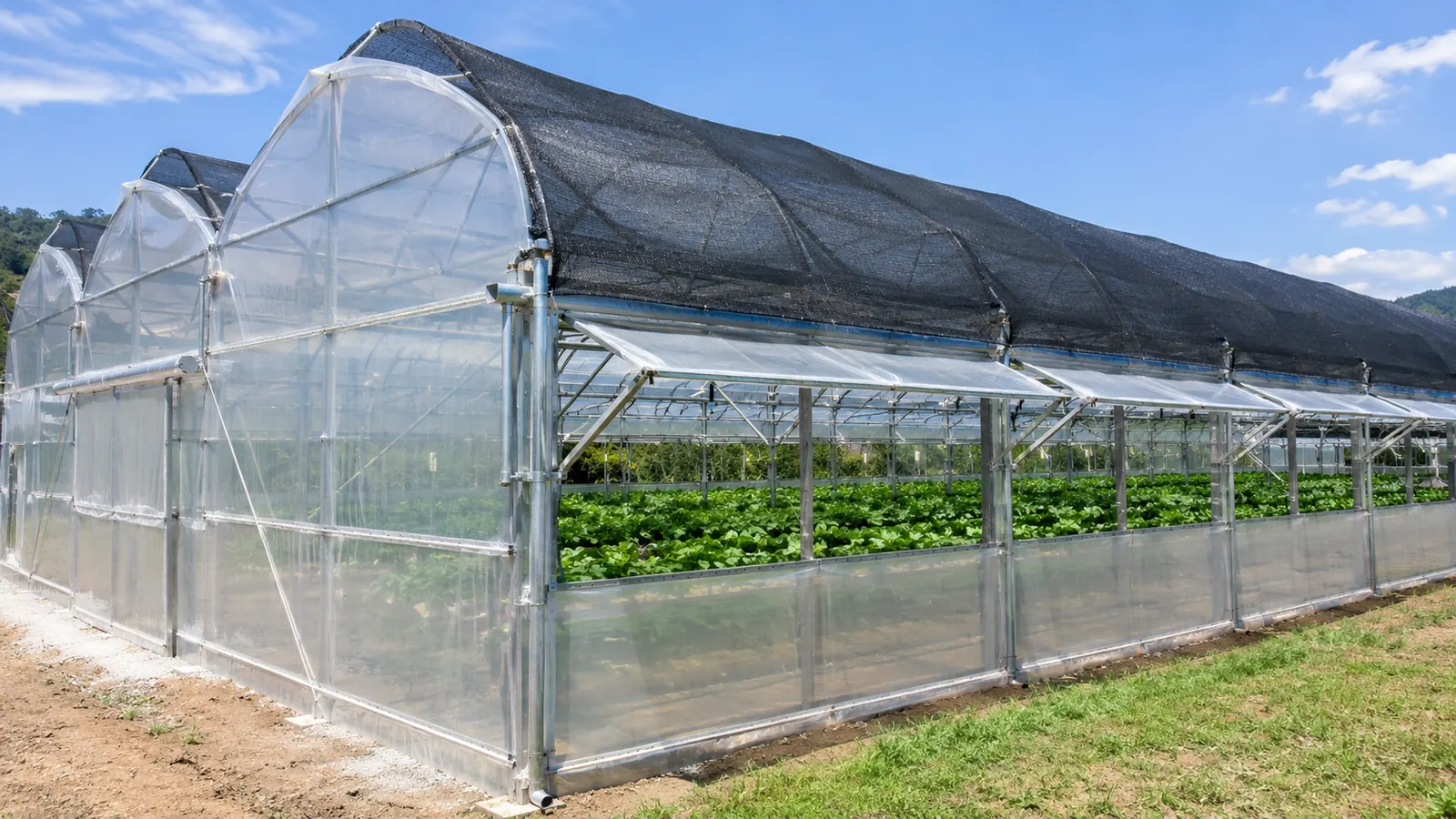
Yes, hybrid designs use screens, nets and film together. Professor William Roberts of Rutgers notes that several newer designs for warmer climates have no glazing, use retractable thermal screens, and offer good environmental control in warm weather. He also notes that open-roof greenhouses are performing well, and that some growers use unglazed structures to add growing space or harden off plants in spring (Roberts, Ventilation and Cooling of Greenhouses, 2003).
- External shade net over a film greenhouse: Cuts roof heat in peak summer while keeping rain protection. See greenhouse shading systems.
- Insect net on vents and sides: Keeps pests out of a naturally ventilated house, though fine mesh slows airflow.
Natural ventilation helps only when the outside air is cooler. Our guide to natural vs mechanical ventilation explains vent area and fan options.
Does the legal definition of a greenhouse matter?
It can, because some rules define a greenhouse by its cover. In the United States, the Worker Protection Standard defines enclosed space production as production of agricultural plants indoors or in a structure or space covered in whole or in part by any nonporous covering and large enough for a person to enter (40 CFR 170.305, Cornell Legal Information Institute). A structure covered only with porous net would not meet that wording, while a film-covered house would.
Subsidy schemes also set rules by structure type, as the MIDH norms do. Check how your local rules classify the structure before you choose.
What should buyers specify before requesting a quote?
A clear brief lets a supplier recommend the right structure. Send:
- Crop and growth stage: Seedlings, leafy greens, fruiting crops or flowers.
- Climate: Summer peak temperature, rainfall pattern, winter lows and wind.
- Protection needed: Sun, rain, wind, pests, cold, or several.
- Size and layout: Area, bay width and height.
- Cover and net: Net shading percentage or film type, and insect-net mesh for vents.
- Scope: Frame, cover, shade screens, installation guidance and spare nets.
How does FANGCHENG supply this?
FANGCHENG supplies film, polycarbonate and glass greenhouses together with ventilation, cooling and shading systems, including internal and external shading. Each structure is designed for the local wind, snow, humidity and crop, and key components are produced in-house. FANGCHENG has worked on greenhouse planning, design, manufacturing and installation since 2002 for growers and contractors in China and overseas, with on-site or remote installation guidance. Price and lead time are confirmed per project. See greenhouse shading systems and multi-span film greenhouses.
Choosing between a shade structure and a greenhouse? Send your crop, climate and budget range. FANGCHENG will recommend a structure, cover and shading plan.
Request a quote
FAQ
What is the difference between a shade net house and a greenhouse?
A shade net house uses porous netting that filters sun and lets air and rain through, while a greenhouse uses a solid cover that holds heat and moisture in. A greenhouse gives much more control over the climate.
Is a shade net house cheaper than a greenhouse?
Yes, a shade net house is cheaper per square metre. India’s MIDH norms set ₹710 per sq m for a tubular shade net structure, against ₹950 to ₹1,200 for a naturally ventilated polyhouse.
What crops grow best in a shade net house?
Seedlings, nursery plants, leafy greens, flowers and hardy vegetables grow best in a shade net house. Fruiting crops such as tomatoes and cucumbers usually do better in a polyhouse or greenhouse.
Does a shade net house protect from rain?
A shade net house gives only partial protection from heavy rain and wind, because the net is porous. Crops damaged by rain need a solid cover.
Can you use shade net on a greenhouse?
Yes, an external or internal shade net can be fitted to a greenhouse to cut heat and light in summer. It combines rain protection with sun control.
Bottom line
Choose a shade net house for low-cost protection from sun, wind and pests, and a greenhouse for crops that need temperature, humidity and rain control. If you want both, put a shade net over a film greenhouse. Match the structure to the crop’s weakest point, not to the lowest price.
Editorial note: Comparison points come from BigHaat (July 2026), a retailer of agri inputs. Cost norms come from the MIDH Operational Guidelines (April 2025, Annexures V and VI). Hybrid designs are from Roberts, Rutgers University (2003). The legal definition is from 40 CFR 170.305. Percentage differences are our calculations. Rupee amounts are as published. Sources retrieved November 2026.
 Blog
 Blog
 Blog
