
Short answer: Choose a greenhouse construction company by asking for evidence, not promises: the full scope, signed structural drawings that state design loads, comparable projects in your climate, an itemized quote, milestone-based payments and written after-sales terms. Use the 12 questions below and score each bidder on the same sheet before you sign.
Key takeaways
- Compare bidders on the same scope; two prices are only comparable if they include the same work.
- Ask which loads the structure is designed for. The NGMA Structural Design Manual lists the loads that drawings should show: dead, roof live, collateral and plant loads, snow, wind and seismic.
- Check whether the supplier is a manufacturer, a design firm or a local contractor, and who carries each interface.
- Get an itemized quote and tie payments to milestones you can verify.
- Verify references and documents yourself; do not accept certificates or project counts on trust.
What types of greenhouse construction companies are there?
There are three main types: manufacturers, design-build firms and local contractors. Each carries a different part of the project, so ask which role a bidder takes.
- Manufacturer: makes the structure and often the covering and systems, and may also design and install them.
- Design-build firm: designs the project and sources parts from several suppliers, then manages the build.
- Local contractor: handles groundwork, erection and permits on site, usually with a supplier’s kit.
No type is always better. What matters is who is responsible for the design, the foundation, the systems and the interfaces between them. For general selection factors, see our guide to choosing the right commercial greenhouse.
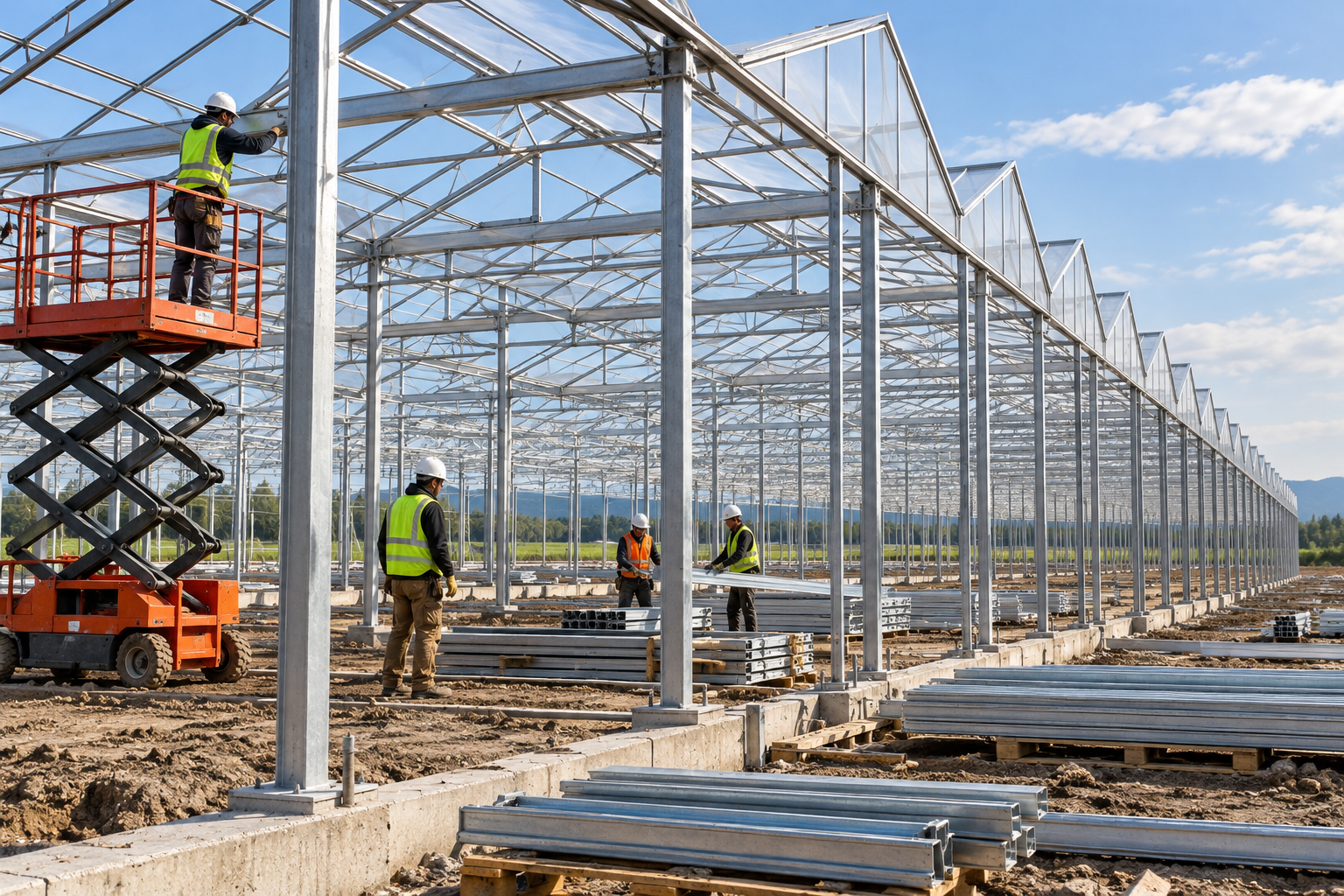
What 12 questions should you ask a greenhouse construction company?
Ask these 12 questions in writing and compare the answers side by side. The table gives the question, what a good answer includes and the evidence to request.
| # | Question | A good answer includes | Evidence to request |
|---|---|---|---|
| 1 | What exactly is in your scope? | Design, supply, foundation, erection, covering, systems, controls, utilities, commissioning | Scope list with inclusions and exclusions |
| 2 | Which loads is the structure designed for? | Dead, roof live, collateral, plant, snow, wind and seismic, with the code used | Structural drawings and calculation summary |
| 3 | Who signs the design? | Named engineer or design office, and whether local approval needs a stamp | Sample signed drawings |
| 4 | What have you built in a climate like mine? | Projects with similar crop, wind and snow conditions | References you can call |
| 5 | What materials and coatings do you use? | Steel type and protective coating, covering type, fasteners and gaskets | Material specification sheets |
| 6 | What does the foundation need? | Foundation type, soil data needed and who is responsible | Foundation drawing and site requirements |
| 7 | Who supplies ventilation, cooling, heating and controls? | One accountable party, or a clear split of responsibility | System list and interface drawing |
| 8 | What is the schedule? | Milestones from drawings to handover, and what could delay them | Written schedule |
| 9 | Is the quote itemized? | Line items for structure, covering, systems, shipping, installation and extras | Itemized bill of quantities |
| 10 | How are payments structured? | Payments tied to verifiable milestones, not mostly up front | Payment schedule in the contract |
| 11 | What is the warranty and after-sales service? | What is covered, for how long, response method and spare parts | Written warranty terms |
| 12 | Who handles permits, licences and insurance? | Responsibility for permits, and proof of the insurance and licences your site requires | Certificates issued to you, checked with the issuer |
Why ask which loads the structure is designed for?
The design loads decide whether the greenhouse survives your worst snow, wind and crop weight. The NGMA Structural Design Manual, Chapter 2, lists what the plan information should show: dead, roof live, collateral and plant loads; ground and flat-roof snow data; basic wind speed as a 3-second gust; wind exposure; and seismic data (NGMA Structural Design Manual, Ch. 2).
The manual also gives example design values. These come from IBC 2000 and ASCE 7-98 as referenced in the chapter, so confirm the current code for your site:
- Roof live load: 10 psf minimum under the IBC.
- Hanging plant load: 2 psf minimum, applied as a concentrated load at truss panel points.
- Vertical deflection: a limit of l/120.
- Snow importance factor: 0.8 for production greenhouses without public access, and 1.0 for commercial greenhouses not in the higher category.
The manual’s year is not stated on the chapter, so treat these as examples, not as your project’s values. Your project’s loads come from local code and site data. For how ASCE 7, NGMA and EN 13031-1 compare, see our guide to greenhouse structural load standards.
Do local codes change what a supplier must provide?
Yes, local rules decide which documents, stamps and loads apply, so ask each bidder how it handles your jurisdiction. UConn Extension’s guide to Connecticut rules shows how much one region can differ (UConn Extension EXT084).
- Use group: the International Building Code places agricultural buildings and greenhouses in miscellaneous use group U, and the guide separates production greenhouses from commercial greenhouses open to the public.
- Engineer’s seal: in Connecticut, farm buildings used for agriculture are exempt from needing an engineer’s seal, but your region may not be.
- Example loads: the guide gives a typical design snow load of 18.6 psf for a conventional greenhouse in northern Connecticut, and a basic wind speed range of 90 to 120 mph.
- Permits and zoning: the guide says it does not address building permits or zoning, so confirm those with your local authority.
These are Connecticut examples, not your project’s values. The point is to ask each bidder which code, load set and approvals apply at your site, and who pays for them.
How should you compare quotes from different bidders?
Put every quote into the same scope, then compare line by line. A low total often hides an exclusion that you pay for later.
- Same scope: structure, covering, foundation, systems, controls, shipping, duties, installation and commissioning.
- Same design basis: the same wind speed, snow load and crop load for every bidder.
- Same exclusions: note what is left to you, such as groundwork, utilities and permits.
- Total cost of ownership: include energy use, maintenance and replacement parts, not only the purchase price.
- Currency and terms: record the trade terms, delivery point and who pays for customs and unloading.
Use the scorecard below. The weights are our own illustrative starting point, not a research finding, so change them to fit your project.
| Criterion | Suggested weight | Score 1-5 |
|---|---|---|
| Scope clarity and itemized quote | 20% | |
| Structural design and load evidence | 25% | |
| Relevant references | 15% | |
| Systems integration | 15% | |
| Schedule and installation plan | 10% | |
| Warranty and after-sales | 15% |

What should importers check when buying from an overseas supplier?
Importers should check documents, shipping and installation support in addition to the structure. Overseas projects add steps that a local contractor would handle for you.
- Drawings and units: confirm the drawings use units and codes your local approver accepts.
- Packing and labeling: ask for a packing list that matches the drawing part numbers.
- Customs and shipping: see our guide on importing a greenhouse.
- Certificates: check them with the issuer; see our guide to CE, ISO 9001 and USDA certification.
- Installation: ask whether the supplier sends supervisors or gives remote guidance, and who supplies local labor.
- Finance: see our overview of greenhouse financing and grants.
What should buyers specify before requesting a quote?
Give every bidder the same project brief so the quotes are comparable. Include these items:
- Crop and production goal: crop, yield target and planting layout.
- Site data: location, soil information, slope, water and power access. See site selection and land preparation.
- Climate and loads: design wind, snow and temperature extremes from local records.
- Size and layout: area, span, bay width, eave height and expansion plans.
- Covering and systems: film, glass or polycarbonate, plus ventilation, cooling, heating, shading and control.
- Budget and timeline: target budget range and the date you need to start growing.
- Support needs: installation scope, training and spare parts.
How does FANGCHENG supply this?
FANGCHENG plans, designs, manufactures and installs greenhouses, and it has done so since 2002. Its listed service chain runs from environmental and site assessment, through structural design, to manufacturing and supply, and then installation and technical support.
- Integrated delivery: see the greenhouse system integration page.
- Assessment and design: see environmental assessment and drawing and design.
- Manufacturing: FANGCHENG states that all key components are produced in-house; see production and supply.
- Installation and support: on-site installation or remote guidance is offered; see installation service and technical support.
- Custom design: designs are set around your local wind, snow, humidity and crop. Prices, lead times, warranty terms and documents are confirmed per project.
Comparing greenhouse suppliers? Send your crop, site conditions and local wind and snow loads, and FANGCHENG will return a scoped proposal you can compare with other bids.
Request a quote
FAQ
How do I choose a greenhouse construction company?
You choose a greenhouse construction company by comparing the same scope, structural design evidence, references, itemized quotes, payment terms and after-sales terms. Score each bidder on one sheet and verify the documents yourself.
What should a greenhouse contract include?
A greenhouse contract should include the scope, drawings, design loads, materials, schedule, payment milestones, warranty and responsibility for permits. Have local legal counsel review it, since requirements differ by location.
Should I hire a manufacturer or a local contractor?
You can hire either, or a design-build firm, as long as one party is accountable for the design and the interfaces. A manufacturer controls the product, while a local contractor handles site work and permits.
How do I know a greenhouse is designed for my snow and wind?
You know a greenhouse is designed for your snow and wind by asking for drawings that state the design loads and code. The NGMA manual says plan information should show snow data and the basic wind speed.
How much should I pay up front to a greenhouse supplier?
You should tie payments to verifiable milestones rather than pay most of the price up front. Agree the schedule in the contract and have it reviewed locally, since customary terms vary by market and project.
Bottom line
The best greenhouse construction company is the one that can show its scope, its design loads and comparable work, and put them in writing. Use the 12 questions, keep every quote on the same basis, and verify references, documents and payment milestones before you sign.
Editorial note: Design-load items, example values and plan-information requirements are from the NGMA Structural Design Manual, Chapter 2, as hosted by the University of Arizona CEAC (opened October 2026; the chapter references IBC 2000 and ASCE 7-98 and states no year). The 12 questions, the scorecard weights and the selection guidance are our own checklist, not an industry standard. Connecticut examples are from UConn Extension publication EXT084 (revised October 2024). Check local codes and licensing with your authority having jurisdiction.
 Blog
 Blog
 Blog
