 跳至内容
Short answer: A commercial glass greenhouse is normally glazed with tempered glass, because tempering raises impact strength. Add low-iron glass where light limits the crop, and diffused glass for tall crops such as tomato and cucumber. Treat 3 mm as the common baseline and 4 mm as a sensible roof starting point, then check thickness against local hail, pane size and bar spacing.
Key takeaways
- Tempered glass is the default for roofs because tempering increases impact strength (NGMA).
- Low-iron glass lifts light transmission; two manufacturer data sheets list 92% and 98% for their products.
- Diffused glass raised yield by about 1.8% for every 10% more light scatter in a 2025 review.
- Double glazing loses light: NGMA lists 88% for 3 mm single glass and 77% for double.
- Thickness is one variable among several. Pane size, frame spacing and local hail matter as much.
What types of glass are used in a glass greenhouse?
Commercial glass greenhouses use six main glass products, and most projects combine two or three of them. The table lists each type with the figure a source actually gives.
| Glass type | What it is | Reported figure | Typical use |
|---|---|---|---|
| Annealed (float) | Standard glass, cooled slowly, no added strengthening | 3 mm: 88% light transmission single, 77% double (NGMA) | Low-risk sites, where code allows |
| Tempered (toughened) | Heat-treated float glass | NGMA: tempering increases impact strength; no single value | Roofs and hail- or wind-exposed areas |
| Low-iron | Float glass with less iron, nearly colorless | Pilkington Optiwhite: 92% light transmittance, 84% hemispherical | Light-limited climates and winter crops |
| Low-iron with anti-reflective coating | Coating applied to both sides of low-iron glass | Pilkington HortiGrow 98: 98% light transmission, 89% hemispherical | Crops where every point of light counts |
| Diffused | Glass that scatters incoming sunlight | Yield +1.8% per 10% more hortiscatter on average (Acta Horticulturae, 2025) | Tall, dense crops: tomato, cucumber |
| Laminated | Layers of glass bonded together | Listed by NGMA as rigid glass; no figure given | Special locations; confirm with the supplier |
NGMA groups rigid glass coverings as annealed, tempered and laminated. Low-iron, coated and diffused glass are surface or composition options applied on top of those base types.
Light transmission figures are not interchangeable. The Pilkington pages separate two numbers: straight-on light transmission, and hemispherical transmission, which measures light from all angles and better matches the moving sun. Compare like with like when you read quotes.
Is tempered glass better than annealed glass for a greenhouse roof?
Yes, tempered glass is the safer specification for a roof, because NGMA states that glass is typically annealed or tempered and that tempering increases impact strength. The reasons to specify it are practical:
- Impact strength: A tempered pane is better placed to survive hail, wind-blown debris and installation knocks than an annealed pane of the same thickness.
- Breakage behavior: Toughened glass is classed as safety glass. The European standard EN 12150-1 for thermally toughened soda lime silicate safety glass sets out fragmentation requirements. Confirm the current edition with your supplier.
- Cost and supply: Tempered panes must be cut to final size before heat treatment, so pane sizes are fixed early. Late changes mean new panes.
- Hail is still a limit: NGMA says impact-modified acrylic and polycarbonate are made to withstand hail, and that the extra investment can pay off where hail is likely. Glass is not the hail-proof choice. See our polycarbonate panel thickness guide for that alternative.
Read the standards and test reports your supplier cites rather than the word “tempered” alone.
What is low-iron glass, and when is it worth specifying?
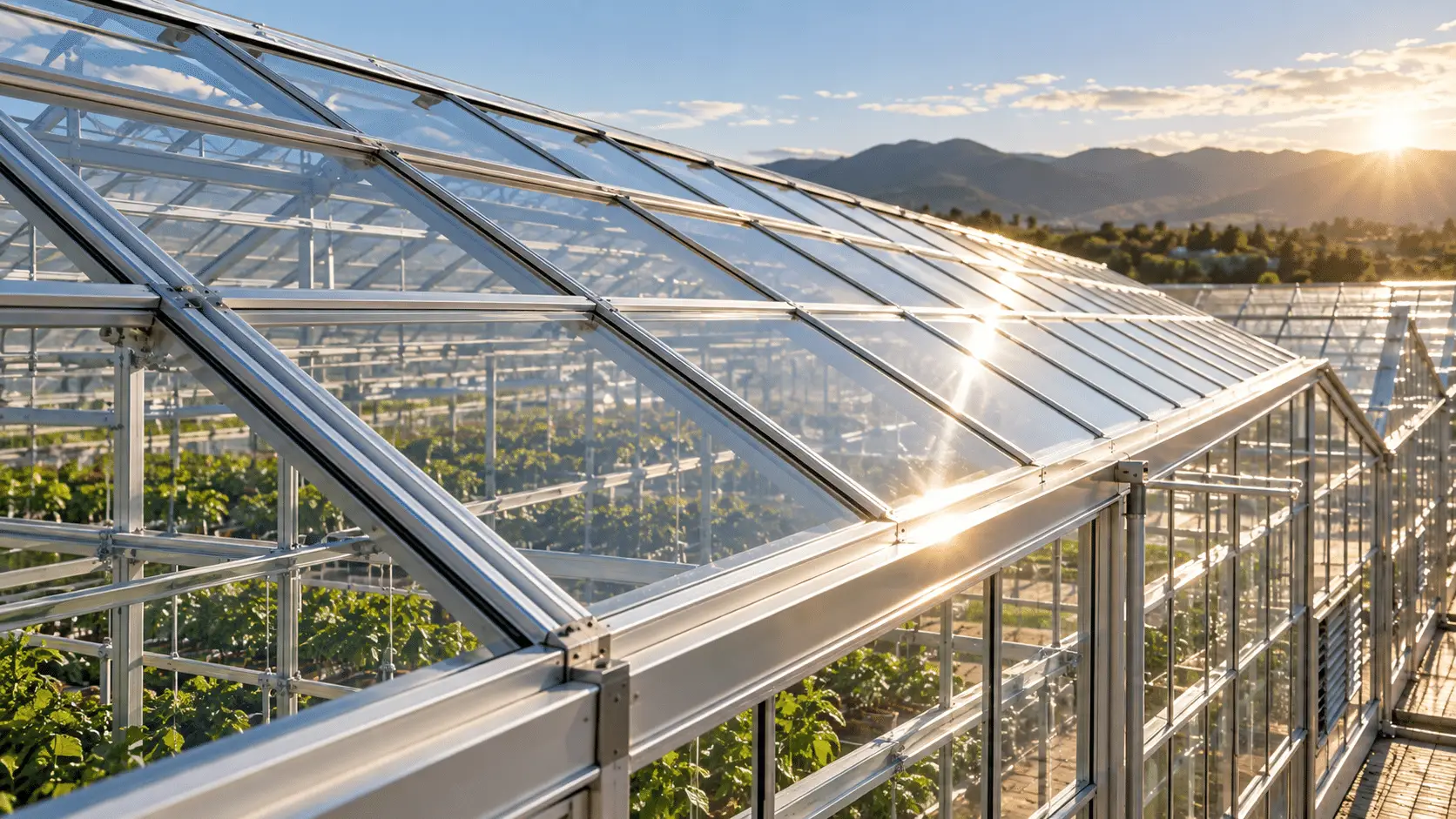
Low-iron glass is float glass with less iron in it, so it is nearly colorless and passes more light than standard glass. Pilkington describes its Optiwhite product as “practically colourless, low-iron float glass” and lists 92% light transmittance and 84% hemispherical transmission. The same maker lists an anti-reflective version, HortiGrow 98, at 98% light transmission and 89% hemispherical, with the coating on both sides of low-iron glass.
These are manufacturer figures for named products, not a general rule for all low-iron glass. Use them as a benchmark for what to ask suppliers, not as a promise for any quote. Both products can be toughened, so low-iron and tempered are not alternatives. You can order both properties together.
Low-iron glass is worth a price inquiry in these cases:
- Low-light regions: Winter light limits growth, so each extra point of transmission matters.
- High-value crops: Growers of crops with a high return per square meter can justify a higher glass price.
- Lit crops: Where you pay for supplemental lighting, better natural transmission reduces how long lamps run.
Ask for a priced option next to standard glass, so the decision rests on your numbers.
Is diffused glass worth specifying?
Diffused glass is worth specifying for tall, dense crops, because published trials show a yield gain for tomato and cucumber. Diffused glass scatters sunlight, which spreads light more evenly through the canopy. Two Wageningen sources put numbers on it:
- Review of earlier trials (2025): van Steekelenburg and colleagues compared diffuse and clear covers across 11 crops. On average, yield rose 1.8% for every 10% increase in hortiscatter, and 2.1% for tomato and 2.2% for cucumber. They corrected for the lower light transmission that often comes with more scatter. Read the Acta Horticulturae abstract.
- Commercial greenhouses (2021): Wageningen Plant Research compared five growers who each ran a diffuse and a clear greenhouse. Radiation use efficiency was 8% higher under diffuse glass on average, with no clear difference in energy use. See report WPR-1085.
Hortiscatter is a unit for how strongly a cover scatters light. Ask suppliers for it, or for the haze value, alongside transmission. A very diffused product can transmit less total light, so look at both numbers together.
Gains are crop-dependent. The review pooled 11 crops and reports tomato and cucumber separately, and the commercial study covers cucumber, tomato and cherry tomato growers, so do not assume the same gain for every crop.
How thick should greenhouse glass be?
Most greenhouse glass is 3 mm to 4 mm, and the right choice depends on hail, pane size and the frame. NGMA calls 3 mm the most common thickness. A finite-element hail simulation by Ding and colleagues in a Chinese agricultural engineering journal found that 4 mm glass could nearly meet the hail-resistance requirements of most glass greenhouses.
| Thickness | What the sources say | How to use it |
|---|---|---|
| 3 mm | NGMA: most common; 88% light transmission single, 77% double | Baseline for small panes and low-hail sites |
| 4 mm | Simulation (Ding et al., 2012): nearly meets hail-resistance requirements of most glass greenhouses | Reasonable roof starting point; check against local hail data |
| 5 mm and above | Pilkington lists float glass from 2 mm to 19 mm | Use where hail, span or code calculations require it |
The same hail study offers three more points:
- Hail flocks: A flock of hailstones does not act like one stone, so a single-stone test is not enough.
- Pane shape: The authors suggest a length-to-width ratio of about 1.5 for glass plates.
- Constraints: Changing how the pane is held was an unreliable way to improve hail resistance. The design goal is a pane that stays globally stable without large cracks or debris.
It is a simulation, so use it to frame questions for your supplier, not as a design rule. Thicker glass adds dead load to bars, gutters and foundations. Confirm loads against the standards in our structural load guide.
Should you use single or double glazing?
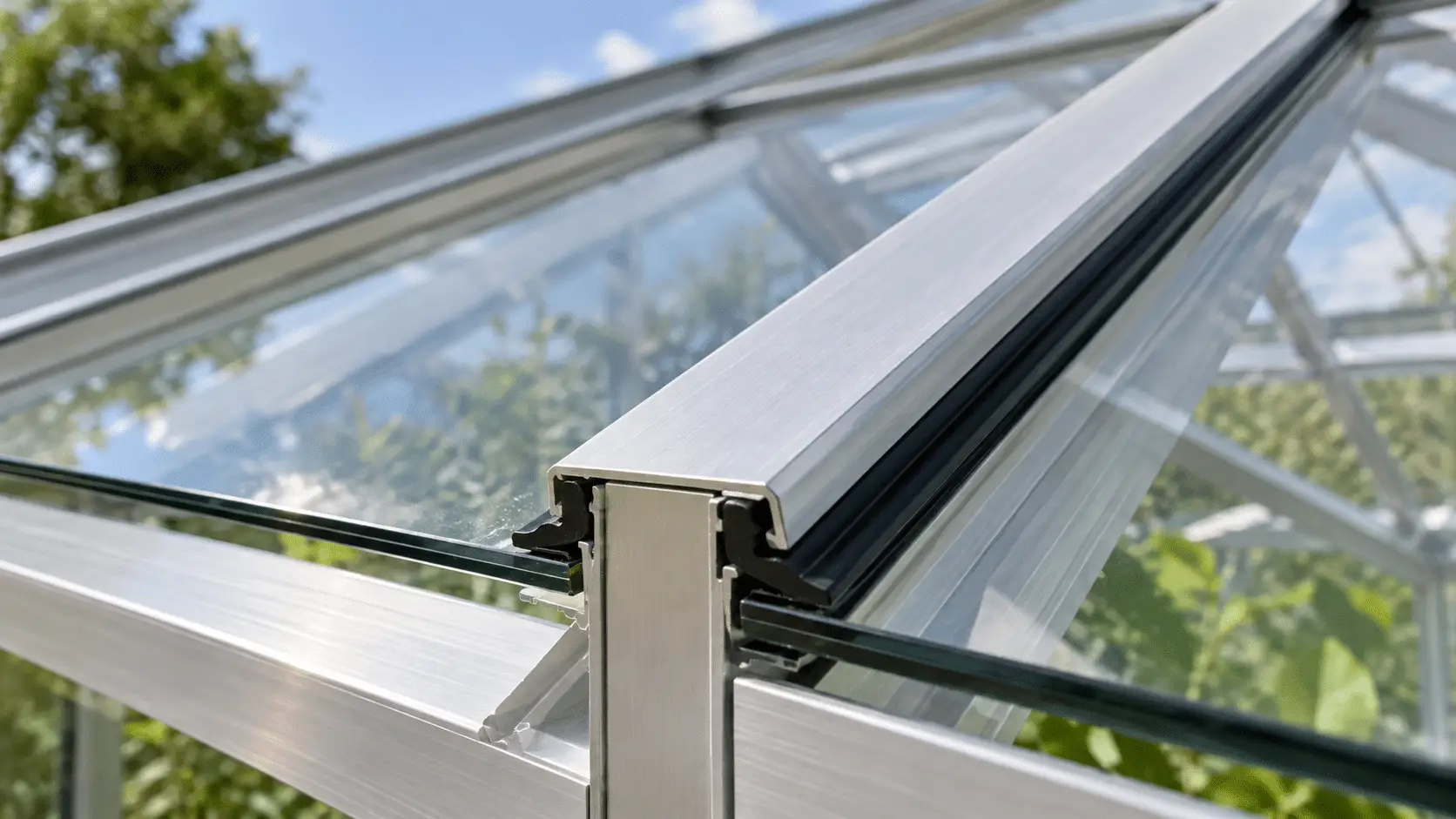
Use single glazing where light matters most and double glazing where heat loss matters most. NGMA lists 3 mm glass at 88% light transmission as a single pane and 77% as a double pane, so the second pane costs about 11 points of light.
- Roofs: Consider single glass here, since the light loss applies to the whole crop.
- Side walls and gable ends: These are the usual places to consider double glazing in cold regions, because light loss matters less there than heat loss.
- Sealing: NGMA notes that gasketed glazing systems are tighter and more energy efficient than non-gasketed systems, and that air infiltration is not included in the U-value. Judge the whole system, not the pane.
Ask for the U-value as well as transmission. NGMA explains that a lower U-value means more resistance to heat transfer, and the figure feeds heating load calculations. Our heating and cooling calculation guide shows how.
How does glass compare with polycarbonate and film?
Glass transmits more light than multi-wall polycarbonate, while polycarbonate is the option NGMA points to for hail. The trade-offs, using only what the sources above support:
- Light: Single glass at 88% (NGMA, 3 mm) transmits more than multi-wall polycarbonate, which NGMA puts at about 80%.
- Hail: NGMA points to impact-modified acrylic and polycarbonate for hail-prone areas.
- Insulation: Multi-wall panels are among the most energy efficient glazing options in NGMA’s description, while a single glass pane has no air gap.
- Cost and structure: Glass is heavier, needs a stronger frame and more careful installation. Price differences depend on your project, so compare quotes in writing.
For a full comparison of the covering options, read our guide to glass, solar and multi-span film greenhouses.
How long does a glass covering last?
No single lifespan figure for greenhouse glass is reliable enough to quote, so ask suppliers for warranty terms in writing. Competing sources give widely different numbers, and most come from sellers. What decides real service life is easier to list:
- Breakage: Hail and impact damage replace panes long before the glass itself ages.
- Seals and gaskets: The glazing system loses airtightness as seals age, which raises heat loss.
- Coatings: Anti-reflective and diffusing treatments can change over time. Ask for the maker’s durability data and warranty basis.
- Frame: The bars, gutters and fixings that hold the glass must last as long as the glass does.
What to specify before requesting a quote
A glass greenhouse quote should state the glass specification line by line, so you can compare suppliers on equal terms. Send or confirm these items:
- Zones: Which glass goes on the roof, side walls, gables and north wall.
- Thickness and temper: Thickness in mm, annealed or tempered, and the standard or test report behind it.
- Iron content and coating: Standard or low-iron, with or without anti-reflective coating, with a transmission figure and its measurement basis.
- Diffusion: Haze or hortiscatter value, and normal or hemispherical transmission.
- Pane size: Length, width and bar spacing, since these affect strength and hail performance.
- Glazing system: Bar material, gaskets, ventilator seals and U-value of the assembled roof.
- Loads: Local wind, snow and hail data, plus the design standard your authority requires.
- Installation and warranty: Who installs, how breakage is handled, and what the warranty covers. NGMA also notes that permits may be required depending on local zoning and codes.
Our greenhouse frame page shows how glazing connects to the structure.
How does FANGCHENG supply this?
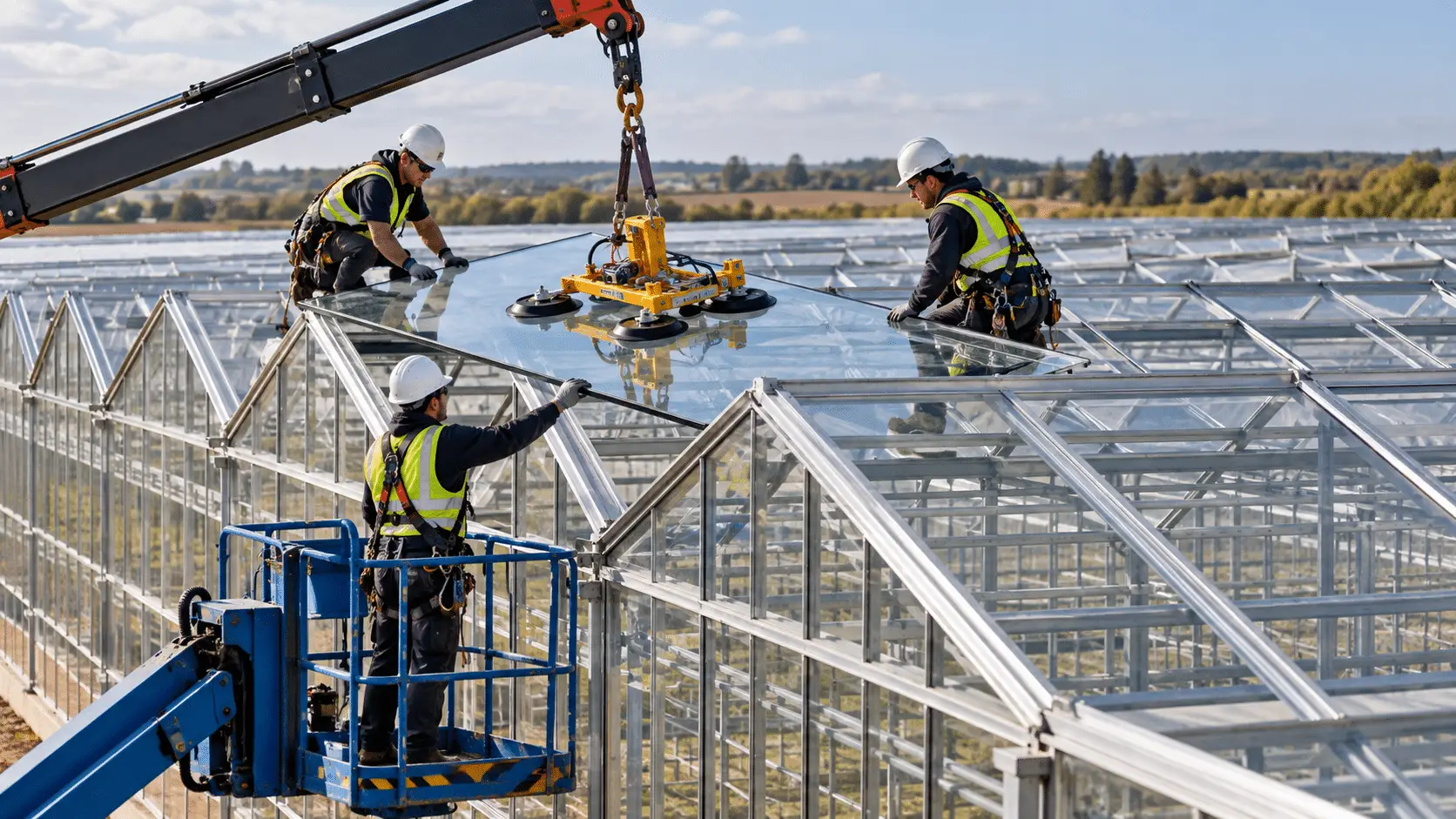
FANGCHENG plans, designs, manufactures and installs greenhouses, and has done so since 2002. Its glass greenhouse range uses tempered or diffused glass. These points apply to a glass project:
- Custom design: Structures are designed for your local wind, snow, humidity and crop.
- In-house parts: FANGCHENG states that all key components are produced in-house.
- Installation: On-site installation or remote guidance is available.
- Supply terms: OEM and ODM supply is available, and samples and quotes can be requested. Lead times, pricing and glass specifications are confirmed per project.
Planning a glass greenhouse project? Send your crop, site conditions and local wind, snow and hail data, and FANGCHENG will propose a structure and glazing to match.
Request a quote
FAQ
What type of glass is used for a commercial glass greenhouse?
Commercial glass greenhouses mostly use tempered glass, with low-iron or diffused glass added for light. NGMA says glass is typically annealed or tempered and that tempering increases impact strength, so tempered glass is the usual roof choice.
How thick should glass greenhouse glass be?
Glass greenhouse glass is commonly 3 mm to 4 mm thick. NGMA calls 3 mm the most common thickness, and a hail simulation found 4 mm nearly meets most hail requirements. Confirm against your local hail data and pane size.
Is low-iron glass worth the extra cost for a glass greenhouse?
Low-iron glass is worth pricing where winter light limits growth or crop value is high. Manufacturer data lists 92% light transmittance for one low-iron product and 98% with an anti-reflective coating, so ask for both quotes and compare.
Does diffused glass increase greenhouse yield?
Diffused glass has increased yield in published studies, mainly for tomato and cucumber. A 2025 review found about 1.8% more yield for every 10% more hortiscatter, and a 2021 Wageningen study found 8% higher radiation use efficiency on average.
Is double glazing better than single glass for a greenhouse?
Double glazing saves heat but costs light, so it suits cold-climate side walls more than roofs. NGMA lists 3 mm glass at 88% transmission single and 77% double.
Bottom line
For a commercial glass greenhouse, specify tempered glass on the roof, check thickness against local hail and pane size, and price low-iron and diffused options against your crop and light. Ask every supplier for transmission, haze, U-value and test reports in writing before you compare quotes.
Editorial note: Glass type, thickness, transmission and glazing-system statements come from the National Greenhouse Manufacturers Association glazing guidance. Low-iron figures are manufacturer data from the Pilkington Optiwhite and HortiGrow 98 pages. The hail finding is from Ding et al., Transactions of the Chinese Society of Agricultural Engineering, 2012. All pages were opened in October 2026. Figures vary between products and test methods, so confirm them against current data sheets.
 Blog
 Blog
 Blog
