 跳至内容

Short answer: For a multi-year commercial greenhouse, specify UV-stabilized greenhouse-grade polyethylene film at 6 mil (about 152 µm). Use 3–4 mil co-poly only for single-season tunnels. Service life runs from one season to 4 years or more, depending on thickness, UV stabilization, climate and how the film is fixed. Add anti-condensate, infrared or diffusing features, or a second inflated layer, when your crop and heating bill justify them.
Key takeaways
- Greenhouse plastic film is a thermoplastic cover, usually polyethylene (PE) or a PE and EVA copolymer. “PO” means polyolefin, the family both belong to.
- Co-poly film (3, 4 or 6 mil) lasts about one season. Greenhouse-grade 6 mil film is typically warranted for 4 years or more.
- Thicker is not automatically longer-lived. UV stabilization and fixing details matter as much as gauge.
- A double inflated layer cuts night heat loss by about 40%, but it also lowers light transmission.
- Ask for the resin, layer structure, additives, warranty terms and test basis in writing before you compare quotes.
What is greenhouse plastic film, and what do PE, EVA and PO mean?
Greenhouse plastic film is a thin thermoplastic sheet, usually polyethylene (PE), stretched over a greenhouse frame as the cover. Many films are built in layers, with additives placed in specific layers.
The three abbreviations you will see in quotations mean this:
- PE: polyethylene, most often low-density (LDPE). It is the standard, low-cost cover film.
- EVA: ethylene-vinyl acetate, a copolymer blended into the film. It is often used to improve heat retention.
- PO: polyolefin, the polymer family that includes both PE and EVA copolymers. A 2023 peer-reviewed study groups LDPE and EVA together as polyolefin films.
The label alone does not tell you the layer structure or the vinyl-acetate content. The European standard EN 13206:2025 sorts polyethylene and ethylene-copolymer covering films into three types: non-thermal, thermal clear and thermal diffusing. It covers thicknesses from 20 µm to more than 250 µm and defines a durability classification. See the EVS-EN 13206:2025 record for the scope.
Which greenhouse film types can you buy?
You can choose between short-life co-poly, multi-year greenhouse-grade PE, copolymer “thermal” films, and ETFE as a separate, longer-life product class. The table sets out what the cited sources say about each.
| Film type | Thickness | Service-life statement | Where it fits |
|---|---|---|---|
| Co-polymer (co-poly) PE | 3, 4 or 6 mil (about 76, 102 or 152 µm) | About one season | Seasonal houses, overwintering structures, high tunnels |
| Greenhouse-grade UV-stabilized PE | 6 mil (about 152 µm) | Typically warranted for 4 years or more | Multi-year commercial houses; costs about double co-poly |
| Polyolefin films (LDPE, EVA copolymers) | Set by the supplier within EN 13206’s 20 µm to over 250 µm scope | A few months up to 3 to 4 years, depending on thickness and stabilization | Thermal and diffusing grades; ask for layer structure and additives |
| ETFE film | 0.1 mm in the cited test | “Significantly longer” than polyolefin films because it is inherently UV-stable | Separate product class; see our ETFE greenhouse page |
The co-poly and greenhouse-grade rows come from University of Connecticut Extension guidance (Bartok, “Plastic Film Update,” updated 2013). The polyolefin and ETFE rows come from a 2023 ageing study in Polymers 15(17):3638. Treat all of them as ranges, not guarantees.
How thick should greenhouse plastic be?
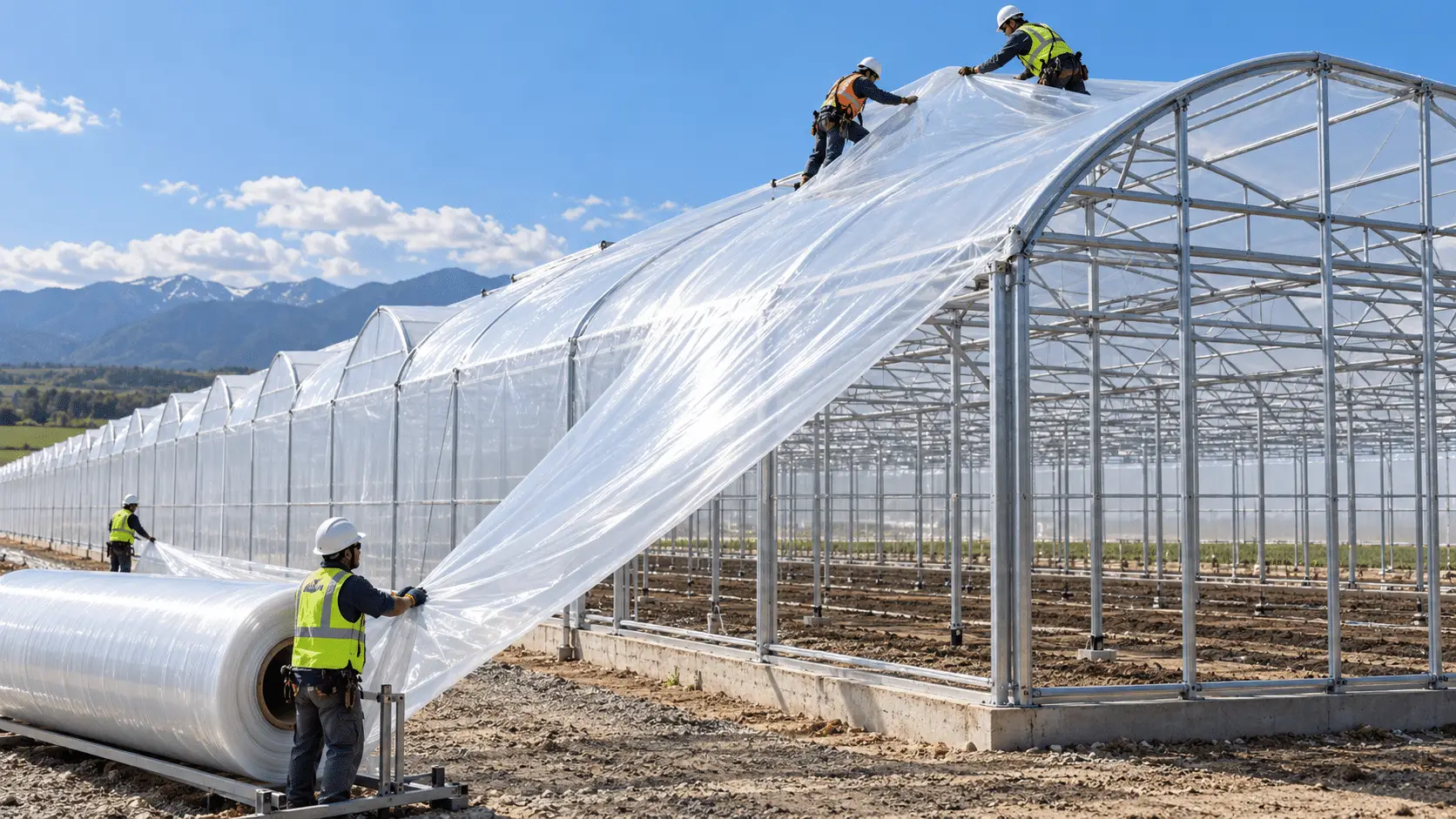
Use 6 mil (about 152 µm) greenhouse-grade film for multi-year service, and 3 or 4 mil only for one-season use. Greenhouse-grade film is sold only in 6 mil, according to UConn Extension.
| Thickness | Micron equivalent | Typical use |
|---|---|---|
| 3 mil | about 76 µm | One-season use on narrow tunnels and overwintering houses |
| 4 mil | about 102 µm | One-season use, same applications as 3 mil |
| 6 mil | about 152 µm | Multi-year greenhouse-grade film |
One mil is one thousandth of an inch, or 25.4 µm. Quotations from outside the US usually give microns, so convert before you compare.
Gauge is only one input. The 2023 ageing study notes that film life depends on thickness and on the degree of stabilization. A thick film with a weak UV package can fail earlier than a thinner, well-stabilized one. Three other points affect the choice:
- Wind exposure: UConn suggests woven poly or nylon-reinforced film for windy sites.
- Single-season goals: if you replace the film every year, a thicker multi-year grade adds cost you will not recover.
- Units: EN 13206:2025 defines its scope as 20 µm to more than 250 µm, so state your gauge in microns on the quote request.
How long does greenhouse plastic film last?
Greenhouse plastic film lasts from about one season (co-poly) to 4 years or more (greenhouse-grade), and polyolefin films overall are reported at a few months up to 3 to 4 years. Climate and installation move you within that range.
The main things that shorten life are:
- Sunlight and heat: both break down the polymer over time. A UV stabilizer slows this.
- Attachment stress: film flexing at the fixing points tears first. An inflated double layer reduces stress at attachments and rippling in wind.
- Abrasion: film rubbing on frame members, wires or loose fixings wears through.
- Chemical exposure: sprays and fumigants can attack the film. Ask the supplier which chemicals the stabilizer package tolerates.
Lab ageing shows the same direction. The 2023 study aged PE and ETFE films for 1,000 hours in a xenon-arc chamber, which the authors say roughly corresponds to 3 years outdoors. Visible-light transmittance fell in every film tested, though the authors judged the degradation acceptable for greenhouse coverings.
Treat published life figures as averages. The University of Arkansas covering-materials table lists single and double polyethylene at 1 to 4 years and states that its values are averages developed from various company sources (Evans, Univ. of Arkansas, Section 3).
How much light and heat does each film option give?
A single UV-stabilized film transmits the most light, and every heat-saving feature you add costs some of it. The figures below are from UConn Extension unless stated.
| Option | What it does | Reported figure | Trade-off |
|---|---|---|---|
| Single UV-stabilized film | Baseline cover | PAR transmission 88–91% | Little heat retention at night |
| Anti-condensate (AC) additive | Wetting agent makes water run off instead of forming droplets | Effect usually lasts a couple of years | The effect fades; confirm whether it is sprayed on or built into the film |
| Infrared (IR) plus AC film | Traps radiant heat inside | PAR 82–87%; 10–20% heating savings measured in heated greenhouses | Lower light than plain film |
| IR plus AC with diffusion | Scatters light | PAR 77–88% | Lower light than plain film; the range depends on the diffusion level |
| UV-blocking film | Helps limit some pests and diseases | No figure given | Can interfere with bee pollination |
Diffusing film increases the share of scattered light that reaches the plants. This reduces leaf scorching and helps light reach lower leaves in tall crops. UConn also notes research linking diffused light to less fungal spore development and insect reproduction.
Sources report different numbers for the same film class. The Arkansas table lists single polyethylene at 85% transmission, below UConn’s 88–91%, and its values are averages from company sources. Use these figures to compare options, not to size your light budget. Ask for a measured PAR transmission from the supplier’s datasheet.
If heating is your main cost, see our greenhouse heating system page before you decide how much to spend on thermal film.
Is a double-layer film worth it?
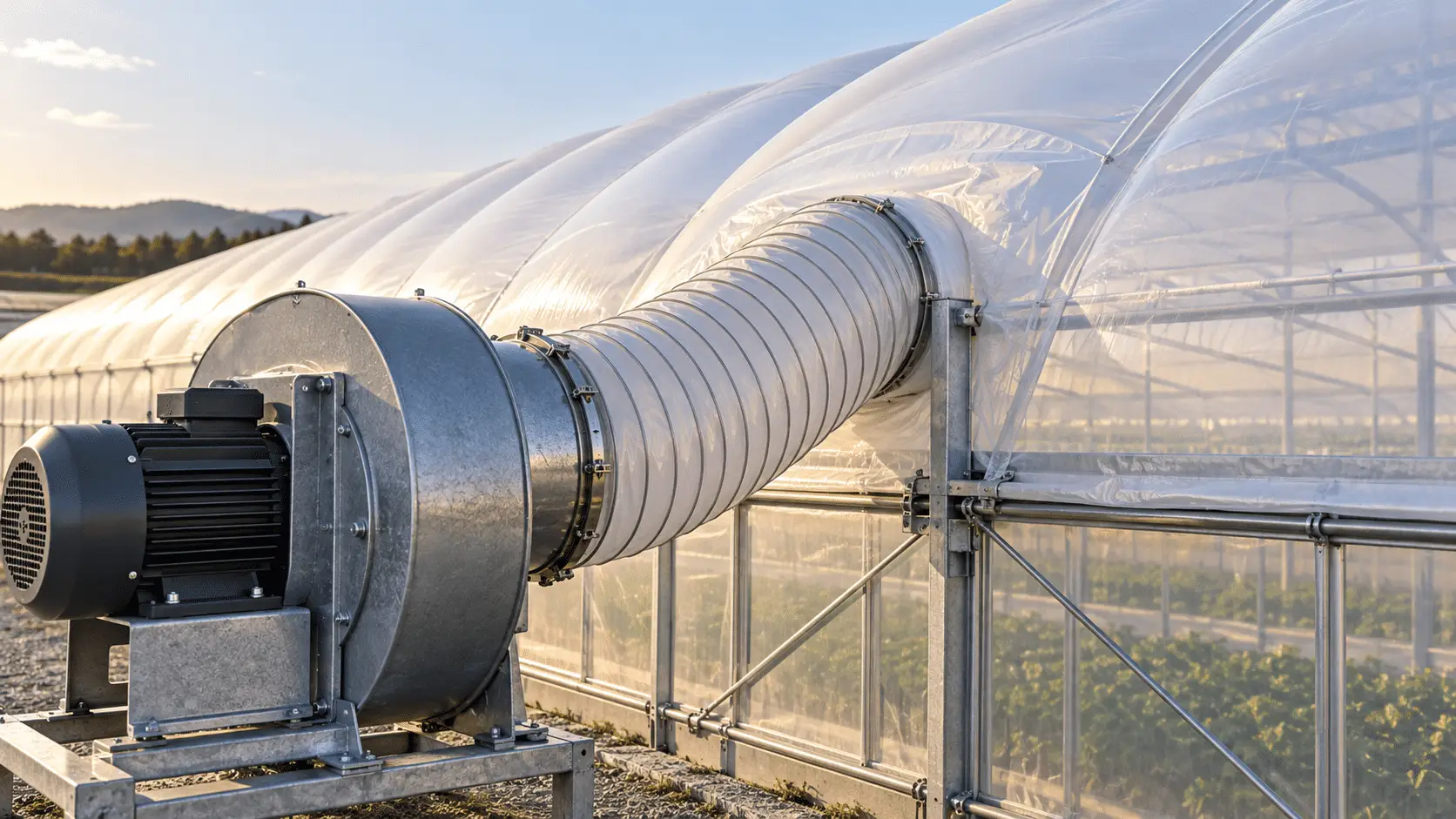
A double inflated layer is worth it when you heat the greenhouse through winter, because UConn Extension reports it cuts nighttime heat loss by about 40%. It also lowers light transmission, so it suits cold-climate or heated production more than mild-climate crops.
- Heat saving: about 40% less night heat loss than a single layer, per UConn.
- Wind behavior: inflation reduces rippling and stress at the attachments.
- Light cost: the Arkansas table lists double polyethylene at 77% transmission against 85% for single.
- Inflation pressure: UConn gives ¼ inch of water static pressure as the best setting, slightly higher in windy or snowy weather.
- Condensation: connecting the blower to outside air reduces moisture between the layers.
Put IR film on the inside layer in a double-layer system, as UConn advises. Specify the blower, the air inlet and a spare unit with the film, not as an afterthought.
How do you choose film for your climate and crop?
Match the film to your winter heating load, summer light level, wind exposure and replacement plan. These rules of thumb follow from the sources above:
- Cold winters, heated house: double inflated layer, IR-type film on the inner layer, and a heating plan sized with it.
- Hot, high-light sites: a diffusing film plus external shading, because scattered light reduces leaf scorching.
- High wind: reinforced film or a double layer, with fixings checked at install.
- High humidity or drip-sensitive crops: AC film, with ventilation sized to move moist air out. See our multi-span film greenhouse page for the structure this film sits on.
- Short project or trial crop: 3–4 mil co-poly, accepting a one-season life.
- Long-term commercial production: greenhouse-grade 6 mil film, with a replacement budget set from the warranty term.
If you are still choosing between plastic and rigid covers, our polycarbonate panel thickness guide and the best-material overview cover those options. The Arkansas table lists 8 mm and 10 mm twin-wall polycarbonate at 80% transmission and a 20+ year life, which is the cost-per-year comparison to run.
How do you maintain and replace greenhouse plastic?
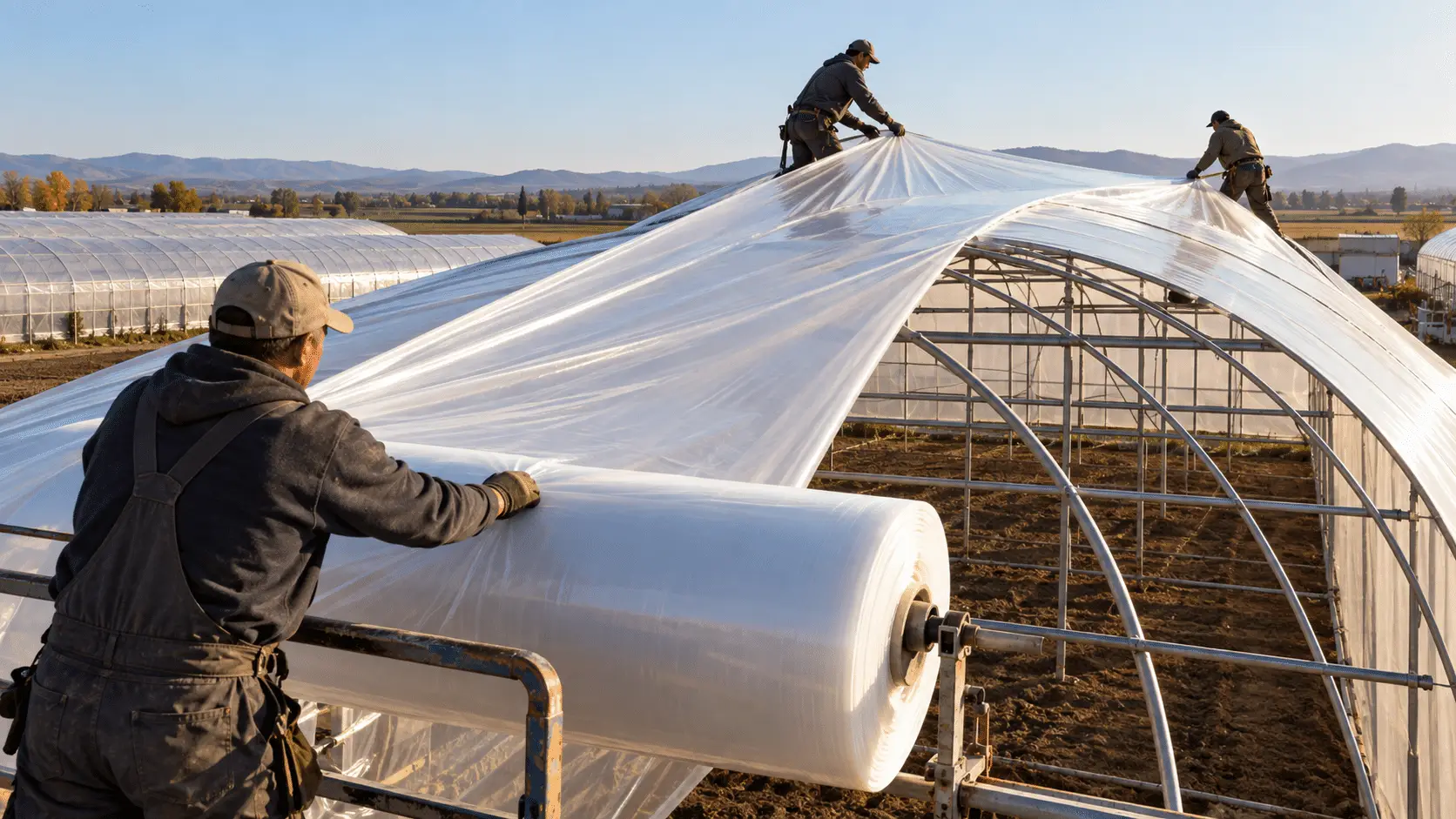
Inspect the film at least before each season, and replace it between crop cycles before tears or brittleness reach the crop. Dust and aging both reduce light transmission, according to UConn.
- Inspect fixings: look at channels, wire and clips for sharp edges and loose points where the film rubs.
- Repair small tears early: a small tear grows in wind.
- Clean when needed: remove dust that cuts light, using methods the film supplier approves.
- Track age: record the install date and the warranty end date for each bay.
- Plan the change-out: schedule replacement for a calm, dry window between crops, with crews and film ready.
What to specify before requesting a quote
Write the film into the specification as a list of measurable items, so quotes from different suppliers can be compared line by line. Use this checklist:
| Item | What to ask for |
|---|---|
| Resin and layer structure | PE, EVA or other copolymer; number of layers; whether the film is non-thermal, thermal clear or thermal diffusing |
| Thickness | Microns (and mil if you work in US units), with tolerance |
| Additives | UV stabilizer, anti-condensate, IR barrier, diffusion, any UV-blocking |
| Optical data | Measured PAR transmission and haze from a datasheet, not a brochure range |
| Width and roll length | Matched to your bay width and roof pitch, to limit seams and waste |
| Warranty | Length, what it covers, whether it is pro-rated, and the conditions that void it |
| Test basis | Whether the supplier classifies the film against EN 13206:2025 or states another named test |
| Fixing and wind | Channel and wire type, reinforcement needed, local wind and snow loads from the project site |
| Double-layer system | Blower size, air inlet, pressure control, and a spare unit |
| Installation and disposal | Install conditions, who installs, and how old film is removed and recycled |
Also give the supplier your sprays and fumigants, your crop and your site’s wind and snow loads. For the frame side of the order, see our structural load standards comparison.
How does FANGCHENG supply this?
FANGCHENG has planned, engineered, manufactured and installed greenhouses since 2002, and its film greenhouses can be built as multi-span structures with single-layer or double-layer PO/PE film. Key components are produced in-house, and each design is adapted to local wind, snow, humidity and crop.
- Film structures: see the film greenhouse range for single-span and multi-span options.
- Project specification: film type, thickness and additive package are set per project, together with lead time and price.
- Installation: on-site installation or remote guidance is available.
- Custom supply: OEM and ODM work is available, and you can request a sample and quote.
Planning a film greenhouse project? Send your crop, site conditions and local wind and snow loads, and FANGCHENG will propose a structure and covering to match.
Request a quote
FAQ
How thick should greenhouse plastic be?
Greenhouse plastic should be 6 mil (about 152 µm) for multi-year use and 3 to 4 mil for a single season. UConn Extension notes greenhouse-grade film is sold only at 6 mil.
How long does greenhouse plastic film last?
Greenhouse plastic film lasts about one season for co-poly and 4 years or more for warranted greenhouse-grade film. Polyolefin films overall are reported at a few months up to 3 to 4 years.
What is the difference between PE, EVA and PO greenhouse film?
PE is the base polyethylene film, EVA is a copolymer blended in to help heat retention, and PO stands for polyolefin, the family that includes both. Ask for the layer structure and additive list, because the label alone does not show them.
Is double-layer greenhouse plastic worth it?
Double-layer greenhouse plastic is worth it for heated winter production, because it cuts night heat loss by about 40% according to UConn Extension. It lowers light transmission, so it is less useful in mild climates.
When should I replace greenhouse plastic?
Replace greenhouse plastic when it tears, turns brittle or loses enough light to affect the crop, and schedule the change between crop cycles. Record the install date and warranty end date so you can plan ahead.
Bottom line
Choose greenhouse plastic by service life, not by price per roll. For long-term commercial production, specify UV-stabilized 6 mil film, add thermal or diffusing features only where the climate pays for them, and write the resin, thickness, additives, warranty and test basis into the quote request.
Editorial note: Thickness, cost-ratio, warranty, additive and light-transmission figures come from University of Connecticut Extension (Bartok, “Plastic Film Update,” updated 2013) and the University of Arkansas covering-materials table, which averages company data. Ageing and service-life statements come from Rujnić Havstad et al., Polymers 2023. Standard scope comes from the EVS-EN 13206:2025 record. All pages were opened in October 2026. Values vary by product, climate and installation; confirm them against the supplier’s datasheet.
 Blog
 Blog
 Blog
