 跳至内容
Short answer: Choose 6 mm twin-wall polycarbonate for mild climates and curved or low-load walls, 8 mm for most commercial roofs, and 10 mm where snow, wind or long purlin spans call for extra stiffness and insulation. Published averages put 8 mm and 10 mm twin-wall at about 80% light transmittance, so the real trade-off is insulation, stiffness and weight, not brightness.
Key takeaways
- 8 mm and 10 mm twin-wall panels are listed at the same ~80% light transmittance, so thickness mainly changes insulation, rigidity and weight.
- Thinner sheets bend to a tighter radius, which suits arched roofs; thicker sheets suit flat roofs and longer spans.
- Panel thickness cannot be chosen alone: support spacing and local snow and wind load decide what the frame needs.
- Ask every supplier for the same four numbers: light transmittance, U-value, UV-layer warranty and load table, all for the exact sheet.
What do 6 mm, 8 mm and 10 mm twin-wall panels actually change?
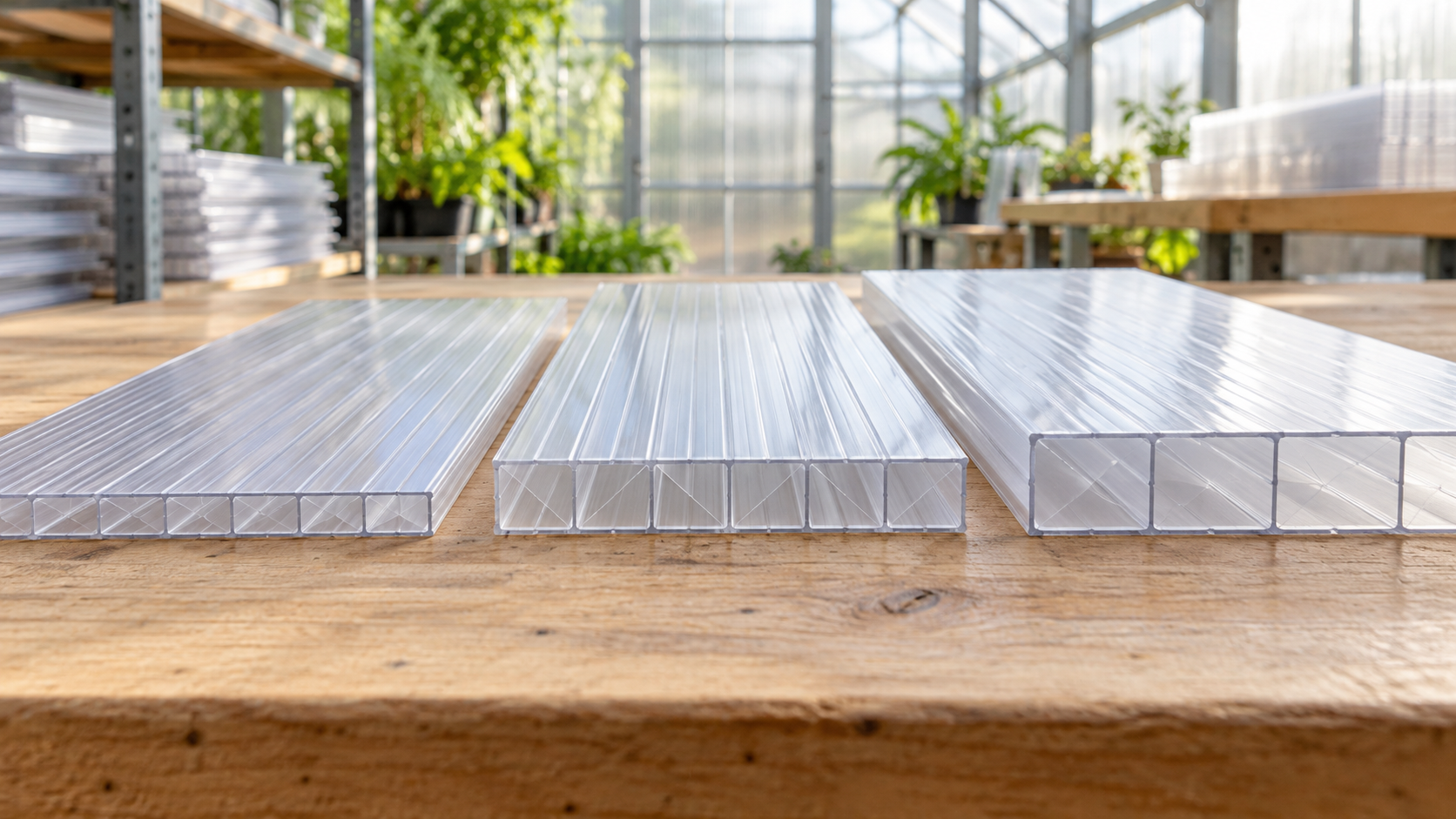
Thickness changes the depth of the air channels between the two skins, and that depth drives insulation, stiffness and weight. Light transmittance barely moves across this range.
- Insulation: deeper air channels slow heat loss. A 1981 comparison of greenhouse glazings notes that thinner double-skinned sheets insulate less than thicker ones.
- Stiffness: thicker sheets deflect less under snow and wind, so they can span farther between purlins.
- Bending: the same paper gives a minimum bending radius of 1.2 m for a 6 mm sheet and 4.6 m for a 16 mm sheet, so thicker panels are harder to curve.
- Light: University of Arkansas data lists polycarbonate bi-wall panels at about 83% and 8 mm and 10 mm twin-wall at 80%.
Which thickness fits which greenhouse?
Match thickness to climate, span and roof shape first, then check cost. The table below summarizes how growers and contractors usually sort the three options.
| Thickness | Best for | Main limit | Confirm before ordering |
|---|---|---|---|
| 6 mm | Mild winters, arched roofs, side walls, end walls | Lowest insulation and stiffness of the three | Maximum purlin spacing for your snow and wind load |
| 8 mm | General commercial roofs in moderate climates | May need closer supports than 10 mm in heavy snow | Load table and UV-layer warranty for the exact sheet |
| 10 mm | Cold or snowy regions, flat roofs, longer spans | Heavier and harder to bend; higher material cost | Frame can carry the added dead load |
| 16 mm and multi-wall | Severe winters where heating cost dominates | Weight, cost and a very wide bending radius | Whether the climate justifies the extra insulation |
Treat the table as a starting point. The right choice for a specific project comes from the supplier’s load table and your local design loads, covered in our guide to greenhouse structural load standards.
How does polycarbonate compare with glass and film on light and life?
Twin-wall polycarbonate gives up some light compared with single glass but lasts far longer than film. The University of Arkansas figures below are published averages from company sources, not guarantees for any one product.
| Glazing | Light transmittance | Typical service life |
|---|---|---|
| Single-layer glass | 88% to 94% | Usually over 25 years |
| Polycarbonate twin-wall (8 mm, 10 mm) | 80% | 20+ years |
| Polycarbonate single-wall | about 94% | Not stated |
| Double-layer polyethylene film | 77% | 1 to 4 years |
The same source notes that most acrylic and polycarbonate panels carry a 10-year warranty and that polycarbonate shows little loss of light transmittance for 10 years. Read the warranty wording: it usually covers the UV-protected surface, not the whole structure.
Is twin-wall polycarbonate strong enough for hail and snow?
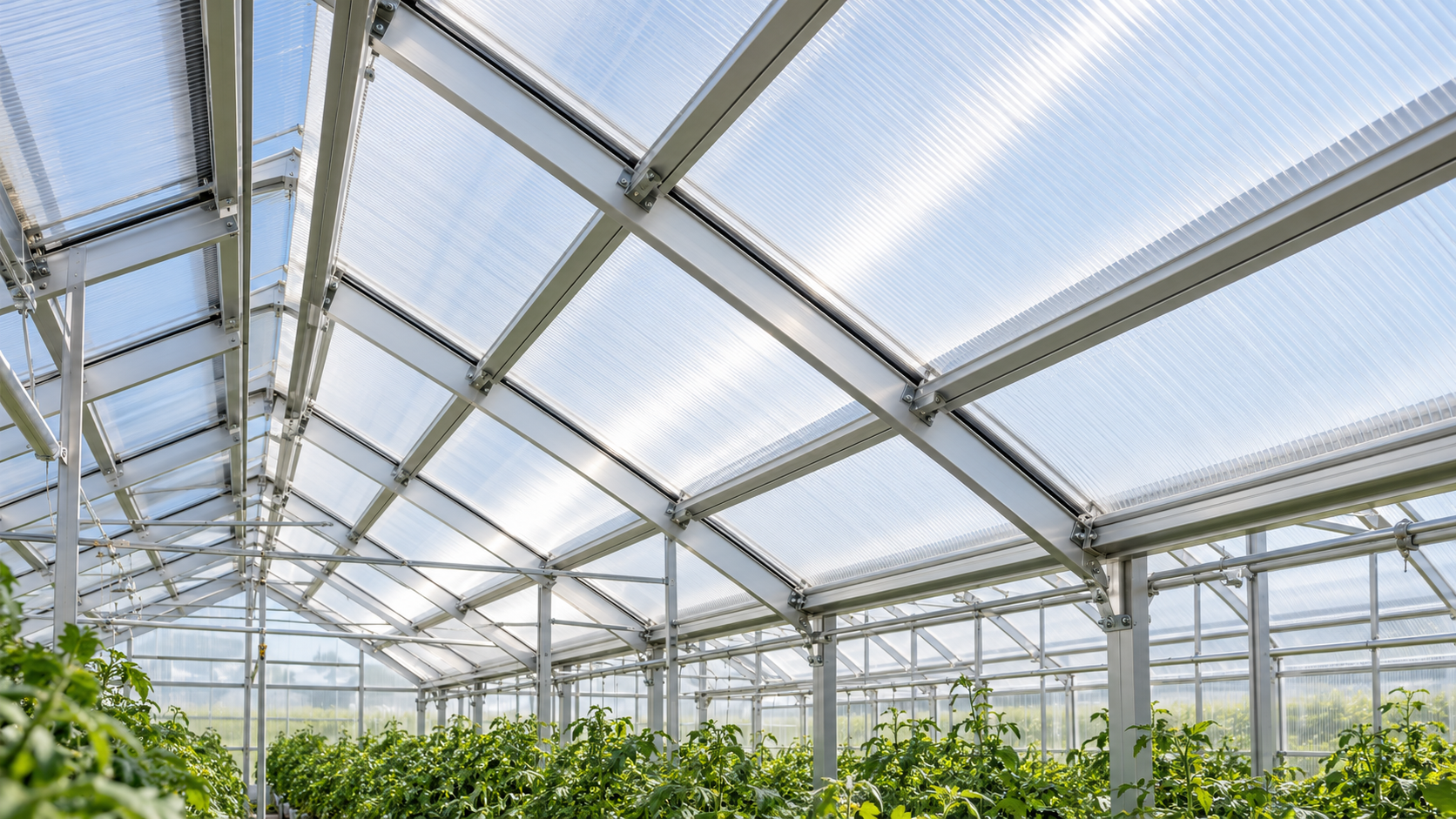
Yes, polycarbonate is highly impact resistant, but panel thickness alone does not set snow capacity. The frame, purlin spacing and fixing system carry most of the load.
- Hail: the 1981 comparison describes polycarbonate double-skinned sheet as highly resistant to impact, while the University of Arkansas notes glass has relatively low impact resistance.
- Snow and wind: thicker sheets deflect less, but the same paper says polycarbonate is less rigid than acrylic and needs more support. Closer purlins often matter more than an extra 2 mm of sheet.
- Thermal movement: polycarbonate expands and contracts more than glass, so profiles and fixings must leave room for movement.
- Surface: the Arkansas guide notes panels scratch easily, so cleaning and handling rules matter on site.
What goes wrong when panel thickness is specified badly?
Most field problems come from the details around the sheet, not the sheet itself. Four failures show up repeatedly on commercial projects.
- Sagging roofs: a thin sheet on wide purlin spacing deflects under snow, holds meltwater and loads the fixings. Fix it with the manufacturer’s span table, not by guessing.
- Thermal movement damage: polycarbonate expands and contracts more than glass, as the University of Arkansas guide notes, so rigid fixings without expansion allowance crack or lift the sheet.
- Condensation and dirt in the channels: moisture inside the flutes clouds the panel and encourages algae. The Arkansas guide notes panels can be treated to reduce condensation, so ask whether the sheet carries an anti-condensation treatment and how the ends are closed.
- Wrong face outward: sheets with a UV-protected layer on one side lose their warranty value when installed upside down. Specify which face is protected and check the protective film marking on delivery.
Weight is the other hidden cost. A heavier sheet adds dead load to the frame and purlins, so a switch from 8 mm to 10 mm can change the steel specification as well as the glazing price. Price the frame and the glazing together before choosing.
What should buyers specify before requesting a quote?
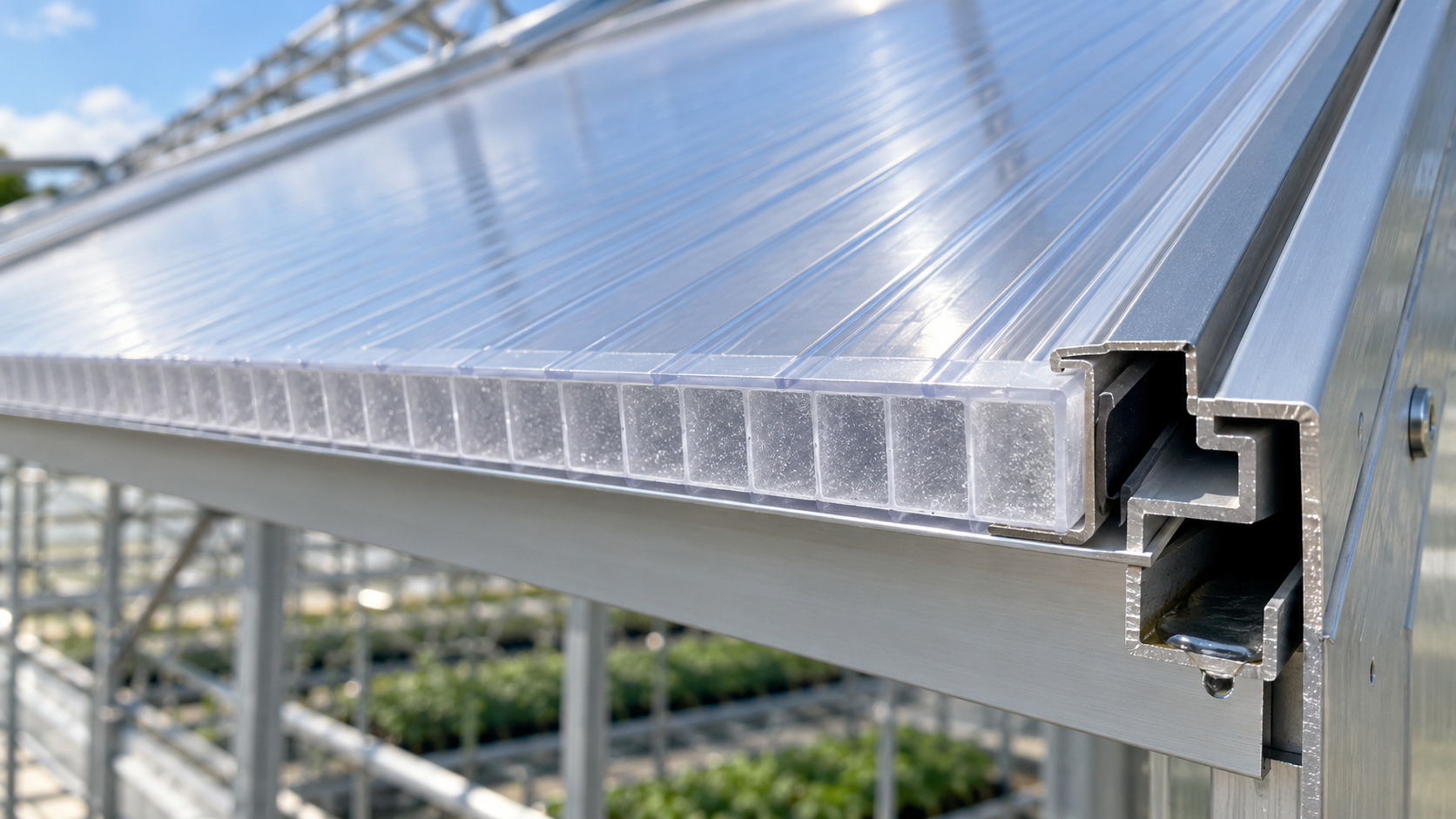
Give each supplier the same written specification so quotes can be compared line by line. A thickness number alone invites quotes that are not comparable.
- Climate and loads: design snow load, wind speed and minimum winter temperature for the site.
- Sheet specification: thickness, number of walls, tint or clear, and the UV-protected side.
- Test data: light transmittance and U-value for the exact sheet, with the test standard named.
- Warranty: term, what it covers (yellowing, loss of light, hail) and how claims are handled.
- Frame and fixings: purlin spacing, glazing bars, sealing and drainage details.
- Climate equipment: ventilation and shading sized for the lower air exchange of a sealed polycarbonate envelope.
For service life, see how long polycarbonate greenhouses really last, and for a wider comparison of covers see choosing the best greenhouse material.
How does FANGCHENG supply polycarbonate greenhouses?
FANGCHENG designs, manufactures and installs polycarbonate greenhouses and tailors panel thickness, frame reinforcement and ventilation to the project. Its polycarbonate page lists 6 mm, 8 mm and 10 mm panel options.
- Design: structures are customized for local wind, snow, humidity and crop requirements.
- Manufacturing: key components are produced in-house.
- Support: on-site installation or remote guidance. Delivery time, price and panel data are confirmed per project.
See the polycarbonate greenhouse range and the PC sheet greenhouse page. For a glass option, compare the glass greenhouse, and see the ventilation system that goes with a sealed envelope.
Planning a polycarbonate greenhouse project? Send your crop, site conditions and local wind and snow loads, and FANGCHENG will propose a panel thickness and structure to match.
Request a quote
FAQ
Is 8 mm or 10 mm polycarbonate better for a greenhouse?
Ten millimeter panels are better for cold, snowy sites and longer spans, while 8 mm panels are enough for most moderate climates. Published averages list both at about 80% light transmittance, so the choice depends on insulation, stiffness and cost.
Is 6 mm polycarbonate thick enough for a commercial greenhouse?
Six millimeter polycarbonate works for mild climates, arched roofs and walls, but it has the lowest stiffness and insulation of the three. Check the supplier’s load table against your snow and wind load before using it on a roof.
How much light does twin-wall polycarbonate let through?
Twin-wall polycarbonate lets through about 80% of light for 8 mm and 10 mm panels, according to University of Arkansas averages. Single glass transmits roughly 88% to 94%, and single-wall polycarbonate about 94%.
How long do polycarbonate greenhouse panels last?
Polycarbonate panels typically last 20 or more years according to University of Arkansas data, though warranties usually run 10 years. Actual life depends on the UV-protected layer, climate and maintenance.
Can polycarbonate panels be curved for an arched roof?
Yes, thinner panels can be curved to arched roofs, and a 1981 comparison gives a minimum bending radius of 1.2 m for 6 mm sheet versus 4.6 m for 16 mm sheet. Always confirm the radius for the exact sheet with the manufacturer.
Bottom line
Use 8 mm twin-wall as the default for moderate climates, step down to 6 mm for curved or low-load areas, and step up to 10 mm for snow, wind and longer spans. Compare quotes on written load data, U-value and warranty terms, not on thickness alone.
Editorial note: Light transmittance, service life and warranty figures are from Glazing Materials (University of Arkansas) and Other Glazing Materials (University of Arkansas), retrieved October 2026; the source states values are examples averaged from company sources. Insulation, impact and bending-radius notes are from J. Siemens, Greenhouse Glazing Materials: A Comparison (1981), an older paper, so confirm current sheet data with the manufacturer.
 Blog
 Blog
 Blog
