跳至内容
跳至内容 
Evaporative cooling is the most cost-effective method for reducing greenhouse temperatures in warm climates. When properly engineered, a fan and pad system can lower air temperature by 10-20°F below outside ambient, creating optimal growing conditions even during peak summer heat.
For an overview of all cooling options, see our greenhouse cooling systems guide.
The Science of Evaporative Cooling
Evaporative cooling harnesses the latent heat of vaporization — when water evaporates, it absorbs heat from the surrounding air. Every gallon of water evaporated removes approximately 8,700 BTU of heat from the air stream. This is the same principle that makes sweating cool the human body.
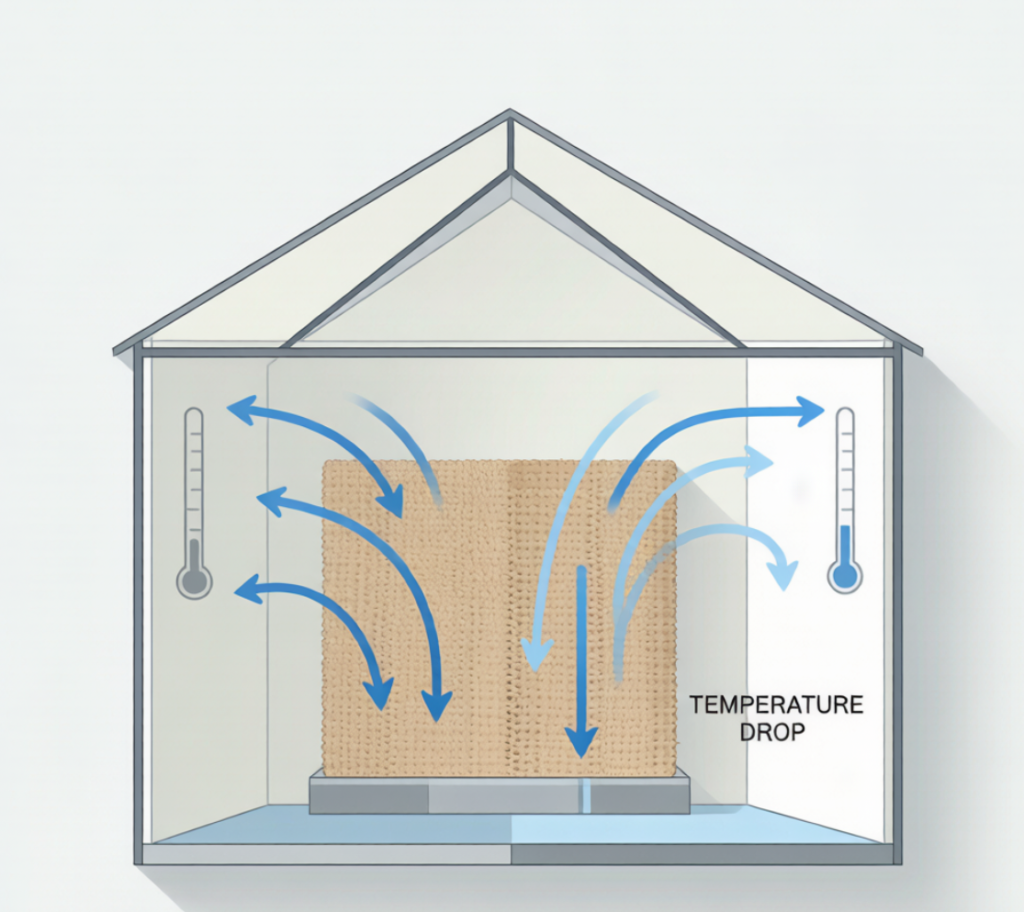
Key physics: The theoretical maximum temperature drop depends on the wet-bulb depression (dry-bulb temperature minus wet-bulb temperature). In practice, well-designed systems achieve 75-90% of this theoretical maximum, known as saturation efficiency. In an arid climate with 100°F air and 60°F wet-bulb, a system at 85% efficiency will deliver air at approximately 66°F.
Engineering standards from ASABE (American Society of Agricultural and Biological Engineers) EP406.4 provide the design framework for evaporative cooling systems in agricultural facilities.
System Components Overview
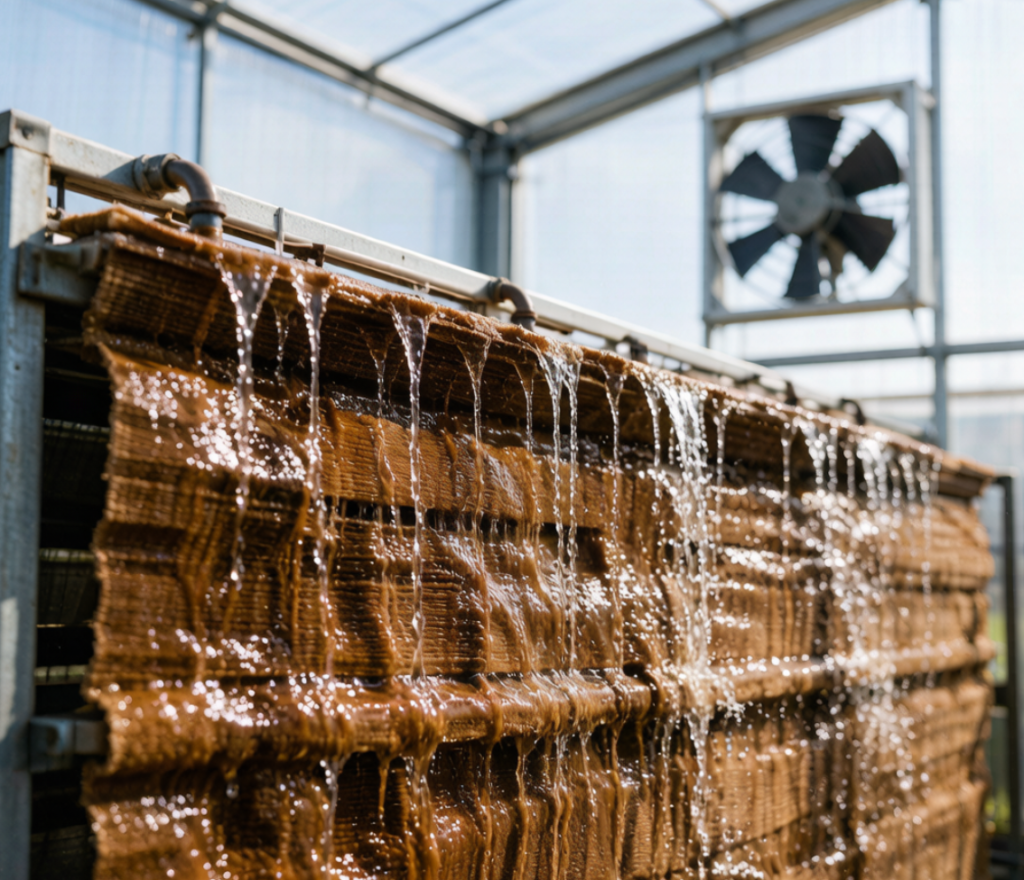
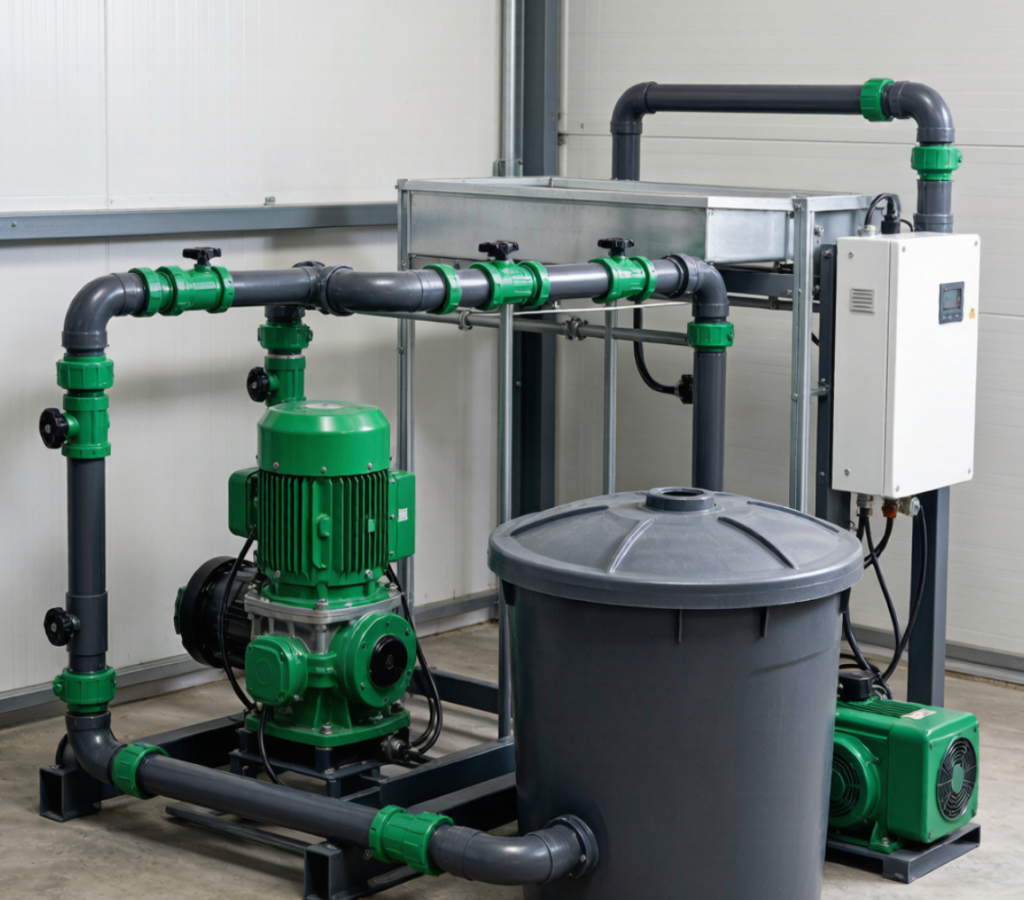
A complete evaporative cooling system consists of: cooling pads mounted on one wall, exhaust fans on the opposite wall, water recirculation system (sump tank, pump, distribution pipes), water treatment and bleed-off system, and controls (thermostat, timer, or climate controller).
The DOE energy efficiency guidelines for evaporative coolers provide additional performance benchmarks for different system configurations.
Sizing Calculations
Proper sizing is the single most important factor in system performance. Undersized systems cannot maintain target temperatures. Oversized systems waste energy and water.
| Parameter | Formula / Standard | Example (10,000 sq ft GH) |
|---|---|---|
| Total fan capacity | 8-10 CFM per sq ft of floor area | 80,000-100,000 CFM |
| Pad area | 1 sq ft pad per 20-25 CFM | 3,200-5,000 sq ft of pad |
| Pad thickness | 4″ (arid) or 6″ (humid) | 6″ for humid climates |
| Air velocity through pad | 200-400 ft/min | 300 ft/min target |
| Water flow rate | 0.5-1.0 GPM per linear ft of pad | 60-120 GPM total |
| Pump head | Minimum 15-25 ft | 20 ft design head |
Cooling Pad Types
| Pad Type | Saturation Efficiency | Lifespan | Cost per sq ft | Best Climate |
|---|---|---|---|---|
| Cross-fluted cellulose (45/15) | 80-90% | 3-5 years | $3-6 | All climates |
| Cross-fluted cellulose (45/45) | 75-85% | 3-5 years | $3-6 | Arid climates |
| Aspen / wood fiber | 55-70% | 1-2 years | $1-3 | Low-budget, temporary |
| Metal mesh | 50-65% | 5-10 years | $5-10 | Industrial facilities |
| Plastic media | 60-75% | 5-8 years | $4-8 | Corrosive environments |
Recommended: Cross-fluted cellulose pads with a 45/15 degree flute angle offer the best balance of cooling efficiency, pressure drop, and longevity for greenhouse applications. The 45/15 configuration provides superior water distribution across the pad surface, reducing dry spots that allow hot air to bypass cooling.
Exhaust Fan Specifications
High-volume, low-speed (HVLS) exhaust fans are preferred for greenhouse cooling. Key specifications: shutters (automatic or motorized for insect exclusion when fans are off), cones (properly designed discharge cones improve efficiency 10-20%), belt drive vs direct drive (belt drive allows speed adjustment), and CFM rating at 0.05-0.10 inches of static pressure.
Water Quality & Treatment
Water quality directly affects pad lifespan and system efficiency. Hard water causes mineral scaling on pads, reducing airflow and efficiency. Key parameters: total dissolved solids (TDS) below 1,000 ppm, water hardness below 200 ppm as CaCO3, and pH between 6.5-8.0. Installation of a water softener or bleed-off system is recommended for areas with hard water.
Bleed-off management: Continuous bleed-off of 5-15% of recirculated water prevents mineral concentration buildup. A conductivity controller that triggers bleed-off when TDS exceeds 1,500 ppm is the most efficient approach. This reduces scaling and extends pad life by 30-50%.
Greenhouse Design Integration
Optimal system arrangement: cooling pads on the entire end wall or side wall (never partially — uneven airflow causes hot spots), exhaust fans on the opposite wall for uniform air movement, minimum 3-4 ft clearance in front of pads for air intake, recirculation sump located inside the greenhouse to prevent freezing, and shade cloth over the pad area to reduce direct sun heating of the pad surface.
Installation Best Practices
- Pad frames must be watertight and sloped (2° minimum) for drainage
- Distribution pipes should be level with 1/8″ holes spaced 2-4 inches apart
- Sump tank capacity: minimum 1-2 gallons per square foot of pad area
- Overflow and drain lines must be larger than supply lines (min 2″)
- Place sump pump strainer below water intake level to prevent vortex air intake
- Install pressure gauges before and after pads to monitor airflow restriction
Maintenance Schedule
| Frequency | Task |
|---|---|
| Daily | Visually inspect pad wetting pattern; check for dry spots |
| Weekly | Inspect for algae growth, mineral deposits, and debris on pads |
| Monthly | Check water quality (TDS, pH); clean sump tank if needed |
| Seasonal (pre-summer) | Replace pads if >3 years old; clean distribution pipes; lubricate fan bearings |
| Seasonal (post-summer) | Drain and winterize system; cover pads to prevent UV damage and debris accumulation |
| Annually | Inspect and tighten all electrical connections; check pump impeller for wear; verify controller calibration |
Troubleshooting Common Issues
| Problem | Likely Cause | Solution |
|---|---|---|
| Insufficient cooling | Undersized pad area, clogged pads, low water flow | Verify sizing; clean/replace pads; check pump flow rate |
| Dry spots on pads | Clogged distribution holes, uneven water supply | Clean distribution pipe holes; check pump pressure |
| Algae growth | Nutrient-rich water, sunlight exposure | Add chlorine/bleach treatment (1-3 ppm free chlorine); shade pad surface |
| High energy consumption | Excessive static pressure from clogged pads | Clean or replace pads; verify fan belt tension |
| Mineral scaling | Hard water without treatment | Install water softener; increase bleed-off rate; replace scaled pads |
| Water leakage at pad frame | Poor seal, incorrect slope for drainage | Reseal frame edges; verify 2° minimum slope |
Cost & Energy Analysis
Initial installation (10,000 sq ft greenhouse): Pads $15,000-30,000, exhaust fans $12,000-25,000, sump/pump/piping $5,000-10,000, controls $2,000-5,000 = total $34,000-70,000. Annual operating cost: Fan electricity $3,000-6,000, water $500-1,500, maintenance $500-1,000 = total $4,000-8,500/year. Comparison to mechanical refrigeration: Evaporative cooling costs 70-80% less in energy and 50-60% less in maintenance compared to equivalent mechanical refrigeration (DX or chilled water systems).
Alternative Evaporative Systems
Beyond standard fan and pad: High-pressure fog systems inject micron-sized water droplets that evaporate before reaching plant surfaces. Less temperature drop than fan & pad (5-12°F) but better humidity control and no pad maintenance. Low-pressure misting is similar but with larger droplets — suitable for propagation but not for main greenhouse cooling. Rooftop evaporative coolers are self-contained units that discharge cooled air through ducts — useful for smaller facilities or retrofits where wall-mounted pads are not feasible.
Fangcheng Cooling Solutions
Need an engineered evaporative cooling system for your greenhouse? Fangcheng Greenhousedesigns, supplies, and installs complete fan & pad cooling systems tailored to your climate and facility dimensions. Our engineered systems include properly sized cellulose pads, high-efficiency exhaust fans, automated water treatment, and climate controller integration. We serve greenhouses of all sizes — from 1,000 sq ft hobby to 100,000+ sq ft commercial facilities.
Explore CGA Cooling Systems → | Request a Free Cooling System Design
FAQ
How does evaporative cooling work?
Warm air passes through wet pads; water evaporates, absorbing heat and cooling the air by 10-20°F below outside temperature.
What size system do I need?
Fan capacity: 8-10 CFM per sq ft of floor. Pad area: 1 sq ft per 20-25 CFM. Both fan and pad sides should span the full wall.
How much water does it use?
0.5-1.5 GPM per 100 sq ft of pad during operation. Recirculation reduces net consumption to 5-15% of circulation rate.
What is the best cooling pad?
Cross-fluted cellulose (45/15 degree) — 80-90% saturation efficiency, 3-5 year lifespan, best for all climates.
How do I maintain the system?
Pads need daily visual inspection, weekly algae check, seasonal replacement, and proper water treatment to prevent scaling.
Conclusion
Evaporative cooling remains the most practical and cost-effective method for greenhouse temperature control in warm and arid climates. Proper engineering — correct sizing, pad selection, water management, and maintenance — determines whether a system performs reliably or becomes a maintenance headache. Working with an experienced greenhouse engineering partner ensures your evaporative cooling system delivers consistent performance season after season.