 Skip to content

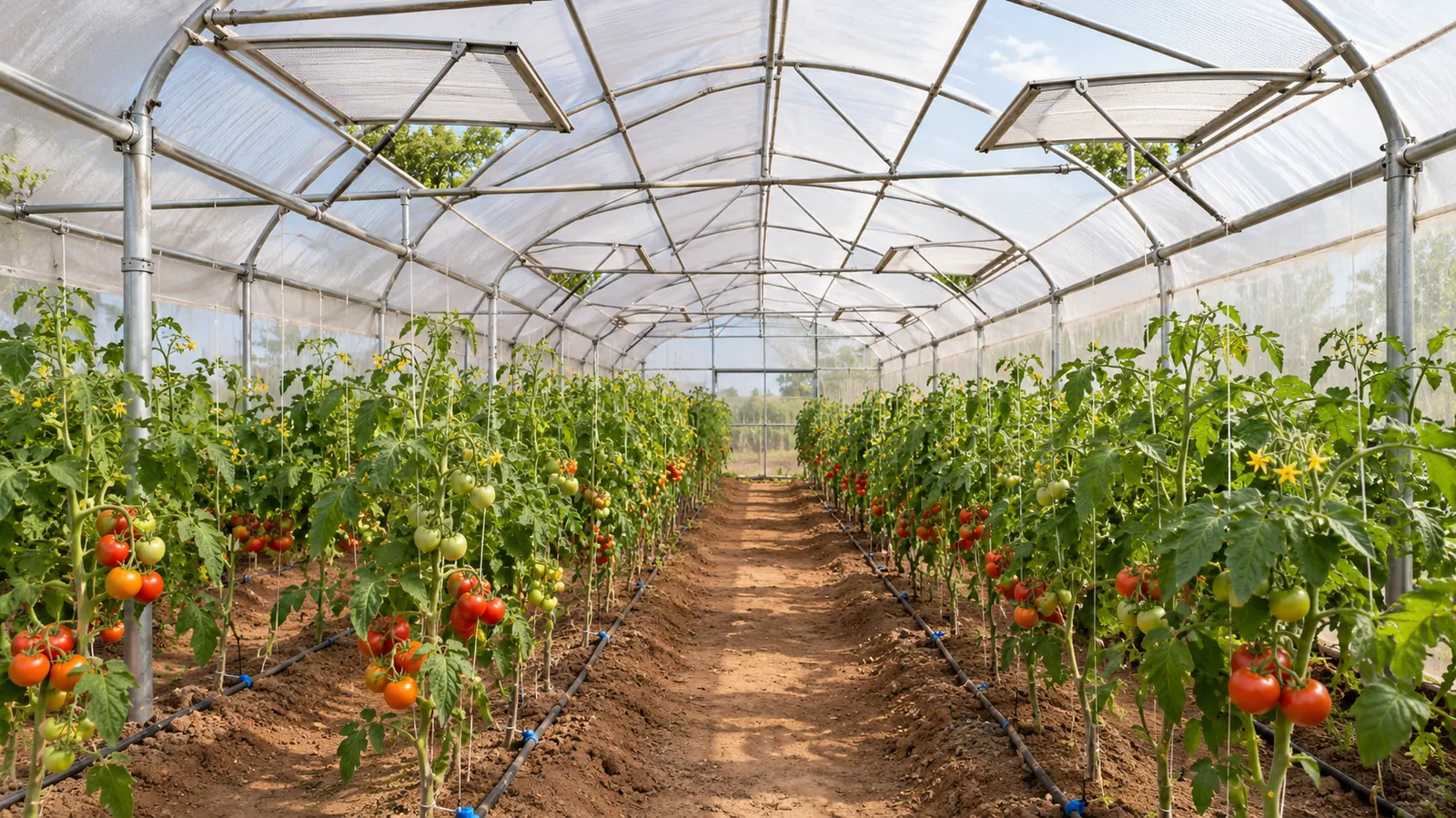
Short answer: A polyhouse is a greenhouse covered with polyethylene film instead of glass or rigid sheet, so every polyhouse is a greenhouse, but not every greenhouse is a polyhouse. The practical differences are the cover, the up-front cost, how long the cover lasts, and how much climate control the structure carries. Polyhouses cost less to build and need their film replaced every few years. Glass and polycarbonate cost more but last longer.
Key takeaways
- “Greenhouse” is the broad term. “Polyhouse” names a greenhouse with a polyethylene (PE) or polyolefin (PO) film cover.
- Film is usually rated for about 3 to 5 years. Glass and polycarbonate last longer but cost more to build.
- A polyhouse can be naturally ventilated or fully climate controlled, so the label does not tell you the control level.
- In India’s official cost norms, a naturally ventilated polyhouse structure is set at ₹950 to ₹1,200 per sq m and a fan-and-pad polyhouse at ₹1,450 to ₹1,800 per sq m.
Is a polyhouse the same as a greenhouse?
A polyhouse is one kind of greenhouse, and “greenhouse” is the wider term. Agri Farming describes it this way: a polyhouse is one kind of greenhouse made from polyethylene, while greenhouse is a wide term (Agri Farming, December 2023). Krishi Jagran likewise defines a polyhouse as a type of greenhouse that uses polyethylene to cover the roof and/or sides (Krishi Jagran, 2021).
So the useful question is not “polyhouse or greenhouse” but “which cover and which level of climate control fits my crop and site”. The sections below compare the options.
How does a polyhouse compare with glass and polycarbonate greenhouses?
A polyhouse costs least to build, a glass greenhouse costs most, and polycarbonate sits between them. The table compares the three on the points buyers check first.
| Feature | Polyhouse (film) | Polycarbonate greenhouse | Glass greenhouse |
|---|---|---|---|
| Cover | PE or PO film | Twin-wall polycarbonate sheet | Glass, tempered or diffuse |
| Cover life | About 3 to 5 years (see below) | Longer than film | Longest |
| Up-front cost | Lowest | Medium | Highest |
| Insulation | Low with single film, better with double film | Good | Low unless fitted with screens |
| Light | Good, but film ages and yellows | Good and diffuse | Highest |
| Climate control | Natural vents or fan-and-pad | Natural or powered ventilation | Ridge vents with full systems |
| Typical fit | Cost-sensitive farms, warm to mixed climates | Cold or hail-prone sites, nurseries, flowers | High-wire vegetables, high-tech year-round production |
Krishi Jagran summarises the trade-off: polyhouses are cheaper to start with, but permanent greenhouses are not. Rigid covers cost more up front but need replacing far less often, so compare lifetime cost, not just the purchase price.

What types of polyhouse are there?
Polyhouses are grouped by ventilation and by how much of the climate they control. India’s Mission for Integrated Development of Horticulture (MIDH) guidelines of April 2025 classify protected structures this way (MIDH Operational Guidelines, Annexure V):
- Fan-and-pad polyhouse: Exhaust fans and wet pads cool the house. Cost norm ₹1,450 to ₹1,800 per sq m, depending on area.
- Naturally ventilated tubular or rectangular structure: Steel frame with vents and no powered cooling. Cost norm ₹950 to ₹1,200 per sq m, depending on area.
- Naturally ventilated bamboo or cable-purlin structure: Lower-cost frame. Cost norm ₹450 per sq m.
- Shade net or agro textile net house: Net cover instead of film. Tubular structure norm ₹710 per sq m. See our comparison of shade net house vs greenhouse.
- Plastic tunnels and walk-in tunnels: Low and walk-in tunnels, at ₹80 and ₹720 per sq m.
A 2020 study in the Indian Journal of Horticulture uses a similar ladder: low-cost naturally ventilated polyhouses, medium-cost partially climate-controlled polyhouses, high-cost fully climate-controlled polyhouses, plastic low tunnels and net houses (Indian Journal of Horticulture 77(4), 2020). Agri Farming suggests a Quonset-type multi-span polyhouse for Indian conditions.
How long does polyhouse film last?
Polyhouse film typically lasts about 3 to 5 years, depending on UV stabilisation and exposure. Agri Farming says covering materials with a lifespan of 3 to 5 years work well economically, and recommends UV-treated polyethylene of 200 microns. Krishi Jagran says most commercially available polyfilm greenhouses carry a 4-year, 6-mil film with UV protection.
Plan film replacement into the operating budget, because film can tear and must be changed at intervals. Single film is cheapest, double inflated film insulates better, and PE and PO are the two common film materials. Our guide to greenhouse plastic film compares thickness, types and lifespan.
Which should you choose: polyhouse or another greenhouse?
Choose a polyhouse when budget and speed matter most, and a rigid-cover greenhouse when you need long life or tighter winter control. Four checks usually settle it:
- Climate: Warm and mixed climates suit film. Very cold or hail-prone sites often justify twin-wall polycarbonate or glass.
- Crop value: High-value crops that need tight control can justify fan-and-pad cooling or a rigid cover.
- Budget and subsidy: Government cost norms often differ by structure type. In India, MIDH sets different rates for naturally ventilated and fan-and-pad polyhouses.
- Scale: Large blocks usually use multi-span structures to cut cost per square metre. See single-span vs multi-span costs.
For per-acre figures, see our guide to polyhouse cost per acre.
What should buyers specify before requesting a quote?
Comparable quotes need the same brief. Send suppliers:
- Site: Location, design wind speed, rainfall, and summer and winter temperatures.
- Crop and method: Crop, soil or hydroponic growing, and the target season.
- Structure: Single-span or multi-span, width, length, gutter or eave height.
- Cover: PE or PO film, single or double layer, UV and anti-drip treatment, thickness.
- Ventilation and cooling: Roll-up sides, roof vents, fans and pads, shading.
- Scope: What is included: frame, film, fittings, installation guidance, freight and spare film.
How does FANGCHENG supply this?
FANGCHENG supplies film greenhouses in single and double PO or PE film on multi-span structures, together with glass, polycarbonate, high tunnel and other greenhouse types. Each structure is designed for the local wind, snow, humidity and crop, and key components are produced in-house. Ventilation, cooling, shading, heating and control systems can be supplied with the structure, and installation is supported with on-site engineers or remote guidance. FANGCHENG has worked on greenhouse planning, design, manufacturing and installation since 2002. See film greenhouses, multi-span film greenhouses and single-span tunnels.
Comparing polyhouse and greenhouse options? Send your crop, site conditions and budget range. FANGCHENG will propose a structure, cover and ventilation package to match.
Request a quote
FAQ
What is the difference between a polyhouse and a greenhouse?
A polyhouse is a greenhouse covered with polyethylene film, while “greenhouse” is the broader term for any glass, film or rigid-sheet structure. The main differences are cover material, cost, cover life and climate control.
Is a polyhouse cheaper than a greenhouse?
Yes, a polyhouse is usually cheaper to build than a glass or polycarbonate greenhouse. The film cover is replaced every few years, so lifetime cost depends on how often you recover it.
How long does polyhouse film last?
Polyhouse film typically lasts about 3 to 5 years. Commercial films are often rated for 4 years, depending on thickness, UV stabilisation and exposure.
Can a polyhouse have climate control?
Yes, a polyhouse can be naturally ventilated or fitted with fan-and-pad cooling, heating, shading and automated controls. Official Indian cost norms list both naturally ventilated and fan-and-pad polyhouses.
Which is better for hot climates?
A naturally ventilated or fan-and-pad polyhouse with roof vents and shading usually suits hot climates, and it costs less than glass. Choose vent area and shading to the site’s peak summer conditions.
Bottom line
A polyhouse is a film-covered greenhouse, so compare covers and control levels, not the names. Film costs least and needs replacing every few years, while polycarbonate and glass cost more and last longer. Get quotes that state the cover, ventilation and scope so you can compare them fairly.
Editorial note: Definitions and film life come from Agri Farming (December 2023) and Krishi Jagran (2021). Structure classes and cost norms come from the MIDH Operational Guidelines (April 2025, Annexure V) and the Indian Journal of Horticulture 77(4), December 2020. Cost comparisons between covers are qualitative. Sources retrieved November 2026.
 Blog
 Blog
 Blog
