跳至内容
跳至内容 
Labor typically represents 30-50% of greenhouse operating costs — and it is the hardest line item to control. This guide covers layout, automation, and workflow strategies that cut labor while improving quality. FangCheng Greenhouse integrates automation-ready infrastructure into commercial greenhouse projects.
Labor Is the Biggest Cost
Greenhouse production is labor-intensive: planting, irrigating, training, pruning, harvesting, and packing. Labor economics in agriculture show wages rising faster than crop prices, squeezing margins. The most successful growers treat labor efficiency as a design problem — optimizing layout, technology, and workflow to get more output per labor hour. Every minute saved on repetitive tasks compounds across the season.
Bench and Layout Optimization
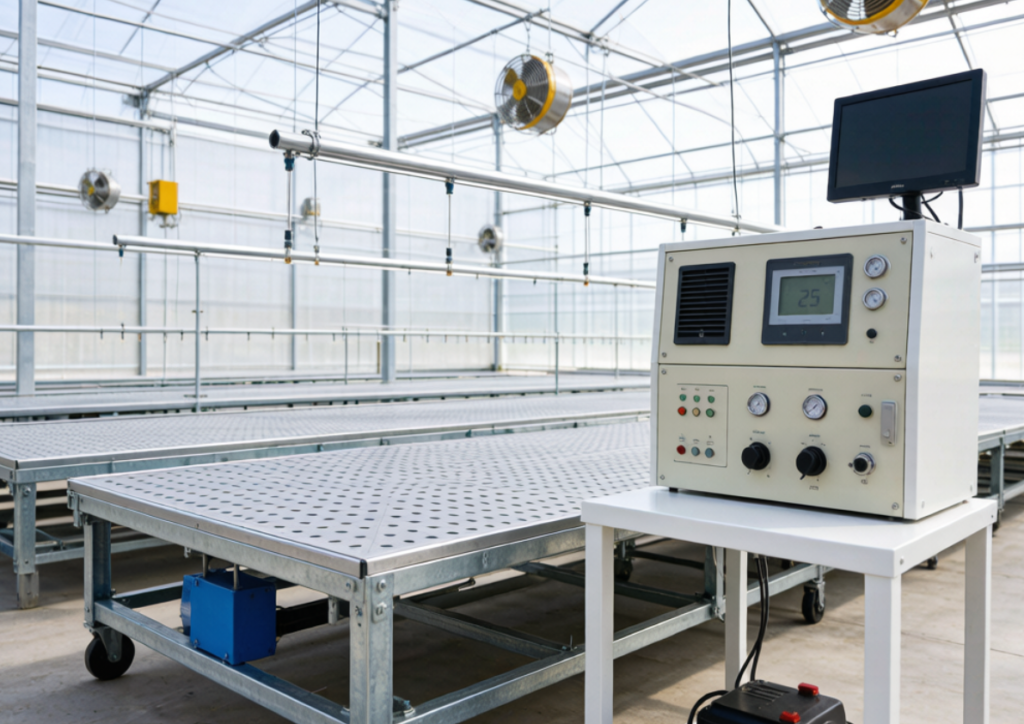
Layout is the cheapest labor-saving investment you can make. Optimize bench and aisle configuration to minimize walking distance. Rolling benches convert aisle space into growing space, increasing capacity 15-30% while keeping the same labor force. Zone crops by task frequency — daily tasks closest to the entrance, low-touch crops farther in. A well-designed layout cuts routine task time by 20-40% with zero technology investment.
Automation Technologies
- Rolling benches — increase usable growing area, reduce walking
- Transplanting machines — mechanize plug-to-container or container-to-ground planting
- Grading and sorting lines — automate size/quality sorting at harvest
- Robotic harvesting — emerging for tomatoes and strawberries, reducing peak labor
- Autonomous sprayers — consistent pest/disease application with less labor
Irrigation Automation
Automated irrigation eliminates one of the most labor-intensive daily tasks. Drip systems with timers or soil-moisture sensors deliver water and nutrients precisely, requiring minimal labor. Ebb-and-flow and flood floors irrigate entire benches simultaneously. Fertigation controllers adjust dosing automatically. Beyond labor savings, automation improves uniformity and yield — irrigation labor can drop 80-90% with full automation.
Harvest and Pack Workflow
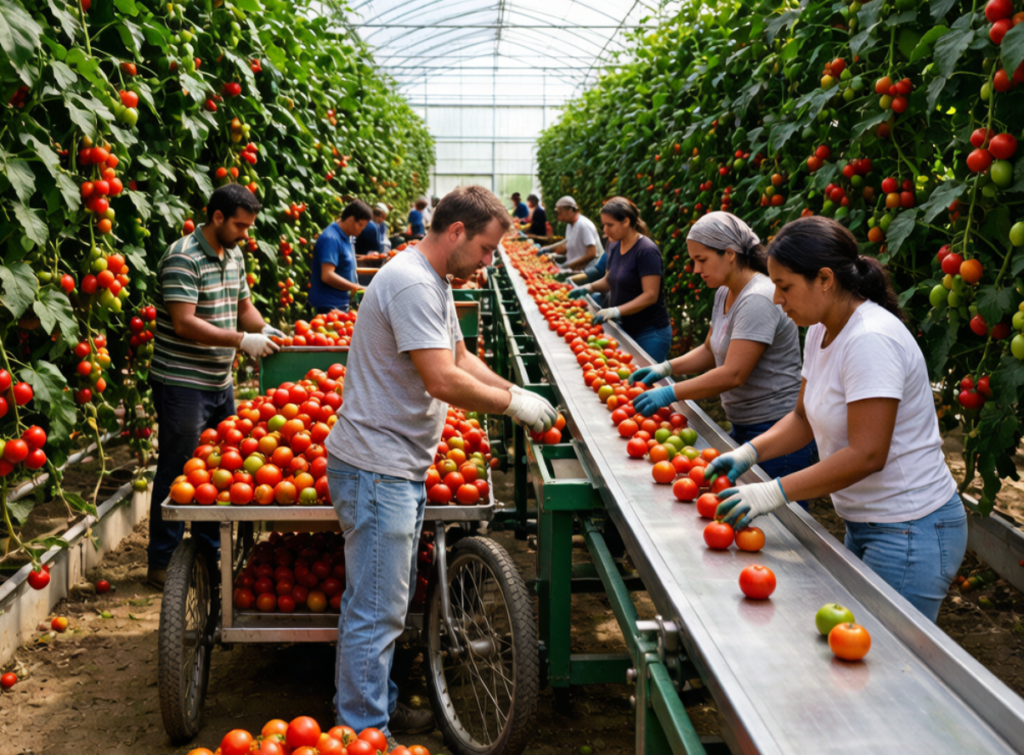
Harvest is the least automatable task for many crops, but workflow can still be optimized. Use mobile harvest carts that move through the crop. Grade and pack at the point of harvest with a mobile station. Pre-assemble packaging. Zone harvesting by crop maturity to avoid wasted trips. The lean/Six Sigma approach to workflow — eliminating non-value-added steps — applies directly to harvest efficiency.
Internal Transport Systems
Moving material within the greenhouse is a hidden labor cost. Conveyors move trays and pots between zones. Cart rails or tow carts transport harvested produce to the pack house. Transport systems cut carrying labor significantly in larger facilities. For multi-span operations, a well-planned transport network is essential to avoid bottlenecking at harvest peaks.
Climate Control Automation
Automated climate control frees staff from manual vent, shade, and heating adjustments. Climate computers manage temperature, humidity, CO₂, and light automatically based on crop-specific programs. The labor saved is significant — plus automation responds faster and more consistently than humans. HVAC automation principles apply to greenhouse climate systems. FangCheng provides fully integrated climate systems.
Data-Driven Labor Management
Track labor hours by task to identify inefficiencies. Use scan or time-tracking systems on mobile devices. Benchmark tasks (plants planted per hour, trays moved per hour) against industry standards. Analyze labor allocation across crops — the highest-value crops should get priority labor during peaks. Data turns labor management from guesswork into a measurable, improvable process.
ROI of Automation
| Automation | Typical Cost | Labor Saved | Payback |
|---|---|---|---|
| Rolling benches | $3-8/sq ft | 15-30% capacity gain | 2-4 years |
| Irrigation automation | $0.5-2/sq ft | 80-90% of watering labor | 1-2 years |
| Climate computer | $5-20K | 30-50% of climate labor | 1-3 years |
| Grading line | $20-100K | 50-70% of sorting labor | 3-5 years |
Prioritize automation with the fastest payback: irrigation and climate first, mechanization second, robotics last. The ROI framework helps rank investments.
FAQ
How much can automation reduce greenhouse labor?
Typical operations cut total labor 30-50% with a combination of layout optimization, irrigation automation, and climate control. Highly automated facilities go further.
What is the first automation investment I should make?
Irrigation automation has the fastest payback (1-2 years) and the largest labor impact. Rolling benches and climate computers are next on the priority list.
Is robotic harvesting practical yet?
Robotic harvesting is commercial for tomatoes and strawberries in leading operations, but costs remain high. Most growers benefit from workflow optimization first.
Does automation improve crop quality?
Yes. Automated irrigation and climate control deliver more consistent conditions than manual management, typically improving uniformity and yield.
Automation-Ready Greenhouses from FangCheng
FangCheng Greenhouse builds infrastructure engineered for automation — rolling benches, irrigation systems, and climate integration. Explore our systems or request a labor-efficiency consultation.