 跳至内容
跳至内容 
The choice between single-span and multi-span greenhouse structures is one of the most consequential decisions in commercial horticulture — affecting cost, land use, and operational efficiency for decades. This guide lays out the trade-offs. FangCheng Greenhouse manufactures both single and multi-span structures for growers worldwide.
The Structure Decision
Single-span greenhouses are individual freestanding tunnels. Multi-span greenhouses (also called gutter-connected) join multiple bays under one roof system. The greenhouse design literature shows how structure choice shapes every downstream decision — heating, cooling, automation, and expansion. Neither is universally better; the right answer depends on scale, budget, crop, and climate.
Single-Span Greenhouses

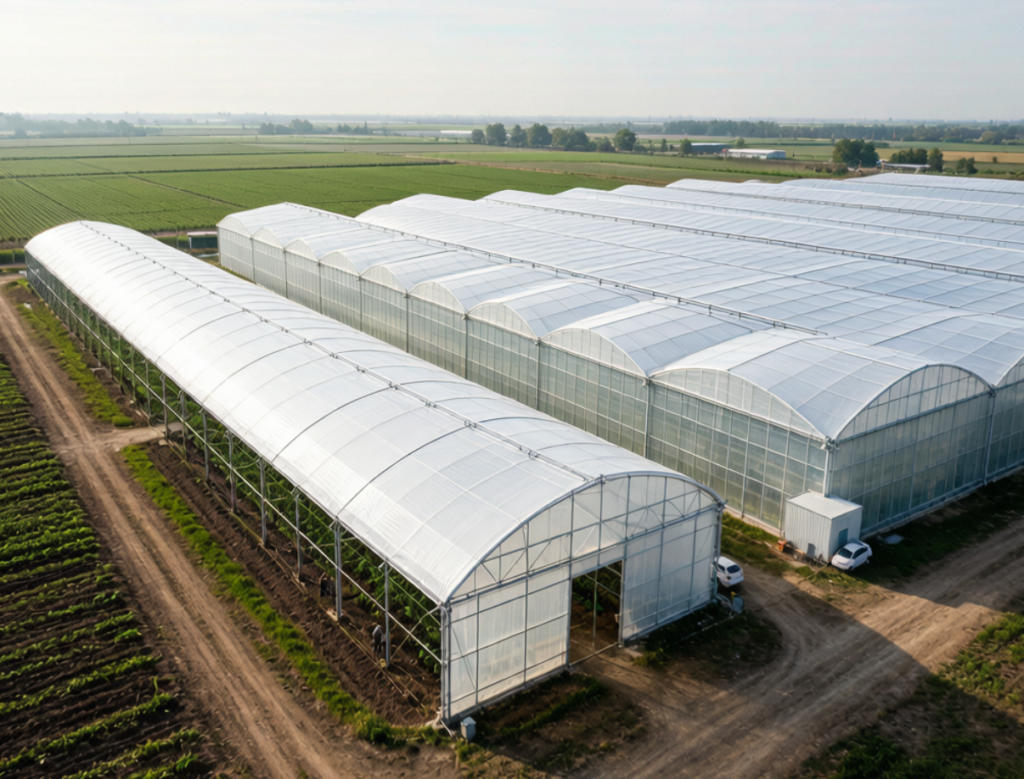
Single-span greenhouses are the economical entry point: lower upfront cost, simpler construction, and natural ventilation from all sides. Typical cost: $5-20 per square foot. Each bay operates independently — ideal for diversified production, nurseries, or phased investment. Disadvantages: more perimeter heat loss, less land efficiency (space between units), and harder to automate at scale. Single-span suits small to medium operations, seasonal growing, and beginners.
Multi-Span Greenhouses
Multi-span greenhouses share walls and gutters between bays, maximizing interior space and automation potential. Typical cost: $15-40 per square foot. Advantages include superior heat retention (less exterior wall per square foot), efficient land use, uniform climate control, and compatibility with advanced systems — mobile benches, climate computers, irrigation rails. Multi-span is the standard for large commercial production. Venlo-type multi-span design is the dominant commercial configuration globally.
Cost per Square Foot
| Factor | Single-Span | Multi-Span |
|---|---|---|
| Structure cost (per sq ft) | $5-20 | $15-40 |
| Foundation cost | Lower per unit | Higher, but shared |
| Climate equipment | Per-unit duplication | Centralized, efficient |
| Automation readiness | Limited | Full integration |
Land Use Efficiency
Multi-span greenhouses use land far more efficiently. Single-span units require spacing between bays for wall access and drainage, wasting 10-30% of land. Multi-span uses nearly 100% of the covered footprint. For the same growing area, a multi-span greenhouse occupies 20-40% less land — significant for expensive or limited land parcels. On a per-square-foot-of-useful-crop-area basis, multi-span becomes more cost-effective as scale grows.
Climate Control Comparison
Multi-span greenhouses maintain more uniform temperatures because interior bays are buffered from outside walls. Heating energy per square foot is typically 20-40% lower than single-span units of equal area. Cooling and humidity control also benefit from centralized systems. Single-span units, with more perimeter exposure, require more energy and more sophisticated per-unit control to maintain stable conditions — especially in extreme climates.
Ventilation and Airflow
Single-span greenhouses excel at natural ventilation — with all sides exposed, ridge and side vents work effectively without fans. Multi-span greenhouses rely primarily on roof vents and fan systems, requiring careful design for cross-flow. In hot climates, multi-span designs need adequate vent area and possibly forced cooling. The trade-off: single-span’s natural ventilation advantage vs multi-span’s energy efficiency and automation.
Scaling Your Operation
Consider your growth path. Single-span allows incremental expansion — add another unit when demand grows. Multi-span requires larger upfront commitment but delivers better economics at scale. Many growers start with single-span, then graduate to multi-span as the business matures. FangCheng supports both paths with crop-specific designs and phased expansion plans.
Which Structure Is Right for You?
Choose single-span for: budget entry, small scale, diversified crops, or phased investment. Choose multi-span for: commercial scale, automation, energy efficiency, or long-term professional production. Match the structure to your business plan — not just today’s needs, but where you will be in five years.
FAQ
Which is cheaper, single-span or multi-span greenhouse?
Single-span is cheaper per square foot ($5-20 vs $15-40). However, multi-span becomes more cost-effective per useful crop area at scale due to land and energy efficiency.
Is a multi-span greenhouse better for commercial production?
Generally yes. Multi-span offers better energy efficiency, land use, and automation compatibility — the requirements of professional large-scale production.
Can I expand a single-span greenhouse into multi-span?
Not directly — structures differ. Many growers plan for transition: start with single-span for cash flow, then build a multi-span facility as demand grows.
What is the most common commercial greenhouse type?
The Venlo multi-span design is the global standard for commercial vegetable and flower production, valued for light transmission and gutter drainage.
Choose the Right Structure with Expert Guidance
FangCheng Greenhouse builds both single-span and multi-span structures — engineered for your crop, climate, and budget. Explore our greenhouse frames or request a design consultation.
 Blog
Blog Blog
Blog Blog
Blog