
...

Greenhouse Structures Built For Performance

Commercial Greenhouses, Built for Your Climate and Crop

The right commercial greenhouse depends on your climate, your crop and how much control you need. A film tunnel suits low-cost seasonal growing, a multi-span film greenhouse suits large commercial production, and glass or polycarbonate suits year-round, high-control projects. This page compares every type we build so you can narrow the choice before you talk to an engineer.

Commercial glass greenhouse rangeBuilt to your site
About FANGCHENG

Greenhouses made to your site

FANGCHENG is a greenhouse manufacturer in Guangzhou. We design, fabricate and supply custom greenhouses for vegetables, tomatoes, flowers, seedlings, hydroponics and large agricultural projects, and we ship them with drawings and installation guidance.

Structure and covering

Two ways to describe a greenhouse: structure and covering

Structure
Covering
01/ 02The structure is the shape of the frame: a single tunnel, a hoop house, several bays joined by gutters, or a Venlo roof.

Buyers often mix up two separate choices. Most greenhouse types are a combination of the two, which is why the same covering can appear on very different frames.

Keeping the two apart makes quotations easier to compare. Two suppliers can both offer a "polycarbonate greenhouse" and mean very different buildings: one a light garden-scale frame, the other a gutter-connected structure designed for snow. Ask each supplier to name the structure and the covering separately, with the span, gutter height and covering thickness.

Find your type

Match the greenhouse to your situation

First greenhouse, small budget.

A single-span tunnel or a high tunnel. Low risk, quick to build, and a way to learn the crop under cover.

Single-Span TunnelHigh Tunnel
Growing farm, one main crop.

A multi-span film greenhouse, with room left to add bays and systems.

Multi-Span Film
High-value crop, year-round supply.

Glass or polycarbonate, often in a Venlo layout, with full climate control.

GlassPolycarbonateVenlo
Hot, humid region, large area.

A sawtooth or a multi-span film house with strong roof ventilation.

SawtoothMulti-Span Film
Cold, snowy region.

Polycarbonate or glass on a frame designed for snow, with thermal screens and heating.

PolycarbonateGlass
Photoperiod crops.

A light-deprivation greenhouse, with blackout curtains and ventilation planned for the dark period.

Light-Deprivation
Cold and snowy.

Insulation and a strong frame matter most. Polycarbonate or double-glazed glass, with thermal screens and heating. Film works with a second layer.

PolycarbonateGlassFilm
Hot and humid.

Getting heat and humidity out matters most. Sawtooth or multi-span film with roof vents, shading and cooling.

SawtoothMulti-Span Film
Hot and dry.

Light and cooling matter. Film or sheet with shading and evaporative cooling.

FilmPolycarbonate
Windy or hail-prone.

Impact resistance and a well-braced frame matter. Polycarbonate over a reinforced structure.

Polycarbonate
Mild, four seasons.

Most types work. Choose by crop and budget.

FilmMulti-Span Film
Tropical and rainy.

Drainage and ventilation matter. Sawtooth or high-vent film greenhouses, with gutters sized for heavy rain.

SawtoothFilm
Leafy greens and herbs.

Robust and fast. Film or polycarbonate works well.

FilmPolycarbonate
Tomatoes, peppers and cucumbers.

High light and tight control pay back. Glass, polycarbonate or a well-vented multi-span film house.

GlassPolycarbonateMulti-Span Film
Berries.

Film tunnels and multi-span houses, often with rain protection as the main benefit.

Single-Span TunnelMulti-Span Film
Flowers and orchids.

Even light and stable temperatures. Polycarbonate, glass or ETFE.

PolycarbonateGlassETFE
Seedlings and nurseries.

Stable conditions and good diffused light. Film, polycarbonate or fiberglass.

FilmPolycarbonateFiberglass (FRP)
Photoperiod crops.

A light-deprivation greenhouse with blackout curtains.

Light-Deprivation
Layout

Free-standing or gutter-connected?

A simple test is to count how many separate houses you would need.

Free-standing film tunnel
Gutter-connected multi-span greenhouse
Free-standing
What it is

A free-standing greenhouse stands alone, so you can add one at a time.

A gutter-connected greenhouse joins many bays into one continuous space.

Count the houses

If the answer is one or two, free-standing keeps things simple.

If it is many, the walls, doors and gables repeated on every house start to cost more than the gutters that would join them, and a connected layout becomes the better use of money.

Tap a side to compare.

The joined layout uses land better, makes heating, cooling and screens easier to run as one system and cuts the walkways between houses. The trade-off is that the whole area shares one climate, so you cannot hold different conditions in different parts unless you add curtains or partitions, and pests can spread more easily inside an open layout.

Choosing

How to choose: six questions

01

What is your climate?

Cold and snowy, hot and humid, dry, windy or hail-prone. This one decides the covering and the structure more than anything else.

02

What are you growing?

A crop that needs strong light and tight control points to glass or polycarbonate. A seasonal or robust crop can do well under film.

03

What scale do you need?

Under a few hundred square meters, a tunnel is practical. Large commercial areas favor multi-span.

04

What is your budget, and over how many years?

Purchase cost and service life pull in opposite directions. Compare the cost per year, not only the price.

05

How much control do you want?

Heating, cooling, screens and automation are easier to fit on a gutter-connected structure.

06

Will you expand?

Free-standing tunnels and multi-span bays can both be extended if you plan for it at the start.

Greenhouse film on the frameFilm ages in cycles
Service life

Service life: how long each part lasts

A greenhouse ages in parts, not all at once. The hot-dip galvanized steel frame is the long-lived part. Film coverings are replaced on a cycle of a few years, while glass, polycarbonate and ETFE last much longer. Moving parts such as vent motors, roll-up gear and curtain drives are serviced on their own schedule.

Planning for this changes the comparison. A film house is cheap to buy but carries a re-cover in its running costs. A rigid covering costs more on day one but removes that item. Both can be right, as long as the budget counts the whole life.
Cost

What decides the price of a commercial greenhouse

01

The covering

film, sheet, glass and ETFE sit at very different price levels

02

The structure

span, height and the steel it takes to carry local wind and snow

03

The systems

ventilation, cooling, heating, shading, irrigation and controls

04

The site

foundations, ground conditions and access

05

Logistics

shipping, import duties and installation

We give a quotation per project, because these items change from site to site. Send us your location, crop and area and we reply within 24 hours.

Two projects of the same area can differ widely in price because of loads alone. A site with heavy snow needs closer columns, heavier trusses and larger foundations than a mild site, even if the two greenhouses look alike. That is why a price per square meter quoted without a location is only a rough guide.

Send us your location, crop and area.We reply within 24 hours.
Get a Free Quote
Scale

Size and scale

A grower with a few hundred square meters can start with a single-span tunnel and learn the crop. A farm planning several hectares should plan for multi-span bays, shared systems and central control from the start. Mixed projects often begin with a tunnel and later add a multi-span range. If you expect to grow, tell us now so the layout can leave room.

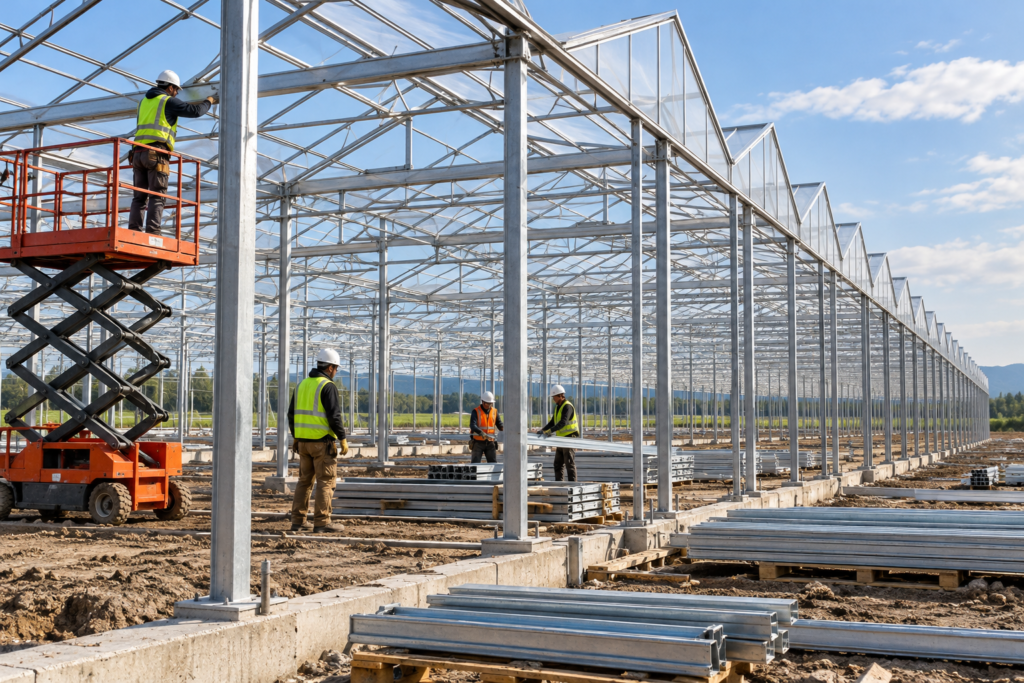
Steel structure on siteSteel structure on site
Systems

A greenhouse is a structure plus systems

The frame and covering are only the shell. A working greenhouse also needs ventilation, cooling or heating, shading, irrigation and a way to control them. We supply the structure together with these systems, so they are designed to fit each other instead of being assembled from several suppliers.

The links between the parts are where single-supplier design pays off. Screens need room above the crop and a frame that can carry their drives. Vents need an opening area matched to the volume of air inside, and fans and pads need end walls built for them. When these are drawn together, nothing has to be cut or added on site.

Process

How a project works with FANGCHENG

01

Brief

You tell us the site, crop, area and budget.

02

Design

We prepare layouts and structural calculations for your local wind and snow.

03

Manufacture

Steel is fabricated and hot-dip galvanized in our factory, ready for bolted assembly.

04

Pack and ship

Parts are labeled and packed for export.

05

Install

Your team builds from drawings, with our technical guidance.

Buying

Buying from a greenhouse manufacturer: what to ask

0 of 6 ready
Pitfalls

Common mistakes when choosing a greenhouse

!

Choosing a covering on price alone and ignoring service life

!

Choosing a tunnel for a crop that needs tight climate control

!

Copying a design from a different climate

!

Buying the structure first and planning ventilation later

!

Leaving no room for expansion

Scope

Structure only, or a turnkey greenhouse?

Structure only
01 / 03

Structure only

Frame, covering, vents and doors. Suits growers who already have system suppliers or an in-house team.

Structure plus key systems
02 / 03

Structure plus key systems

Adds shading, cooling, heating or irrigation, designed into the frame.

Turnkey
03 / 03

Turnkey

A complete greenhouse with climate control, irrigation and automation, designed and supplied together.

We can quote each level, so you can see exactly what the extra scope adds.

Quotation

What to prepare before you ask for a quotation

You do not need all of these on day one. Send what you have and our engineers ask for the rest.

0 of 6 ready
FAQ

Common questions

Straight answers. If yours is not here, ask us.

A film tunnel has the lowest purchase cost. Over a long period, a more durable covering can cost less per year. Tell us your site and we compare options.

A high tunnel is a tall, unheated structure used to extend the season, usually with crops planted in the ground. A greenhouse is built for more climate control, with heating, cooling and automation.

Yes. Span, height, length, bay distance and covering are customized for each project.

Yes. We provide drawings and technical guidance, and your team installs.

Yes. Parts are packed for export. Tell us your destination.

Send your location, crop and planned area. We reply within 24 hours with suggested types.

Yes. A common pattern is a multi-span house for the main crop and a few tunnels for seedlings or seasonal crops.

Polycarbonate or double-glazed glass on a frame designed for snow, with thermal screens and heating. Film can work with a second layer and heating when the budget is tight.

A sawtooth or a multi-span film house with large roof vents, shading and, where needed, pad and fan cooling.

Get started

Tell us about your project

Send your location, crop and area. Our engineers reply within 24 hours.

Consultation and project proposals are free.

What to include

  • Location
  • Your crop
  • Planned area
  • Reply within 24 hours
Scroll to Top
Two people choosing plants inside a greenhouse
Greenhouse manufacturer in Guangzhou
  • We reply within 24 hours
  • Free consultation and project proposals
  • Free sample and quote
Contact us

Leave us your info

We are always happy to help you with any commercial greenhouse questions or requests you may have.

We use your details only to answer your inquiry.