
A well-run commercial strawberry greenhouse produces 8-15 kg/m² per year (50,000-80,000 lbs/acre), per Harnois Greenhouse — two to three times open-field’s 25,000-35,000 lbs/acre. Three decisions before construction set where a project lands in that range:
- Structure type
- The climate control tier that structure can support
- Growing system: table-top/hydroponic or ground-bed soil
This guide covers all three, plus variety, fertigation, and pollination. See our commercial strawberry greenhouse systems page for the structural options FANGCHENG builds for this use case.
- Commercial yields run 8-15 kg/m²/year (50,000-80,000 lbs/acre), roughly 2-3x open-field output.
- Gutter-connected poly is the commercial default; Venlo glass suits high-light, long-lifespan builds; high tunnels fit lower budgets.
- Target climate: 18-24°C daytime, 10-13°C night, 65-75% relative humidity.
- Elevated table-top/gutter systems are now standard over ground beds, at 6-8 plants/m².
- Day-neutral varieties are default for continuous, year-round cropping; June-bearing suits field matted-row systems.
- Closed-loop fertigation with a 30-40% drainage/leaching fraction is the resource-efficiency benchmark.
How Much Can a Commercial Strawberry Greenhouse Yield?
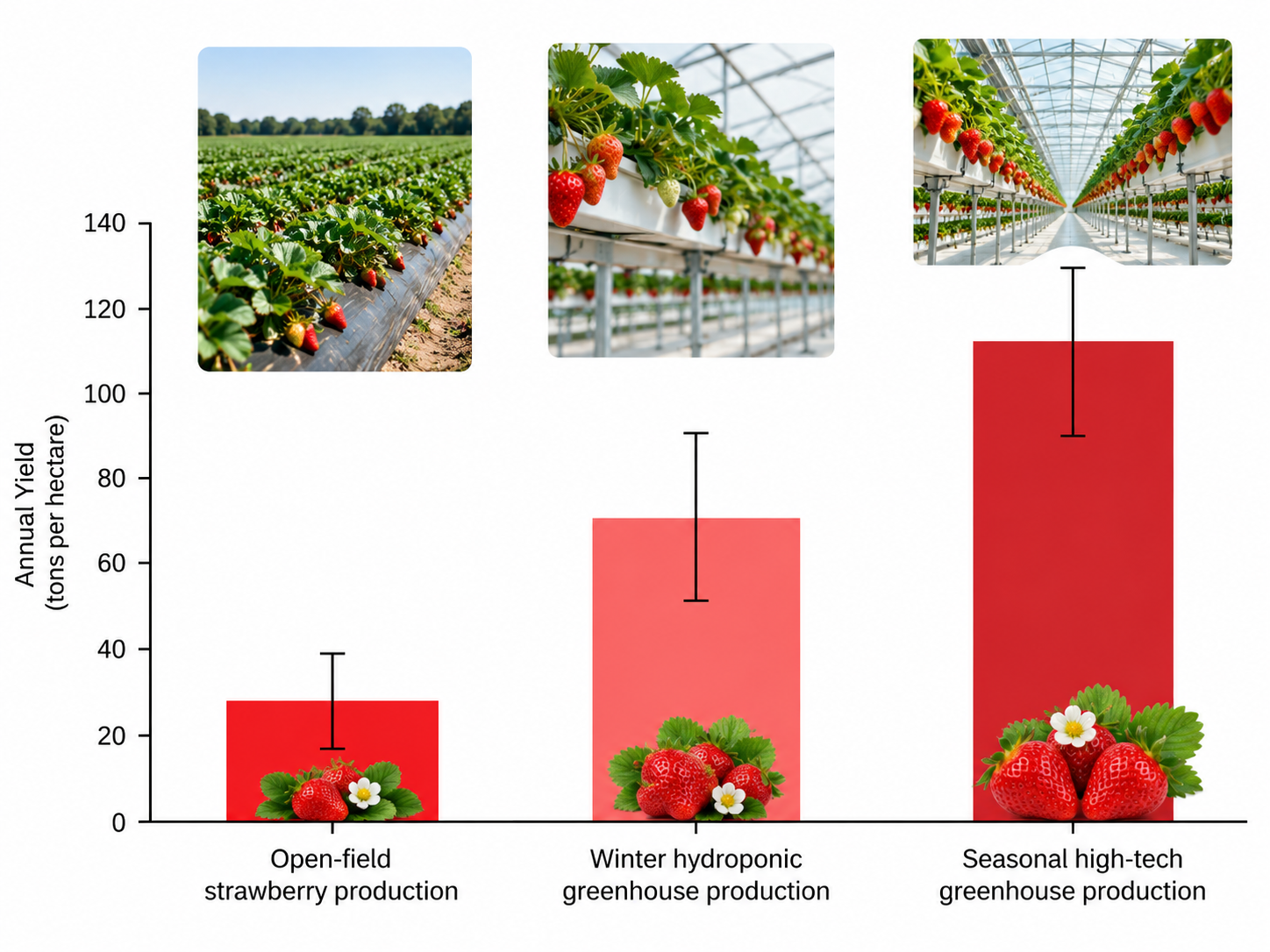
A well-managed greenhouse produces 8-15 kg/m² of strawberries per year, versus 25,000-35,000 lbs/acre (2.8-3.9 kg/m²) in open-field production, per SEF and GrowPro Dutch Greenhouses benchmarks. Season length, lighting, and growing system drive the spread — not luck.
- Winter hydroponic (limited light, no supplemental lighting): 7-9 kg/m²/year.
- Seasonal high-tech (full climate automation, extended light, table-top systems): 12-15 kg/m²/year.
- Open-field, for comparison: 25,000-35,000 lbs/acre, per Harnois Greenhouse.
Three variables explain most of that gap:
- How many months of the year the crop is actively fruiting
- Table-top/hydroponic versus soil growing system
- How tightly temperature and humidity are controlled
Choosing the Right Greenhouse Structure for Strawberries
Structure choice sets the ceiling on cost, climate control, and scalability:
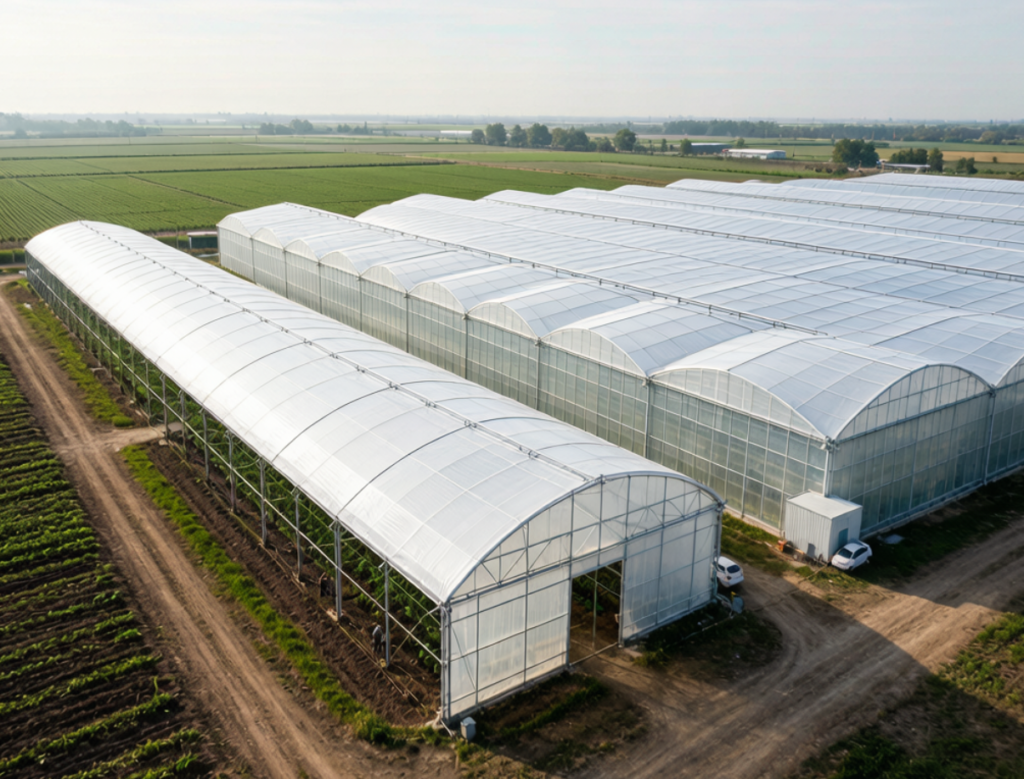
- Gutter-connected polycarbonate/poly-film: commercial-scale default, best balance of cost, climate control, and scalability.
- Venlo glass: maximum light transmission and multi-decade lifespan, usually at higher entry cost.
- High tunnels: fit smaller, lower-capital operations accepting less climate precision.
A high tunnel with roll-up sides supports passive ventilation and basic shading, not the sealed VPD automation a gutter-connected structure with a full greenhouse climate control system can run. If humidity control matters long-term, build it in now — retrofitting later costs more.
| Structure Type | Relative Cost Tier | Light Transmission | Expected Lifespan | Best Fit |
|---|---|---|---|---|
| Gutter-connected poly/polycarbonate | Entry-mid (from roughly $12/sq.ft.) | Good, with diffusion options | 15-25 yrs (cover replaced periodically) | Commercial-scale, most operations |
| Venlo glass | Higher | Excellent, minimal diffusion loss | 25+ years (structure) | High-light regions, long-term high-tech investment |
| High tunnel | Lowest | Moderate to good | 5-10 years (film) | Smaller operations, natural-ventilation-only budgets |
Climate Control Requirements: Temperature, Humidity & VPD
Strawberries perform best at 18-24°C daytime, 10-13°C at night, with 65-75% relative humidity, per OSU Extension’s Controlled Environment Berry Production program.
Cooler nights matter for sugar content: photosynthesis peaks near 20°C; above 25°C daytime or 15°C at night, sugar drops and acidity rises, per Atop Lighting. Chasing yield at the expense of night cooling costs quality — and price.
Humidity cuts both ways, per DryGair’s analysis:
- Below 65-75% RH: calcium uptake suffers and tip burn appears.
- Above it: Botrytis (gray mold) and powdery mildew risk rises sharply — the two most damaging strawberry diseases in enclosed structures.
What determines whether you can hold these targets
- Natural ventilation only (roof vents, side curtains): workable in mild climates; struggles in heat or humidity.
- Fan-and-pad or fog cooling: extends the climate window into hotter regions.
- Full VPD automation (sensors, dehumidification, integrated shading/ventilation): needed for consistent year-round quality, only on gutter-connected or glass structures with an integrated climate control system.
For a deeper look at how temperature and humidity interact across crop stages, see our companion post on balancing greenhouse temperature and humidity.
Table-Top and Vertical Growing Systems vs. Soil
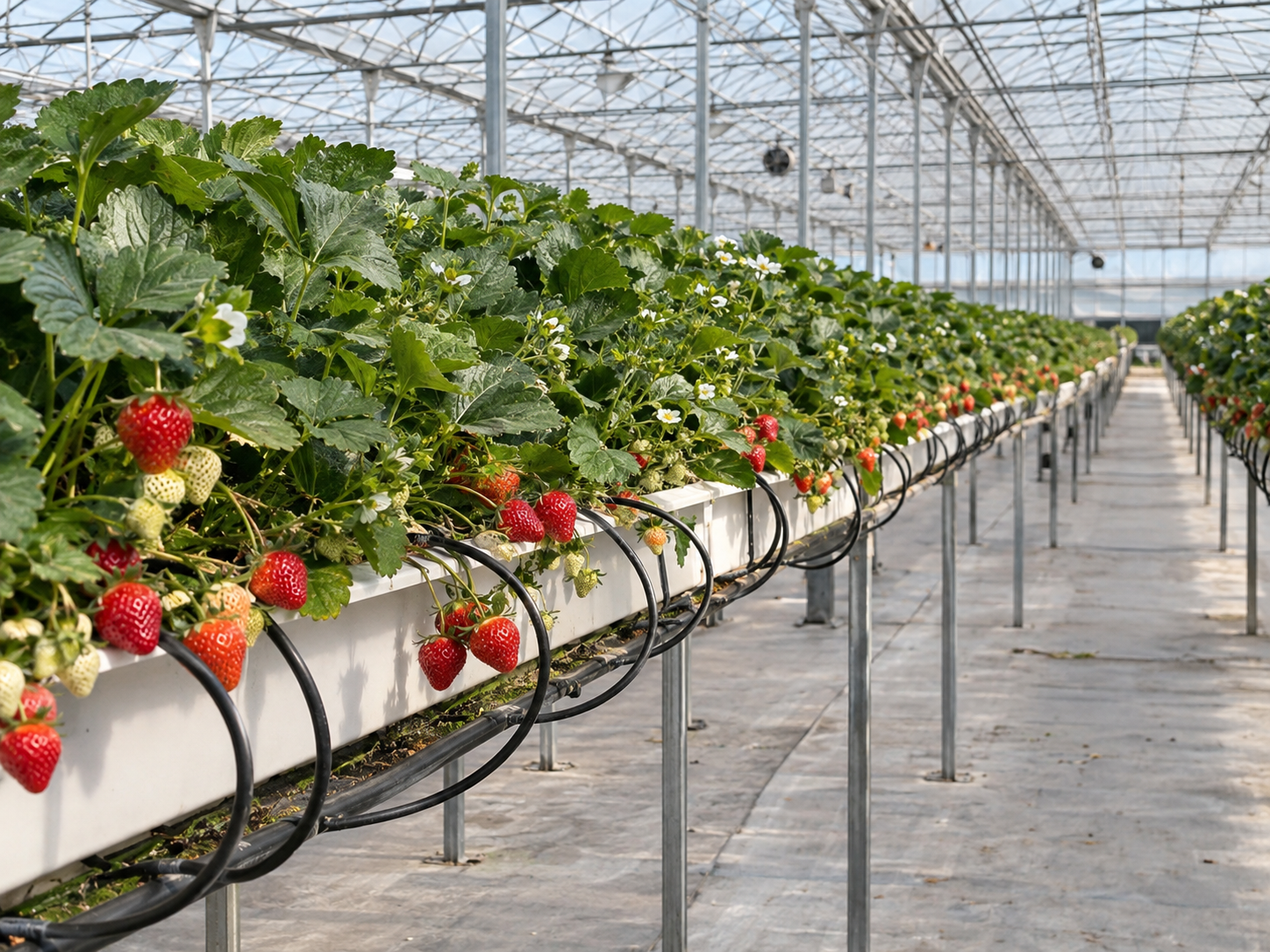
Elevated table-top (gutter) systems are now the commercial standard over ground-bed soil. Plants grow in troughs at working height, typically 6-8 plants/m², per OSU Extension. They pair naturally with a closed-loop hydroponic growing system for direct control over root-zone nutrition and drainage.
Table-top system advantages
- Ergonomic harvest height: lower labor cost and injury risk.
- Better root-zone drainage and disease control than soil beds.
- Precise fertigation via hydroponic/closed-loop systems.
- Higher planting density per footprint than soil rows.
- Easier substrate swaps between cycles, less pathogen carryover.
Table-top system trade-offs
- Higher upfront capital cost than ground beds.
- Depends on reliable fertigation; failure hits faster than soil buffers.
- Substrate (coco coir, perlite, or rockwool) is a recurring cost.
When ground-bed soil still makes sense
- Lower-capital operations in high tunnels lacking hydroponic infrastructure.
- Regions with excellent soil, drainage, and low labor cost.
- Operations transitioning from open-field production in phases.
Some operations go further with mobile, multi-layer gutter systems: a shaded or LED-supplemented lower tier beneath a sunlit upper tier. SEF and OSU Extension suggest these roughly double berry output per footprint — though some marketing cites far larger multipliers by comparing soilless vertical systems against open-field soil, not like-for-like greenhouses. Treat any uplift claim as directional until validated against your own baseline.
Variety Selection: Day-Neutral vs. June-Bearing for Greenhouse Production
Day-neutral varieties are the greenhouse default: they flower and fruit continuously, not on a single seasonal trigger. Per University of Minnesota Extension, they flower regardless of day length (40-85°F), fruit within about 10 weeks, and crop late June to November in year one.
June-bearing varieties, by contrast, are photoperiod-triggered: one concentrated flowering flush, one annual harvest window. That fits open-field matted-row systems, not the continuous-cropping economics a greenhouse is built for.
| Factor | Day-Neutral | June-Bearing |
|---|---|---|
| Flowering trigger | Temperature-driven, day-length independent | Day-length (photoperiod) dependent |
| Cropping pattern | Continuous through the season | Single concentrated harvest flush |
| Production cycle | Typically annual replant | Often perennial (matted row) |
| Best structure fit | Greenhouse, table-top/hydroponic | Open field, matted-row soil beds |
Practical takeaway: if the business case depends on year-round or extended-season supply, day-neutral is almost always the right start. June-bearing genetics belong in field planning, not continuous-output greenhouses.
Fertigation and Water-Use Efficiency in Greenhouse Systems
Closed-loop hydroponic fertigation with a 30-40% drainage (leaching) fraction is the resource-efficiency benchmark, per University of Arizona CALES. That margin flushes accumulated salts without wasting water or nutrients.
Typical commercial fertigation runs 6-12 events per day, delivering roughly 200-400 mL per plant per day, per University of Arizona CALES and OSU Extension. EC and pH targets shift across the crop cycle:
- Propagation/establishment stage: lower EC, more frequent light irrigation.
- Vegetative growth stage: moderate EC, standard irrigation frequency.
- Flowering/fruiting stage: higher EC within tolerance, consistent drainage maintained.
Closed-loop systems that recapture drainage cut water and fertilizer cost vs. run-to-waste setups, and matter more as water rules tighten. A properly specified greenhouse irrigation system enables that loop at scale. See our comparisons of drip vs. ebb-and-flow vs. overhead irrigation and rockwool, coco coir, perlite, and peat moss for substrate trade-offs.
Pollination and Pest Management in an Enclosed Structure
An enclosed greenhouse removes wind and wild pollinators, so most operations deploy managed bumble bee colonies. Design for this from the start:
- Adequate hive placement
- Minimal airflow disruption near hive entrances
- Screened openings that keep bees in without blocking airflow
Disease pressure in an enclosed structure is largely a climate-control problem: the same 65-75% RH range that maximizes yield also keeps Botrytis and powdery mildew in check, per DryGair’s strawberry greenhouse guidance. Growers who treat humidity purely as a yield lever tend to see recurring Botrytis regardless of fungicide use.
Baseline IPM practices for enclosed strawberry production
- Maintain 65-75% RH as the first line of fungal defense.
- Remove diseased leaves promptly to cut Botrytis inoculum.
- Screen ventilation openings against pests without blocking airflow.
- Introduce beneficial insects (e.g., predatory mites) proactively.
- Monitor with sticky traps and scheduled scouting, not visible symptoms alone.
Why Growers Are Converting to Greenhouse Production
Growers convert mainly to extend the marketable season and cut weather-driven volatility, not to chase peak yield. A greenhouse produces fruit on a schedule the grower controls, supporting contracts open-field can’t fill.
The decision pencils out when a grower can answer yes to most of the following:
- Local prices reward extended- or off-season supply with a real premium.
- Labor and water infrastructure can support fertigation.
- A retail/foodservice buyer will commit to a longer supply window.
- Capital covers the climate-control tier the target yield needs — not just the cheapest covering.
The yield range at the top of this guide is the outcome of how well those questions get answered before ground is broken.
Frequently Asked Questions
What is a realistic strawberry yield per acre in a commercial greenhouse?
Roughly 50,000-80,000 lbs/acre/year (8-15 kg/m²), versus 25,000-35,000 lbs/acre in open-field production, per Harnois Greenhouse and SEF. Winter hydroponic sits near 7-9 kg/m²; seasonal high-tech with table-top systems reaches 12-15 kg/m².
What temperature and humidity should I maintain in a strawberry greenhouse?
Target 18-24°C daytime and 10-13°C at night, with humidity at 65-75%, per OSU Extension. Above 25°C daytime or 15°C at night, fruit sugar content drops and acidity rises, per Atop Lighting.
Are table-top/elevated gutter systems worth the added cost over ground beds?
Yes, for most operations. Table-top systems offer better drainage, ergonomic harvest height, precise fertigation, and higher density (6-8 plants/m², per OSU Extension) than ground beds, at higher capital cost. Lower-capital operations may still start with ground beds and upgrade later.
Should I choose day-neutral or June-bearing varieties for greenhouse production?
Day-neutral varieties are the commercial default: they flower independent of day length and support continuous, near-year-round cropping, per University of Minnesota Extension. June-bearing varieties suit open-field matted-row production instead, where a single concentrated harvest flush fits the model.
What greenhouse structure is best for commercial strawberry production?
Gutter-connected poly or polycarbonate is the commercial-scale default: cost, light, and climate-automation balance. Venlo glass suits growers prioritizing light and longevity, at higher cost. High tunnels fit smaller, lower-capital, natural-ventilation-only operations.
Planning a commercial strawberry greenhouse and want structure and climate specs matched to your yield target? Explore our strawberry greenhouse systems or talk to our team about sizing a project for your region and market.
- Harnois Greenhouse, “Field Scale Polytunnels Strawberry Production”
- SEF, commercial strawberry greenhouse yield benchmarks
- Ohio State University Extension, “Controlled Environment Berry Production”
- DryGair, “Ideal Conditions for a Strawberry Greenhouse”
- Atop Lighting, horticultural physiology summary on temperature and fruit quality
- University of Minnesota Extension, “Growing day-neutral strawberries”
- University of Arizona College of Agriculture and Life Sciences (CALES), hydroponic strawberry irrigation guidance
 Blog
 Uncategorized
 auto Blog
