跳至内容
跳至内容 
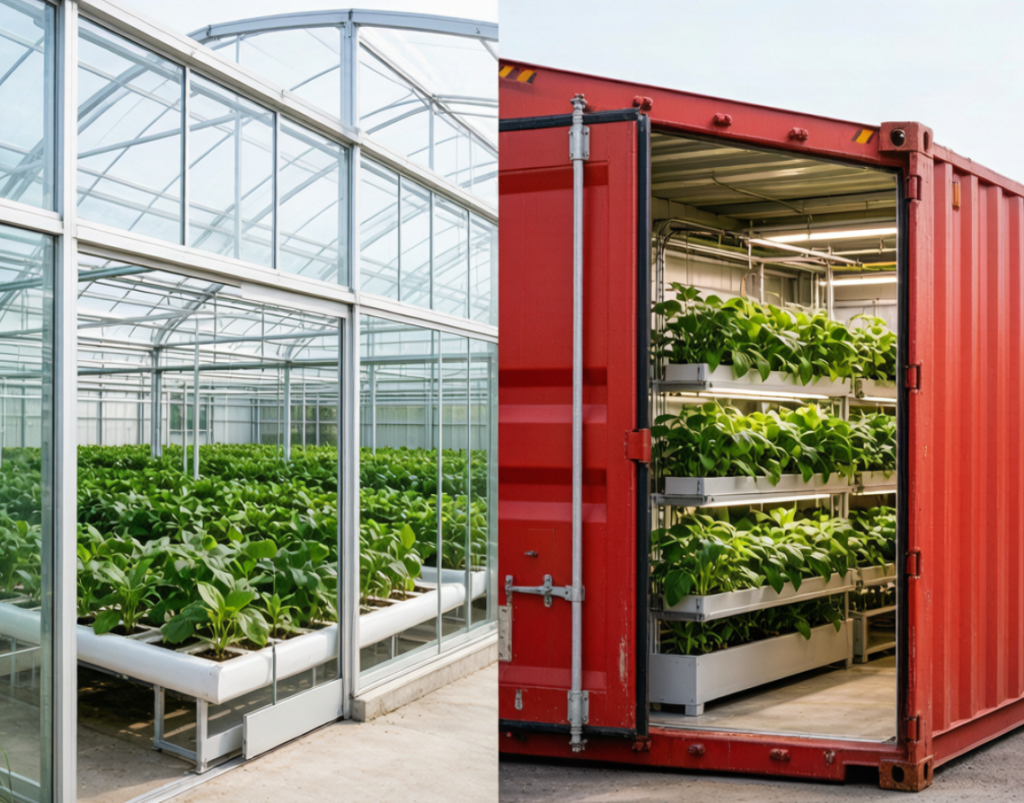
Controlled environment agriculture (CEA) is one of the fastest-growing sectors in food production. Two of the most popular CEA models — greenhouses and shipping container farms — serve different markets and budgets. Understanding their differences is critical before investing.
For commercial greenhouse solutions, see Fangcheng multi-span greenhouses.
CEA Investment Landscape
The global CEA market is projected to reach $30+ billion by 2030. Investors face a fundamental choice: invest in large-scale greenhouse infrastructure for volume production, or modular container farms for niche, distributed markets. The USDA CEA research initiative provides data on the productivity and economics of both approaches.
Greenhouse Farming
Scale advantage: Greenhouses offer the lowest cost per square foot of growing space, making them the preferred choice for commercial-scale crop production. A typical 1-acre greenhouse ($100,000-400,000) can produce 50,000-100,000 lbs of tomatoes annually.
Key specs: Cost $10-50/sq ft. Growing space 5,000-500,000+ sq ft. Light source: primarily natural sunlight. Energy cost: $0.50-2/sq ft/year. Crop diversity: excellent — most crops thrive under natural light. Payback: 2-5 years for commercial operations.
Shipping Container Farms
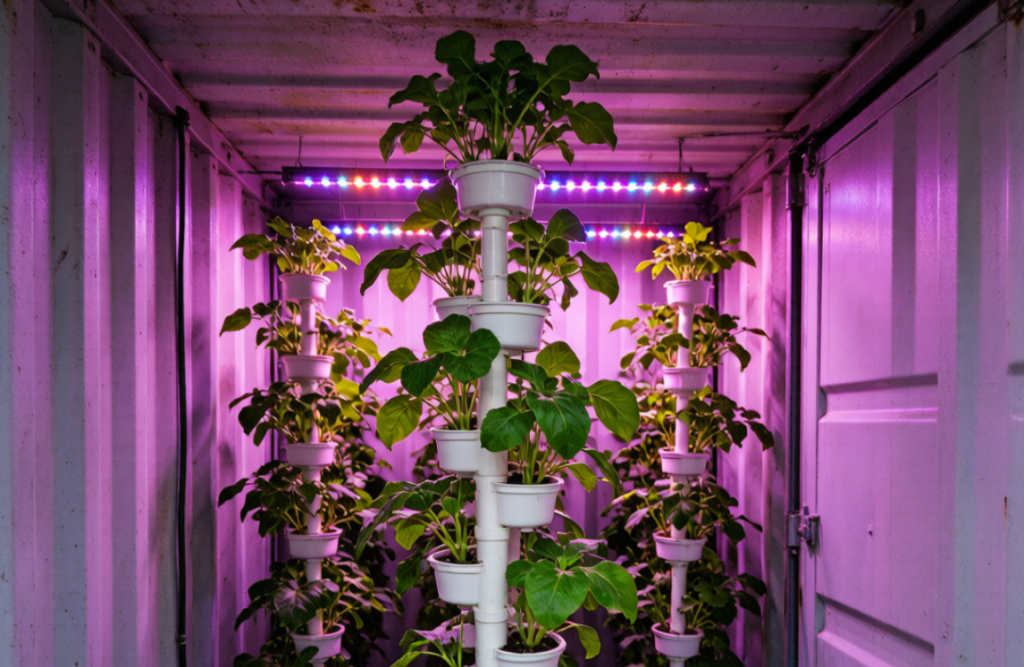
Shipping container farms (also called freight farms or containerized CEA) are fully enclosed, insulated growing environments inside recycled shipping containers. They use 100% LED lighting, vertical hydroponics, and precise climate control.
Key specs: Cost $200-500/sq ft of growing area. Growing space 160-480 sq ft per container. Light source: 100% LED. Energy cost: $5-10/sq ft/year. Crop diversity: limited — best for leafy greens, microgreens, herbs. Payback: 3-7 years.
Side-by-Side Comparison
| Factor | Greenhouse | Container Farm |
|---|---|---|
| Cost per sq ft | $10-50 | $200-500 |
| Scale potential | Virtually unlimited | Limited by container count |
| Energy source | Natural sunlight + supplement | 100% LED (high electricity) |
| Water usage | Lower per lb of production | Higher per lb (recirculating) |
| Crop diversity | Excellent | Limited (leafy greens, herbs) |
| Location flexibility | Moderate (needs land) | High (any flat surface) |
| Permitting complexity | Higher (building code) | Lower (often no permit) |
| Ideal investor | Commercial growers, institutions | Entrepreneurs, urban farms, restaurants |
Cost Analysis
Initial investment (1/4 acre): Greenhouse: $25,000-75,000 installed. Container farm (1x 40ft): $50,000-150,000. Annual operating costs: Greenhouse: $5,000-15,000 (heat, electric, water). Container: $10,000-25,000 (electricity, HVAC, LED replacement). Revenue potential: Greenhouse: $30,000-80,000 (mixed vegetables). Container: $40,000-80,000 (premium greens, microgreens).
Energy Efficiency
Greenhouses use natural sunlight for 80-90% of plant lighting needs — essentially free. Container farms require 100% artificial lighting. At $0.12/kWh, a container farm consumes $5,000-15,000 in electricity annually. A greenhouse of equivalent production area uses $500-2,000 in supplemental lighting.
Scalability
Greenhouses scale linearly — expanding from 1 acre to 10 acres reduces per-unit costs by 20-30%. Container farms do not benefit significantly from scale — each container operates independently, with minimal cost reduction per additional unit.
Decision Framework
Choose a greenhouse when: You need volume production, have access to land, want the lowest cost per pound of production, plan to grow diverse crops, and aim for wholesale / grocery distribution. Choose a container farm when: You lack suitable land, want hyper-local urban production, are producing high-value specialty crops, need quick deployment, or want a turnkey system with minimal construction.
FAQ
Which is more cost-effective?
Greenhouse: 10-20x more growing space for the same investment.
Production comparison?
Container farms yield more per sq ft, but greenhouses yield far more total volume.
Lower operating costs?
Greenhouse — natural sunlight is free. Container farms require 100% LED lighting.
Best for container farms?
Extreme environments, urban food deserts, research, specialty crops, hyper-local production.
Best for greenhouses?
Commercial-scale vegetable production, wholesale markets, diverse crop rotations.
Conclusion
Greenhouses and shipping container farms serve different roles in the CEA ecosystem. Greenhouses are the clear choice for volume production at the lowest cost per pound. Container farms fill specific niches — extreme environments, urban micro-farms, and specialty production — where their higher cost per square foot is justified by unique location or market advantages.