 跳至内容
跳至内容 
Bench systems are one of the most impactful infrastructure decisions in a commercial greenhouse. The choice between rolling and stationary benches affects space efficiency, labor productivity, and initial construction cost.
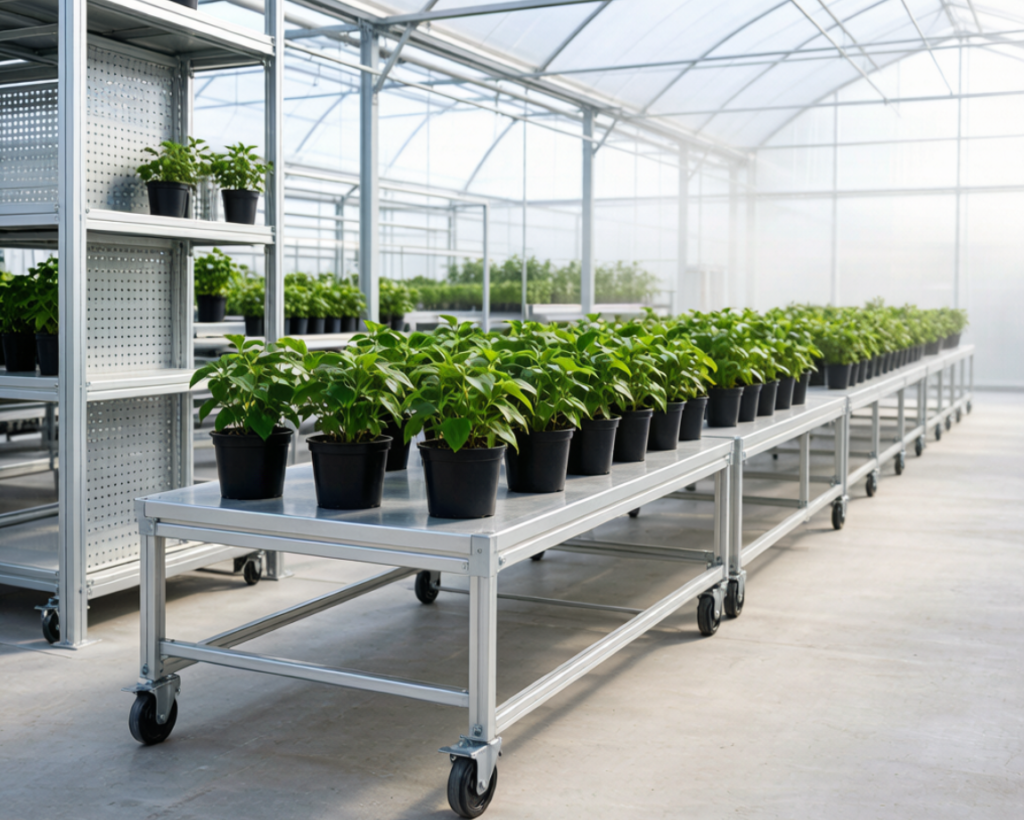
Bench Systems Overview
Greenhouse benches support plants at a comfortable working height, improve drainage, and maximize growing space. According to ASABE standards, bench layout significantly affects operational efficiency in commercial greenhouse facilities.
Rolling Benches
Space efficiency leader: Rolling benches sit on rails or wheels and can be moved laterally, creating a single access aisle and eliminating multiple fixed aisles. This increases usable growing space by 20-40% compared to stationary bench layouts. The aisle space is shared across the entire bench area.
Stationary Benches
Stationary benches are fixed in position with permanent aisles between rows. Standard width: 5-6 ft with 18-24 inch aisles. Simple, durable, lower cost. Best for operations where bench layout does not need to change seasonally.
Space Utilization
| Bench Type | Usable Space % | Typical Aisle Ratio | Sq Ft/Tray |
|---|---|---|---|
| Rolling (1 aisle layout) | 80-90% | 1 aisle per 20-40 benches | Lowest |
| Stationary (fixed aisles) | 55-70% | 1 aisle per 2 benches | Higher |
In a 10,000 sq ft greenhouse: rolling benches = 8,000-9,000 sq ft of growing space. Stationary = 5,500-7,000 sq ft. The 20-40% space premium from rolling benches is significant for high-value crops.
Labor Efficiency
Rolling benches reduce walking distance for workers by 30-50%. Workers can stay in one area while benches are shifted. Stationary benches require more walking between aisles. For operations with 5+ workers, rolling bench labor savings alone can justify the investment within 2-3 years.
Crop Access & Care
Stationary benches provide constant access to both sides of each bench — no need to move benches for daily care. Rolling benches require bench movement to create access aisles, which can be a minor time burden. However, for most commercial operations, the space efficiency gain outweighs the movement time.
Cost & ROI
Rolling benches: $8-15 per sq ft of installed bench area (includes rails, casters, drive system). Stationary benches: $4-8 per sq ft. ROI: The additional 20-40% growing space from rolling benches typically pays for the cost premium within 1-3 growing seasons for high-value crops.
Comparison Table
| Factor | Rolling Benches | Stationary Benches |
|---|---|---|
| Growing space (10k sq ft GH) | 8,000-9,000 sq ft | 5,500-7,000 sq ft |
| Installed cost per sq ft | $8-15 | $4-8 |
| Walking distance reduction | 30-50% less | Baseline |
| Layout flexibility | Modifiable | Fixed permanently |
| Maintenance | More (rails, casters) | Minimal |
Fangcheng Bench Solutions
Maximize your greenhouse growing space with Fangcheng bench systems. We design and supply both rolling and stationary benching systems for commercial greenhouses. Aluminum or galvanized steel frames, wire or expanded metal mesh decks, and customizable widths.
Explore Greenhouse Benching Systems →
FAQ
Which bench type gives more growing space?
Rolling benches — 20-40% more space than stationary by eliminating fixed aisles.
Are rolling benches worth the extra cost?
Yes for commercial operations — the space premium pays for the cost difference in 1-3 seasons.
Which type is better for labor efficiency?
Rolling benches reduce walking by 30-50%. Workers stay in one area and shift benches as needed.
Are stationary benches less expensive?
Yes — $4-8/sq ft vs $8-15/sq ft for rolling. Simpler construction and no moving parts.
What is the best bench material?
Aluminum for lightweight, long life. Galvanized steel for maximum durability. Wire mesh for drainage.
Conclusion
Rolling benches maximize greenhouse space utilization and improve labor efficiency, making them the preferred choice for commercial operations growing higher-value crops. Stationary benches remain cost-effective for smaller operations or lower-value crops where bench density is less critical. Consider your crop value and labor costs when deciding.
 Blog
Blog Blog
Blog Blog
Blog