跳至内容
跳至内容 
Successful greenhouse cultivation begins with healthy seedlings. Producing your own transplants saves money, ensures crop quality, and extends your growing season.
The Seedling Advantage
Growing your own seedlings in a controlled greenhouse environment eliminates the uncertainty of direct seeding and the expense of buying transplants. University extension programs like University of Minnesota Extension provide research-backed seedling production guidelines.
Greenhouse Setup for Seedlings
Optimal seedling greenhouse conditions: Temperature 65-75°F day / 55-65°F night. Supplemental lighting with T5 fluorescents or LEDs (150-300 μmol/m²/s). Bottom heat via propagation mats (72-78°F for most crops). Humidity 50-70%. Clean, sanitized environment with good airflow.
Sowing Methods
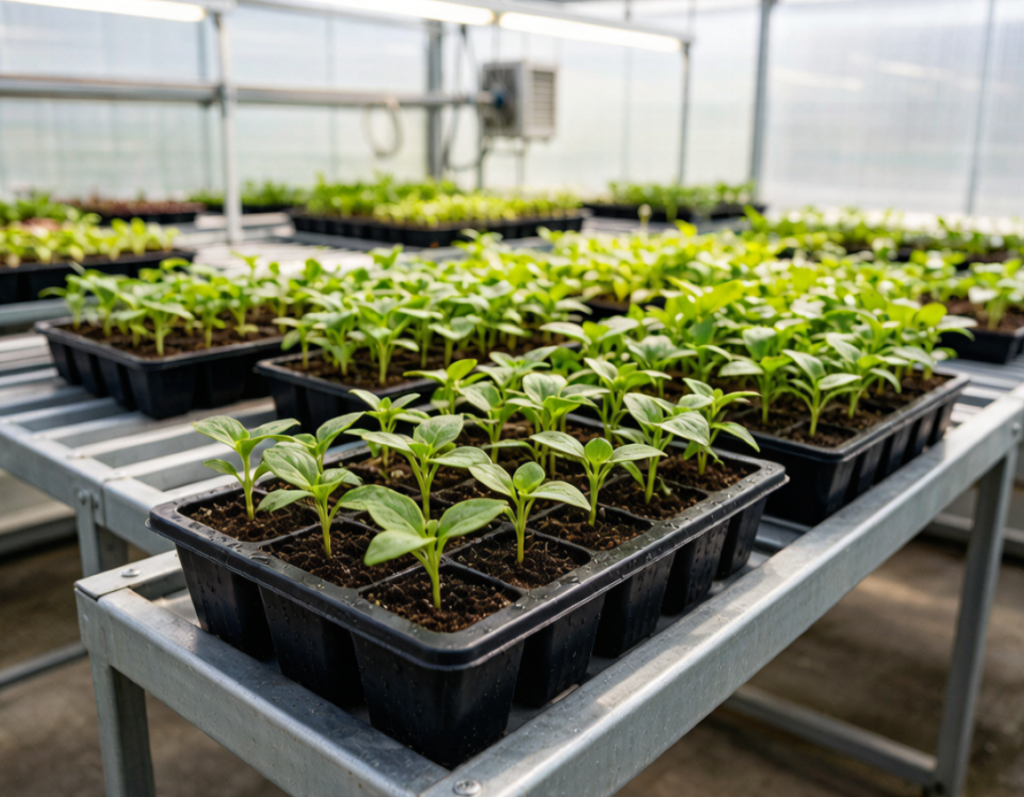
Use sterile seed-starting mix (fine texture, good drainage), not garden soil. Sow seeds at the correct depth: general rule = seed diameter × 2-3. Use plug trays (50, 72, or 128 cells) for efficient space use.
Germination Conditions
| Crop | Germ Temp | Days to Germ | Light Needed |
|---|---|---|---|
| Tomato | 75-85°F | 5-10 days | No (dark germinator) |
| Pepper | 75-85°F | 7-14 days | No |
| Lettuce | 60-70°F | 2-8 days | Yes (light germinator) |
| Cucumber | 75-85°F | 3-6 days | No |
| Cabbage | 65-75°F | 4-7 days | No |
Lighting for Seedlings
Seedlings need 14-16 hours of light daily. Place lights 2-4 inches above the plants and raise as they grow. Insufficient light causes leggy, weak transplants. Full-spectrum LED or T5 fluorescent at 150-300 μmol/m²/s PPFD is ideal.
Watering & Fertilizing
Water from below (tray irrigation) to prevent damping off disease. Once true leaves appear, begin weekly fertilization with dilute balanced fertilizer (150-200 ppm N). Maintain pH 5.5-6.5.
Hardening Off
Begin 7-10 days before transplanting. Reduce temperature by 10°F. Reduce watering slightly. Introduce natural wind/air movement. Move to lower light intensity gradually.
Transplanting
Transplant when seedlings have 4-6 true leaves, roots fill the plug (root-bound but not circling), stems are thick and sturdy, and plants are dark green (not yellow from nitrogen deficiency).
Production Scheduling
Work backward from your transplant date. Tomato: sow 6-8 weeks before transplant. Pepper: sow 8-10 weeks. Lettuce: sow 4-5 weeks. Cucumber: sow 3-4 weeks. Include 1 week for hardening off in the schedule.
Common Problems
- Damping off: Overwatering, poor air circulation. Use sterile mix, fan for air movement
- Leggy growth: Insufficient light. Lower lights, increase intensity
- Yellow lower leaves: Nitrogen deficiency. Begin fertilizing earlier
- Algae on mix surface: Overwatering, poor drainage. Improve air flow
Fangcheng Greenhouse Solutions
Build the perfect seedling production system with Fangcheng. We design and manufacture greenhouse structures, benches, irrigation systems, and environmental controls for commercial seedling production. From propagation benches to automated irrigation — optimize your nursery operation.
FAQ
How long do seedlings need in the greenhouse?
4-10 weeks depending on crop. Tomato: 6-8 weeks. Pepper: 8-10 weeks. Lettuce: 4-5 weeks. Includes 1 week hardening off.
What temperature for seedlings?
Day 65-75°F, night 55-65°F. Bottom heat 72-78°F for germination. Reduce after true leaves appear.
How much light do seedlings need?
14-16 hours with lights 2-4 inches above plants. 150-300 μmol/m²/s PPFD from LED or T5.
What causes leggy seedlings?
Insufficient light intensity or duration. Raise light intensity, lower lights, ensure 14-16 hour photoperiod.
How to prevent damping off?
Use sterile seed-starting mix, water from below, provide air circulation, avoid overwatering and overcrowding.
Conclusion
Greenhouse seedling production is a skill that improves crop quality and reduces costs. With proper temperature, light, watering, and timing, you can produce strong, healthy transplants ready for vigorous growth. A well-designed seedling greenhouse with propagation benches and environmental control makes the process efficient and reliable.