Imagine growing tomatoes in January without a heating bill. A well-designed passive solar greenhouse makes this possible by capturing the sun’s energy during the day and releasing it at night — creating a stable growing environment without fossil fuels.
For active greenhouse solutions, see Fangcheng greenhouse heating systems.
What Is a Passive Solar Greenhouse?
A passive solar greenhouse is designed to capture, store, and distribute solar energy without mechanical heating. Unlike conventional greenhouses that rely on gas, propane, or electric heaters, passive solar designs use strategic orientation, glazing, thermal mass, and insulation to maintain growing temperatures year-round.
The US Department of Energy (DOE) passive solar design principles provide the scientific foundation for these greenhouses, adapted for horticultural applications.
Design Principles
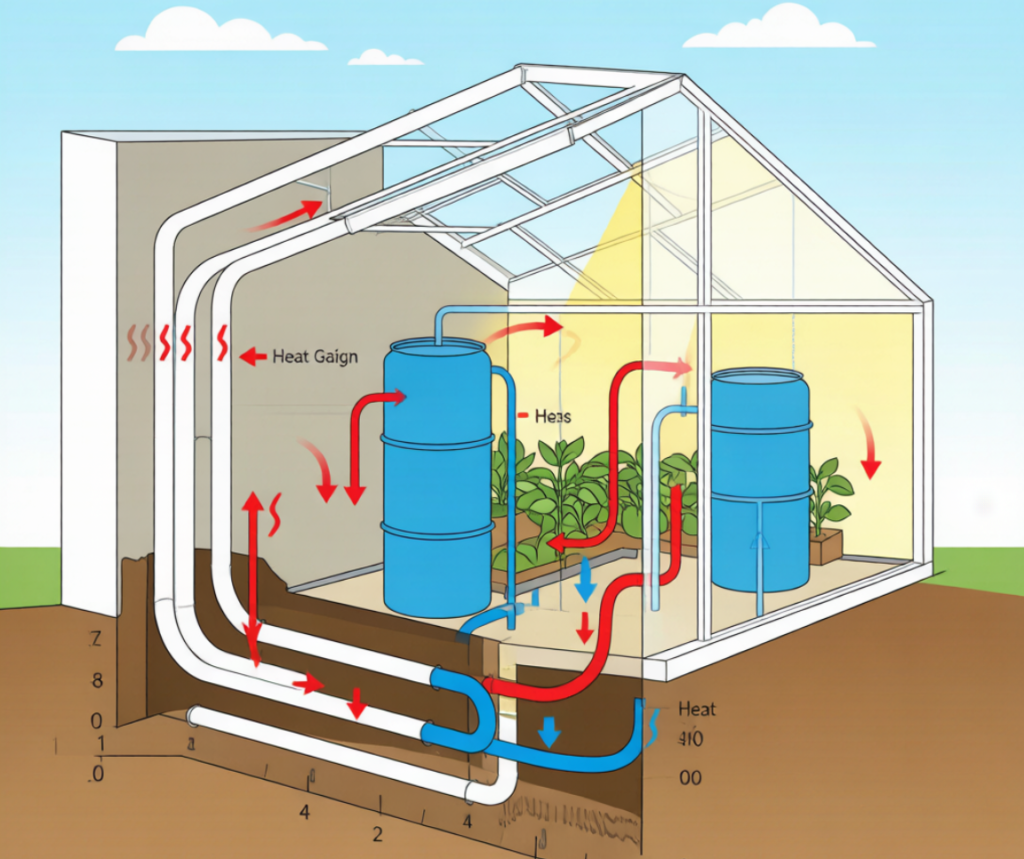
Five elements of passive solar design: 1) South-facing glazing to capture low winter sun. 2) Thermal mass (water, concrete, stone) to store daytime heat. 3) Super-insulation on the north wall and foundation. 4) Earth coupling or geothermal exchange for thermal stability. 5) Adjustable shading to prevent summer overheating.
Orientation & Glazing
Optimal orientation: True south (Northern Hemisphere), long axis east-west. Glazing angle: Latitude + 15° for winter-optimized solar capture. Glazing options: Double-wall polycarbonate (best balance of light transmission and insulation, R-2 to R-4), twin-wall polycarbonate (lighter, less expensive), glass (highest light transmission, lowest insulation).
Thermal Mass Strategies
| Material | Heat Capacity (BTU/cu ft/°F) | Cost | Best Application |
|---|---|---|---|
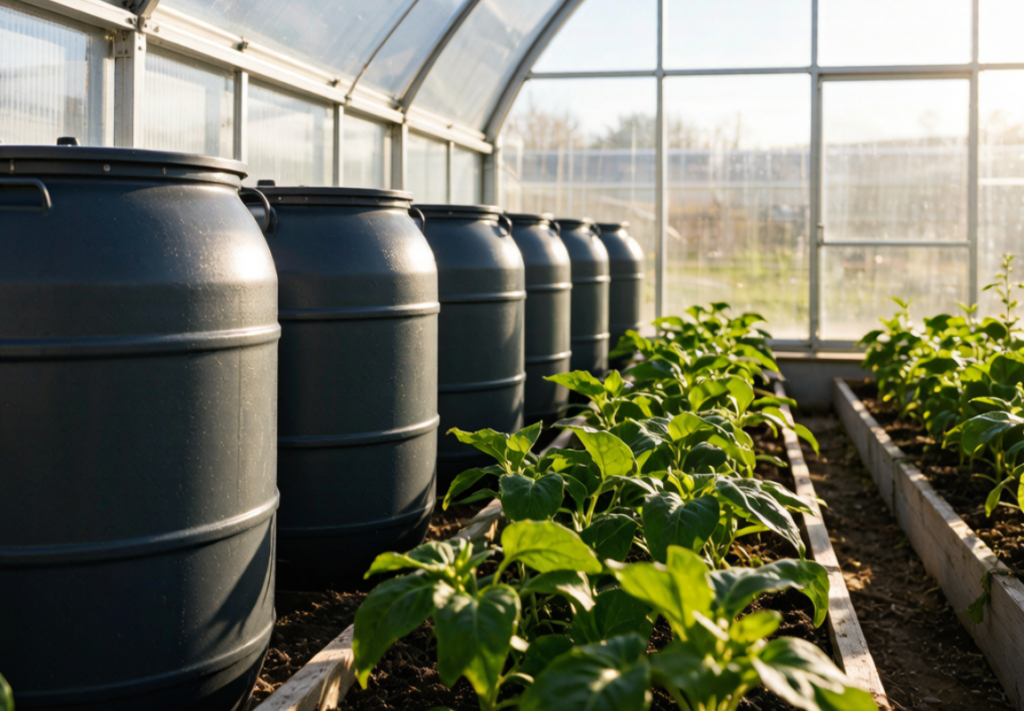
| Water (55-gallon drums) | 62.4 | $80–150 per drum | Most effective per volume, black drums absorb heat |
| Concrete slab (4-6″) | ~30 | $5–12 per sq ft | Integrates with greenhouse floor |
| Stone / gravel (2-3 ft deep) | ~20 | $25–75 per ton | Under-floor thermal storage, earth coupling |
| Phase change materials (PCM) | High | $2–50 per kg | Compact storage, emerging technology |
Rule of thumb: For a passive solar greenhouse in USDA Zone 5, provide 5-10 gallons of water per square foot of glazing. A 100 sq ft south wall needs 500-1,000 gallons of water thermal mass.
Super-Insulation
The north wall is critical — it receives no direct sun but loses heat constantly. Recommended: R-20 to R-40 insulation in cold climates. Foundation perimeter: R-10 to R-20 rigid foam insulation extending 2-4 ft below grade. Night insulation (thermal curtains or blankets) over glazing can reduce night heat loss by 50-70%.
Earth Tubes & Geothermal
Earth tubes (also called ground-coupled heat exchange) run 4-8 ft below grade where soil temperature stays at 50-55°F year-round. Air is drawn through the tubes, absorbing ground heat in winter and dumping excess heat in summer. According to ATTRA (National Center for Appropriate Technology), earth tubes can provide 10-15°F of temperature moderation without electricity for fans.
Cold Climate Performance
Passive solar greenhouses have proven effective in climates as cold as -40°F (USDA Zone 3). Key adaptations: triple-wall polycarbonate glazing (R-4+), 1,000+ gallons thermal mass per 100 sq ft glazing, R-40 north wall insulation, ground-coupled floor, and automated night insulation curtains.
Cost & ROI
Owner-built: $15-35/sq ft — significant labor input but lowest cost. Professional kit: $25-45/sq ft. Custom built: $30-60/sq ft. Heating cost savings: $2-8/sq ft annually vs conventionally heated greenhouses. Payback period: 3-7 years in cold climates. Additional benefits: carbon footprint elimination, price stability (no fuel cost volatility), and potential organic certification.
FAQ
What is a passive solar greenhouse?
Captures and stores solar energy without mechanical heating. Uses thermal mass, insulation, and strategic design.
How does it stay warm at night?
Thermal mass absorbs day heat, releases at night. Insulation retains it. Can stay 20-30°F warmer than outside.
Best orientation?
True south (N. Hemisphere), east-west axis. Glazing at latitude + 15°.
Can it work in cold climates?
Yes — even USDA Zone 3 (-40°F) with adequate thermal mass and insulation.
Cost vs standard greenhouse?
Higher upfront ($15-60/sq ft) but eliminates heating costs. Payback 3-7 years in cold climates.
Conclusion
Passive solar greenhouse design is a proven, cost-effective approach to year-round growing without fossil fuels. By optimizing orientation, glazing, thermal mass, and insulation, growers can maintain productive temperatures even in harsh winter climates. While upfront costs are higher than standard greenhouses, the elimination of heating expenses provides compelling long-term ROI — both financial and environmental.