跳至内容
跳至内容 
Choosing the right cooling system is one of the most important decisions in greenhouse design. Fan & pad and high-pressure misting are the two primary active cooling methods, each with distinct advantages depending on your climate and crop requirements. For an overview of all cooling options, see our greenhouse cooling guide.
The Cooling Challenge
Summer greenhouse temperatures can exceed 110°F, stressing or killing crops within hours. Active cooling is essential for year-round production in most climates. The ASABE EP406.4 standard provides engineering guidelines for greenhouse cooling system design, including both evaporative pad and fog-based systems.
Fan & Pad Cooling
Fan and pad systems work by drawing outside air through wet cellulose pads via large exhaust fans on the opposite wall. As water evaporates from the pad surface, it absorbs heat from the air, cooling it by 10-20°F below outside ambient. The cooled air then moves across the greenhouse and is exhausted by the fans.
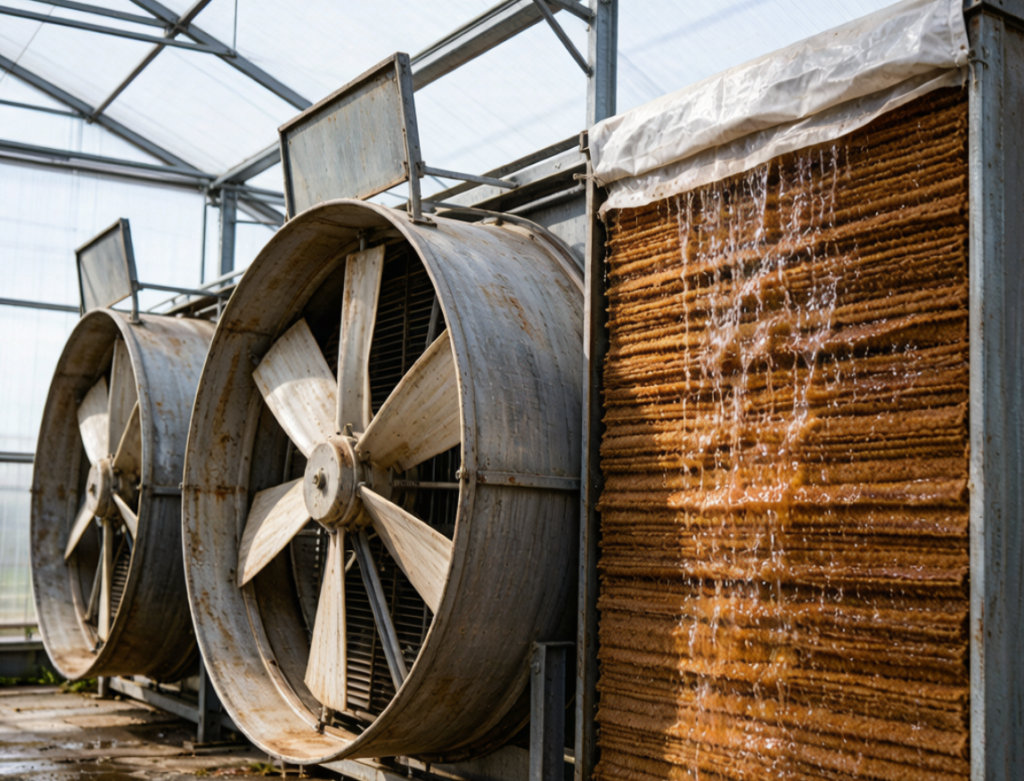
Best for arid and semi-arid climates: Fan & pad achieves 75-90% saturation efficiency, making it the most powerful active cooling method for greenhouses. In an arid climate at 100°F outside, a properly designed system delivers air at 70-75°F. The system requires substantial water consumption and regular pad maintenance.
High-Pressure Misting / Fog Systems
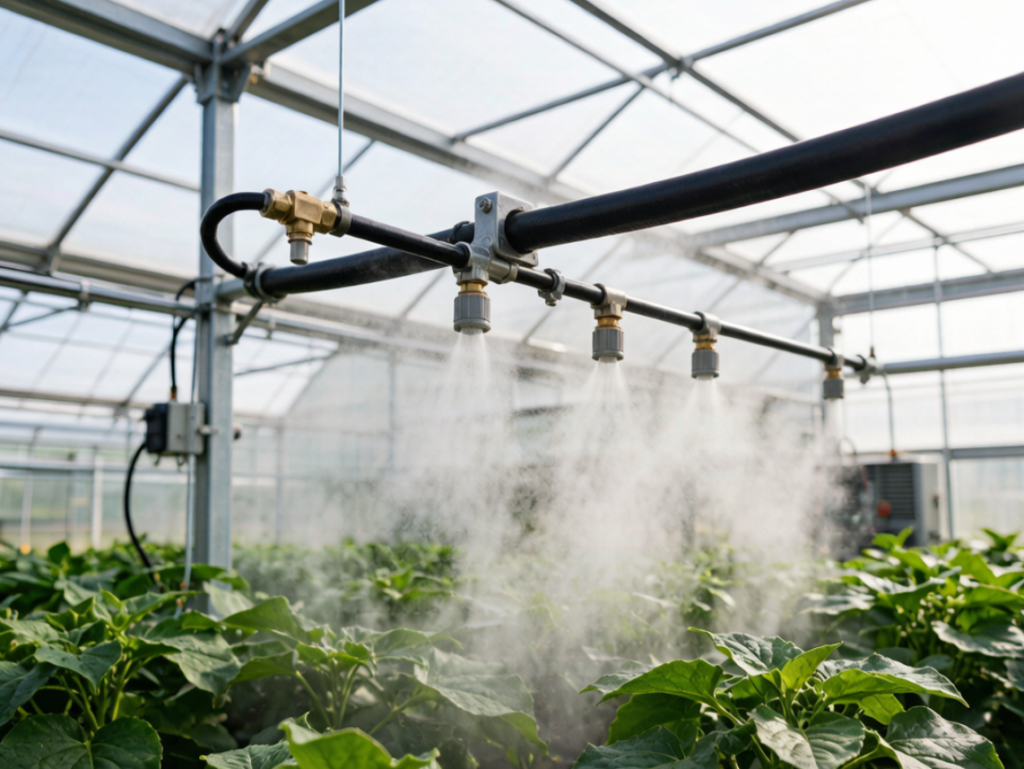
High-pressure misting systems inject micron-sized water droplets (5-50 microns) into the greenhouse air. The droplets evaporate instantly, cooling the air without wetting the plants or surfaces. Operating at 800-1,500 PSI, these systems can reduce temperatures by 5-12°F while also providing humidity control. Fog systems are often paired with natural or mechanical ventilation to remove the cooled, humidified air.
Side-by-Side Comparison
| Factor | Fan & Pad | High-Pressure Misting |
|---|---|---|
| Temperature reduction | 10-20°F | 5-12°F |
| Saturation efficiency | 75-90% | 60-80% |
| Water consumption | High (0.5-1.5 GPM per 100 sq ft pad) | Low to moderate (depends on frequency) |
| Energy consumption | High (multiple large fans) | Moderate (high-pressure pump + small fans) |
| Installed cost per sq ft | $3-8 | $5-12 |
| Maintenance | Pad replacement 3-5 yr, water treatment | Nozzle cleaning, water filtration |
| Humidity increase | High | Controllable |
| Foliage wetting | No (pads are separate from plants) | Minimal with proper nozzle selection |
| Best climate | Arid to semi-arid | Semi-arid to humid |
Cooling Performance Analysis
Fan & pad systems achieve greater temperature reduction because the cooling happens across a large surface area of wetted pad, with the cooled air then pushed through the entire greenhouse. Misting systems cool the air more gradually and rely on air exchange to remove the cooled air. In practical terms, a greenhouse in Phoenix, AZ (arid) would see far better results from fan & pad, while a greenhouse in Atlanta, GA (humid) might achieve comparable results from either system.
Climate Suitability
Climate is the deciding factor. Fan & pad performs best when outside humidity is below 60%. Above 60% relative humidity, evaporation slows and cooling efficiency drops significantly. Misting systems are less affected by high humidity because the droplets are smaller and evaporate more readily. For tropical and subtropical climates, misting is often the preferred choice. The US DOE evaporative cooling guidelines explain the relationship between humidity and cooling efficiency in detail.
Cost Comparison
Fan & pad: initial investment $3-8 per sq ft, annual operating cost $0.50-1.50 per sq ft (fans electricity + water + pad replacement). Misting: initial investment $5-12 per sq ft, annual operating cost $0.30-1.00 per sq ft (pump electricity + water + nozzle/filter maintenance). While misting has higher upfront cost, its operating cost is typically lower due to reduced fan energy consumption.
Maintenance Requirements
Fan & pad requires: daily visual inspection of pad wetting pattern, weekly algae and mineral deposit checks, seasonal pad cleaning, pad replacement every 3-5 years, and water treatment for hard water. Misting requires: monthly nozzle inspection and cleaning, high-quality water filtration (reverse osmosis recommended for hard water), pump maintenance and seal replacement, and seasonal winterizing to prevent freeze damage.
Can You Use Both?
Yes — advanced greenhouses sometimes combine both systems. Fan & pad handles the primary cooling load during peak summer heat, while misting provides fine humidity control during shoulder seasons. This approach offers maximum climate control flexibility but at significant additional cost and complexity. The US Department of Energy recognizes integrated evaporative cooling strategies as an energy-efficient approach for agricultural climate control.
FANGCHENG Cooling Solutions
Get the right cooling system for your greenhouse and climate. FANGCHENG designs and installs both fan & pad and high-pressure misting systems. Our engineering team can evaluate your climate, crop requirements, and budget to recommend the optimal cooling solution — or a combination of both.
Explore CFANGCHENGCooling Systems → | Request a Cooling System Design
FAQ
Which is better: fan & pad or misting?
Fan & pad for arid climates (greater temperature drop). Misting for humid climates (lower water use, better efficiency at high humidity).
How much does each system cost?
Fan & pad: $3-8/sq ft installed. Misting: $5-12/sq ft. Operating costs are similar, with misting slightly lower due to reduced fan energy.
Which system is easier to maintain?
Fan & pad requires pad replacement every 3-5 years. Misting requires more frequent nozzle cleaning but has fewer major replacement items.
Can I use both systems together?
Yes, advanced greenhouses use both — fan & pad for peak cooling and misting for shoulder season humidity control.
How does humidity affect each system?
Above 60% humidity, fan & pad efficiency drops significantly. Misting is less affected by high humidity and performs better in tropical climates.
Conclusion
The choice between fan & pad and high-pressure misting depends primarily on your climate. Fan & pad delivers superior cooling performance in arid regions, while misting offers better efficiency and lower operating costs in more humid environments. Consider your local climate, crop requirements, budget, and maintenance capacity when making your decision. Both systems are proven technologies that, when properly designed and maintained, provide effective greenhouse cooling for years.