Table of Contents
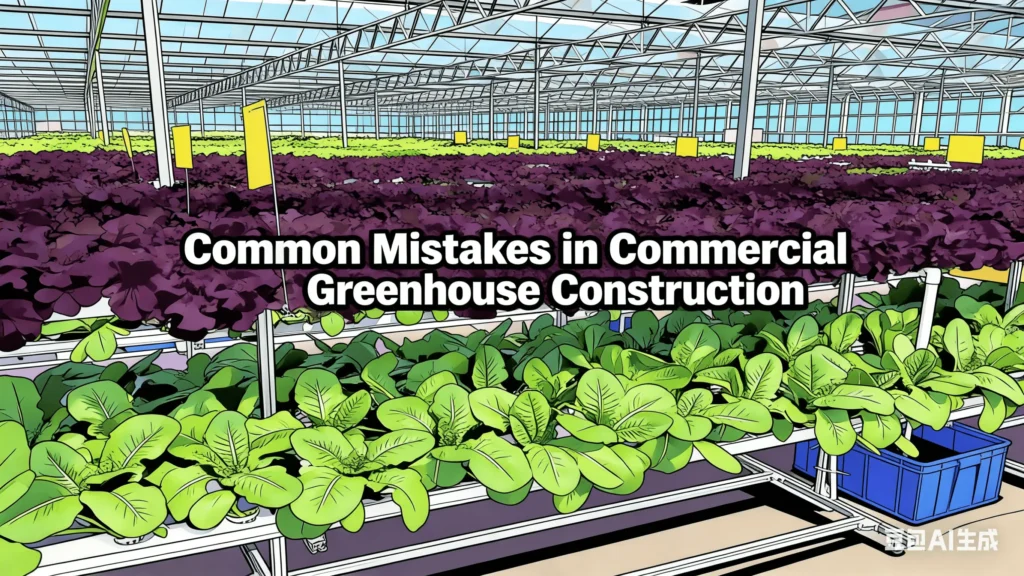
Building a commercial greenhouse is not just a construction task — it is the foundation of a long-term production system. Structural decisions made during planning will directly impact crop yield, energy consumption, maintenance costs, and overall return on investment.
In many cases, greenhouse performance problems do not originate from equipment failure. They result from early-stage planning and construction mistakes.
Below are the most common mistakes seen in commercial greenhouse construction projects — and how professional teams avoid them.
1. Starting Structural Design Without a Full Site Evaluation
One of the most costly mistakes in greenhouse construction is finalizing structural design before completing a comprehensive site assessment.
Commonly overlooked factors include:
Soil bearing capacity
Drainage conditions
Prevailing wind direction
Sunlight exposure patterns
Access to water and electrical infrastructure
Without proper evaluation, projects may experience foundation instability, water accumulation, or uneven structural loading. These issues often appear after completion — when correction costs are significantly higher.
Best practice:
Conduct a detailed site survey before determining greenhouse structure type or foundation specifications. Structural engineers should confirm load requirements and soil compatibility early in the planning phase.
2. Poor Location Selection
Even a well-designed greenhouse can underperform if it is built in the wrong location.
Typical site selection mistakes include:
Choosing low-lying areas prone to flooding
Ignoring wind corridors that increase structural stress
Improper orientation that limits uniform sunlight distribution
For commercial greenhouse operations, environmental stability is essential for consistent crop quality and yield.
Best practice:
Select sites with natural drainage, proper elevation, and orientation optimized for the specific climate zone and crop type. Wind and snow load conditions should be evaluated based on local data.
3. Underestimating Climate Control System Design
A commercial greenhouse is fundamentally a climate control system enclosed by a structure.
Common errors include:
Insufficient ventilation capacity
Incorrect fan and cooling pad sizing
Inaccurate heating load calculations
Poor insulation planning in cold regions
Improper airflow leads to temperature stratification, humidity pockets, increased disease pressure, and higher operational costs. Undersized heating systems may cause crop loss during winter peaks.
Best practice:
Climate control systems must be engineered using:
Extreme local temperature data
Crop environmental requirements
Air exchange rate calculations (CFM)
Heating load calculations (BTU)
Equipment selection should be based on engineering calculations — not estimation.
4. Selecting Materials Based Only on Initial Cost
In an effort to reduce upfront investment, some projects choose thinner steel profiles, lower-grade covering materials, or under-specified structural components.
While this lowers initial construction costs, it often results in:
Accelerated structural fatigue
Premature material degradation
Increased maintenance frequency
Shortened lifespan
Over time, lifecycle costs exceed the original savings.
Best practice:
Evaluate materials based on long-term durability, corrosion resistance, wind and snow load ratings, and expected service life. A commercial greenhouse should be treated as a long-term asset, not a short-term structure.
5. Ignoring Local Building Codes and Load Standards
Commercial greenhouse construction must comply with local regulations and structural load requirements.
Common compliance mistakes include:
Designing without reference to regional wind or snow load standards
Overlooking permit procedures
Ignoring fire safety or electrical codes
Failure to comply can delay project approval or create legal and insurance risks.
Best practice:
Confirm local building codes and engineering standards during the design phase. Structural calculations should be documented and aligned with regional compliance requirements.
6. Poor Coordination Between Construction Teams
Commercial greenhouse projects involve multiple systems, including:
Structural framework
Electrical installations
Irrigation systems
Ventilation and cooling equipment
Environmental control systems
Without proper coordination, conflicts can arise between structural and mechanical installations. This often leads to delays, rework, and additional costs.
Best practice:
Conduct pre-construction coordination meetings. Ensure all technical drawings are aligned and installation sequences are clearly defined.
7. Failing to Plan for Long-Term Maintenance and Expansion
Many greenhouse projects focus on completion rather than long-term operation.
Common oversights include:
Insufficient maintenance access space
No provision for future system upgrades
Lack of modular expansion capability
This limits operational flexibility and increases future retrofit costs.
Best practice:
Design commercial greenhouse systems with maintenance access, upgrade pathways, and scalable expansion options in mind. Long-term adaptability enhances return on investment.
Conclusion: Successful Greenhouse Construction Starts With System Thinking
Commercial greenhouse construction is not about building speed — it is about engineering reliability.
Most costly failures originate from early-stage planning errors. By investing in thorough site evaluation, engineered climate system design, compliant structural standards, and long-term planning, project developers can significantly reduce operational risk.
A well-planned greenhouse structure is more than a building — it is the foundation of consistent agricultural productivity.