Table of Contents
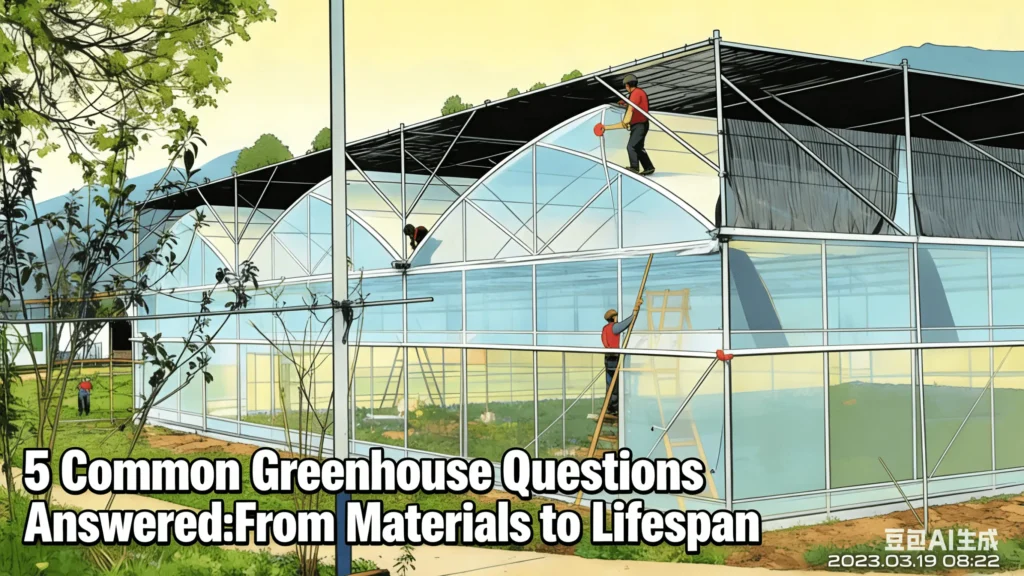
When planning a greenhouse, many growers focus heavily on heating systems, irrigation, or automation. However, the structure of the greenhouse itself—including cladding materials, frame design, and flooring—often has a greater long-term impact on operating costs, durability, and crop performance.
Below are five of the most common greenhouse questions, answered clearly and practically.
1. Which cladding material is best for my greenhouse?
This is one of the most frequently asked questions in greenhouse design.
Common options include glass, plastic film, and polycarbonate. Among them, polycarbonate is widely considered one of the best choices for long-term greenhouse use.
Its main advantage is insulation. Twin-wall or multi-wall polycarbonate panels have a high R-value, which helps retain heat during cold nights and reduces overall heating costs. At the same time, polycarbonate diffuses light rather than allowing harsh direct sunlight, creating a more even growing environment and reducing plant stress.
For growers with tighter budgets, high-quality polyethylene film is also a viable option. Modern agricultural films can be engineered to adjust light diffusion or spectral balance. However, their lifespan is usually shorter, typically around 3–5 years.
Please leave your contact email, and one of our professional greenhouse engineers will reach out to you within 24 hours.
2. Why is galvanized steel commonly used for greenhouse frames?
The frame determines the greenhouse’s structural stability and resistance to wind, snow, and long-term wear.
Galvanized steel is widely used because it offers excellent corrosion resistance. The zinc coating protects the steel from moisture and oxidation, making it suitable for humid, coastal, or rainy environments.
Compared with untreated steel or wood, galvanized frames maintain their strength over many years with minimal maintenance. For commercial or permanent greenhouses, this durability makes galvanized steel the preferred choice.
-1024x473.jpg)
3. What type of flooring should a greenhouse use?
Flooring is often overlooked, but it plays an important role in drainage, cleanliness, and disease control.
Two of the most practical options are concrete and gravel.
Concrete floors are flat and easy to clean, making them ideal for equipment movement and daily maintenance. With proper drainage, they can also help reduce standing water and disease pressure.
Gravel flooring is more cost-effective and provides excellent natural drainage. When combined with a weed barrier underneath, it can effectively control weed growth. Gravel is also a good option for greenhouses designed for future expansion or gutter-connected layouts.
4. How can a greenhouse be heated more efficiently?
Efficient heating is not just about adding more heaters. It is mainly about retaining heat and distributing it evenly.
The first step is reducing heat loss. Using high-insulation cladding, such as twin-wall polycarbonate, makes a significant difference.
Next is heat distribution. Large greenhouses should not rely on a single heat source. Multiple heaters or circulation fans help maintain uniform temperatures throughout the space.
In colder regions or high-end projects, radiant or floor heating systems are sometimes used. These systems warm plants from the ground up, improving efficiency and supporting healthier root development.
5. How long does a greenhouse usually last?
The lifespan of a greenhouse depends on material quality and maintenance.
Under normal conditions, polycarbonate panels can last around 10 years, while polyethylene films usually last 3–5 years. Choosing materials with proper UV protection is critical, as UV-treated cladding resists yellowing and degradation.
Regular cleaning and inspection also extend lifespan. When paired with a galvanized steel frame, a well-maintained greenhouse structure can remain functional for well over a decade.
Conclusion
A successful greenhouse is not built on equipment alone. It starts with smart structural choices.
Selecting the right cladding, using a durable frame, planning proper flooring, and designing an efficient heating strategy all contribute to lower costs, stable yields, and long-term reliability.
In greenhouse construction, strong fundamentals always lead to better results over time.